

- Medicines
- Personal Care
- Skin Cream
- Sunscreen
- Face Wash
- Skin and Body Soap
- Acne Care
- Body Lotions
- Moisturising Lotion
- Moisturising Cream
- Mosquito Repellent
- Moisturising Gel
- Body Wash
- Hair Oils
- Hair Shampoo
- Hair Conditioners
- Hair Supplements
- Hair Colour
- Hair Serum
- Hair Mask
- Hair Solutions
- Baby Diapers and Wipes
- Baby Lotion and Moisturising Cream
- Baby Bath Essentials
- Baby Skin Care
- Baby and Infant Food
- Baby Healthcare
- Women Multivitamins
- Ovulation Test Kit and Women Intimate Care
- Sanitary Pads
- Nutritional Drinks
- Condoms
- Lubricants
- Massage Gels
- Personal Body Massagers
- Men Performance Booster
- Sexual Health Supplements
- Massage Oils
- Ayurveda
- Tooth Paste
- Mouth Ulcer Gel
- Mouthwash
- Toothache and Gum Pain
- Tooth Brush
- Gargle Solution
- Orthopaedic Supports
- Adult Diapers
- Footwear
- Mobility and Support Accessories
- Urinary Support and Care
- Health Conditions
- Bone and Joint Care
- Digestive Care
- Eye Care
- Pain Relief
- Smoking Cessation
- Liver Care
- Stomach Care
- Cold and Cough
- Heart Care
- Kidney Care
- Piles, Fissures & Fistula
- Respiratory Care
- Mental Wellness
- Derma Care
- Pre and Probiotics
- Acidity
- Gas
- Constipation
- Loose Motion/Diarrhoea
- Digestive Fibres
- Digestive Enzymes
- Eye Lubricant Drops
- Lens Solution
- Safety Eye Wear
- Eye Cream
- Eye Vitamins and Supplements
- Eye Drops
- Eye Ointment and Gel
- Nicotine Patch
- Nicotine Gum
- Nicotine Lozenges
- Cough Syrups
- Chest Rubs and Balms
- Nasal Spray
- Lozenges
- Inhalant Capsules
- Cold and Cough Tablets
- Vitamins & Supplements
- Diabetes Care
- Healthcare Devices
- Homeopathic Medicine
- Health Guide
Amritarishta
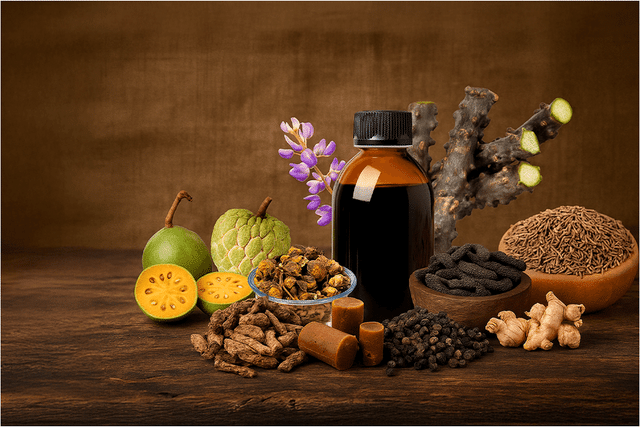
Amritarishta is a classical Ayurvedic arishta, which means a liquid preparation made by fermenting a herbal decoction. It is built on Guduchi and Dashamoola, sweetened with jaggery and fermented with Dhataki flowers, and it contains a small amount of naturally produced alcohol. It is traditionally used after fevers and infections to support appetite and strength during recovery.
 50
50Last updated on : 18 Aug, 2026
Read time : 20 mins
What is Amritarishta?
The name reflects both the main ingredient and the type of preparation. Amrita is one of the Sanskrit names for Guduchi (Tinospora cordifolia) and means "nectar" or "that which does not perish", referring to the plant's ability to survive and regrow from a cut stem. Arishta is an Ayurvedic dosage form prepared by naturally fermenting a herbal decoction with a sugar source. Together, the name Amritarishta means a fermented preparation of Guduchi. The formulation is described in the classical Ayurvedic text Bhaishajya Ratnavali in the chapter on Jwara (fever).
In Ayurveda, Amritarishta is traditionally described as Deepana and Pachana, meaning it is believed to support appetite and digestion, and as Jwaraghna, indicating its traditional use in the management of fever. Guduchi is described as having Tikta (bitter) and Kashaya (astringent) Rasa (taste), Ushna Virya (heating potency) and Madhura Vipaka (sweet post-digestive effect). It is also regarded as Tridoshahara, meaning it is traditionally believed to help balance the three doshas. In Ayurveda, the fermented Arishta dosage form is considered to enhance the delivery of herbal constituents compared with a plain decoction, which is one of the traditional reasons for preparing the medicine in this form.
Key Facts
| Feature | Details |
| Formulation name | Amritarishta |
| Formulation type | Arishta, a liquid preparation made by fermenting a herbal decoction. Contains naturally produced alcohol. |
| Classical reference | Bhaishajya Ratnavali, chapter on Jwara. |
| Composition | Guduchi (Tinospora cordifolia), Dashamoola, Guda (jaggery), Dhataki (Woodfordia fruticosa) flowers, Trikatu, Musta, Nagakesara, Ajaji and Saptaparna.
|
| Also known as | Amritarishtam, Amrutarishta, Amrutarishtam, Amritharishta
|
| Key active compounds | Tinosporin, columbin, berberine and an immunologically active arabinogalactan from Guduchi. Piperine from Trikatu. Ethanol produced during fermentation.
|
| Dosha action | Described as acting on all three doshas, with the digestive ingredients directed mainly at Kapha and Ama. |
| Traditional uses | Jwara (fever) and the weakness that follows it, Agnimandya (poor digestive capacity), Aruchi (loss of appetite) and Daurbalya (debility)
|
| Common forms | Sold as a ready-made liquid in amber glass bottles. It is not available as a tablet, capsule or powder.
|
| General dosage | Commonly 15 ml to 30 ml twice daily for adults, taken after food and usually diluted with an equal volume of water. |
| Best taken | After food, diluted with water, at a fixed time each day
|
| Key safety note | Contains naturally produced alcohol and jaggery. Use only on medical advice in children, during pregnancy or breastfeeding, or in people with liver disease or those avoiding alcohol. Stop it and see a doctor if you develop jaundice, dark urine, persistent nausea or unusual tiredness. |
Alternative Names of Amritarishta
The name of this preparation is transliterated from Sanskrit rather than translated, so the variations below are mainly spelling variations or names of its principal ingredient, Guduchi, rather than different names for the formulation.
- Sanskrit: Amritarishtam (also written as Amrutarishtam, Amrutarishta and Amritharishta)
- Malayalam: Amrutarishtam
- Tamil: Amrutarishtam
- Hindi: Giloy
- Kannada: Amrutballi
- Tamil: Seenthil kodi
- Sanskrit: Guduchi, Amrita
Composition of Amritarishta
Amritarishta is built on a decoction of two ingredients, then sweetened and fermented, with a group of aromatic powders added before fermentation begins. The ingredients below are those described for the classical preparation.
- Guduchi (Tinospora cordifolia) stem, the principal ingredient
- Dashamoola, the classical group of ten roots, which forms the second half of the decoction
- Guda, jaggery, which provides the sugar for fermentation
- Dhataki (Woodfordia fruticosa) flowers, the traditional fermenting agent
- Trikatu, meaning Shunthi (dry ginger), Pippali (long pepper) and Maricha (black pepper)
- Musta (Cyperus rotundus)
- Nagakesara (Mesua ferrea)
- Ajaji, cumin seed
- Saptaparna (Alstonia scholaris)
Chemical Constituents of Amritarishta
Amritarishta contains compounds derived from its herbal ingredients as well as substances formed during natural fermentation. The main groups of constituents identified in studies are listed below.
- Guduchi: Tinosporin, tinosporide, columbin, berberine and an arabinogalactan polysaccharide that has shown immunological activity in laboratory studies.
- Dashamoola: A mixture of iridoid glycosides, plant sterols and phenolic compounds derived from the constituent roots.
- Trikatu: Piperine from black pepper and long pepper, and gingerols from dried ginger.
- Musta and Nagakesara: Volatile oils and other aromatic compounds.
- Fermentation: Ethanol (the alcohol produced during natural fermentation), along with organic acids formed during the fermentation process. The alcohol content varies between products and should be checked on the product label.
- Jaggery: Sucrose and residual sugars remaining after fermentation.
Ingredients
Some main ingredients used in Amritarishta are as follows:
- Giloy (Tinospora Cordifolia)
- Dashmool (A combination of ten herbs)
- Trikatu (A mix of dried ginger, long pepper and black pepper)
- Jaggery
Medicinal Properties of Amritarishta
The following properties describe the traditional actions of this preparation and the types of evidence available for them.
- Deepana and Pachana: Traditionally described as supporting appetite and digestion
- Jwaraghna: Traditionally described for use in fever
- Rasayana: Traditionally described as restorative during recovery
- Immunomodulatory: Reported for Guduchi in laboratory studies
- Anti-inflammatory: Reported for Guduchi in laboratory and animal studies
- Antimicrobial: Reported for the finished preparation in laboratory testing
- Antioxidant: Reported for Guduchi in laboratory studies
These properties have not been confirmed in controlled clinical trials of the finished Amritarishta formulation. Its traditional digestive and fever-related uses are based on classical Ayurvedic texts, while many of the other reported properties come from laboratory and preclinical studies of Guduchi rather than studies of the finished preparation. The immune-modulating activity described in experimental studies has also been proposed as one possible mechanism for the rare cases of liver injury reported with Guduchi, although the exact cause remains uncertain (Nagral et al., 2021).
Key Health Benefits of Amritarishta
Amritarishta is used mainly during recovery rather than during an acute illness. Its traditional uses and the available evidence are described below.
Restoring Appetite and Digestion After Illness
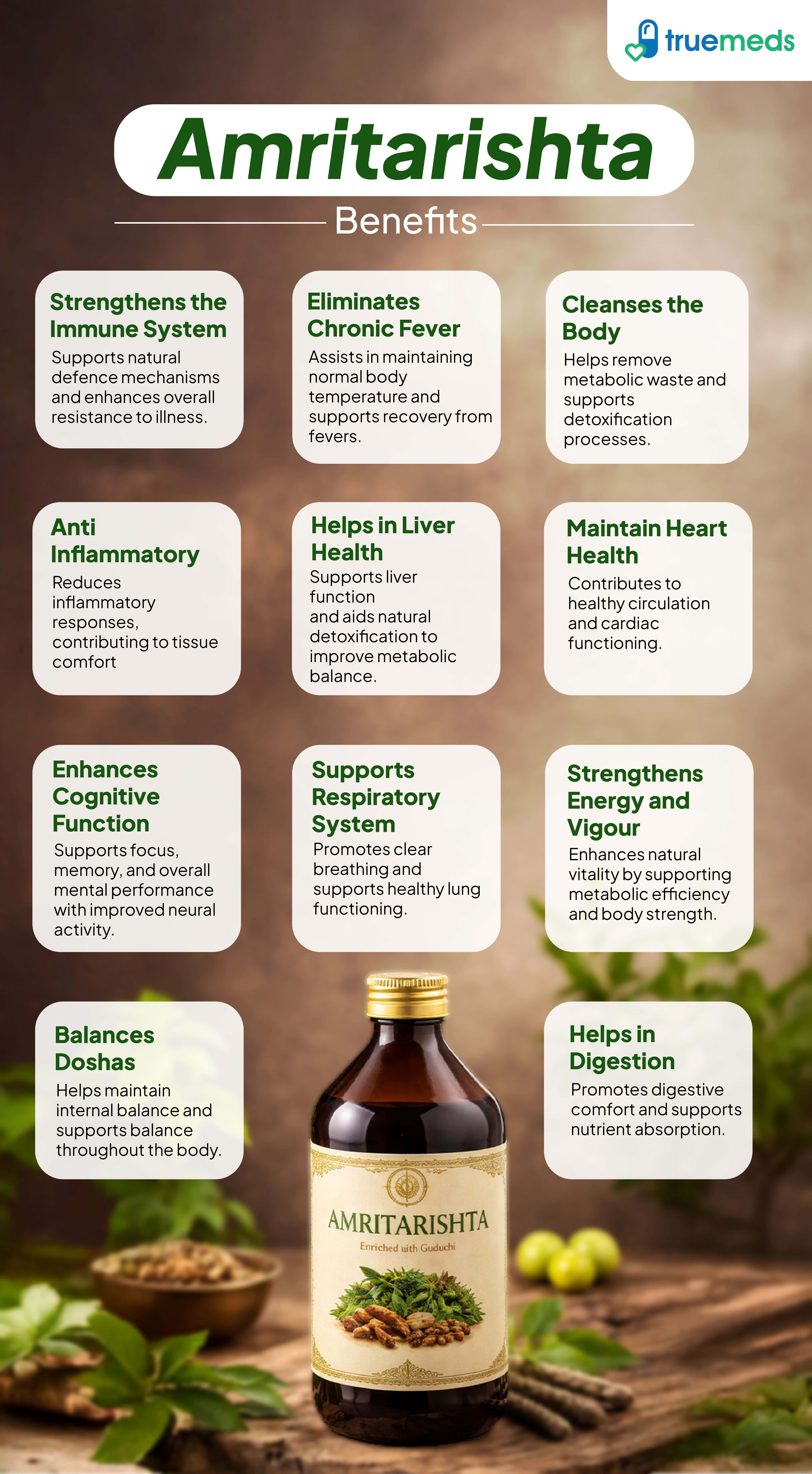
In Ayurveda, Amritarishta is traditionally described as Deepana and Pachana, meaning it is believed to support appetite and digestion. Ingredients such as Trikatu and other aromatic herbs are included to help restore appetite and digestive function, which may be reduced after a fever. This is one of the formulation's best-known traditional uses and is based on classical Ayurvedic texts rather than modern clinical trials.
Support During Recovery From Fever
Classical Ayurvedic texts describe Amritarishta in the context of Jwara (fever). It is traditionally used during the recovery phase to support people experiencing tiredness and weakness after a fever has settled, rather than to treat an active fever. It is considered a supportive preparation and should not replace medical assessment to identify and treat the underlying cause of a fever.
Traditional Use as a Rasayana in Convalescence
Rasayana preparations are given to rebuild strength after illness. The fermented form is traditionally held to be absorbed more readily than a plain decoction, which is why this dosage form is chosen. This traditional use has not been confirmed in controlled human studies of the finished preparation.
Effects on Immune Cells Seen in Laboratory Studies
Guduchi contains an arabinogalactan polysaccharide that stimulates immune cells in laboratory work. This has not been shown to reduce infections in people. The same immune-stimulating action has also been proposed as one possible mechanism behind the liver injury reported with this herb (Kulkarni et al., 2022).
Disclaimer: Amritarishta is a supportive preparation and not a treatment for fever, infection or any lung condition. A fever lasting more than three days, or any fever with breathlessness, severe headache, a rash, confusion or persistent vomiting, needs medical assessment rather than a tonic. Never stop or delay a prescribed antibiotic, inhaler or other medicine in order to take it.
Common Uses of Amritarishta
Amritarishta is used in a few specific situations rather than as an everyday supplement. It is traditionally used in the following situations.
In the Weeks After a Fever Has Settled
It is started once the acute illness is over and the person is left tired, has reduced appetite and is slow to regain strength. It is not used during the fever itself, and it does not replace finding out what caused it.
Where Appetite and Digestion Are Slow to Return
Prescribed where someone has recovered from an infection but still has no appetite, feels heavy after meals or has a coated tongue. The Trikatu and aromatic ingredients are traditionally included to support appetite and digestion in this situation.
As Part of a Prescribed Rasayana Course
Ayurvedic physicians prescribe it as a defined course during convalescence, usually alongside dietary advice, rather than as an open-ended daily tonic. The duration of treatment should be decided and reviewed by the prescribing practitioner.
Alongside Other Classical Preparations in Recovery
It is sometimes given with a churna or a kashaya, where one preparation is traditionally used for specific symptoms and the arishta is used as a nourishing preparation during recovery. Combinations should be arranged by a practitioner, particularly where another fermented preparation is involved.
Precautions While taking Amritarishta
Amritarishta contains naturally produced alcohol and is built on Guduchi. Most of the precautions relate to these two aspects. Read the points below before starting it.
- This preparation contains naturally produced alcohol, usually in the range found in beer or wine. Check the maximum alcohol content printed on the pack before you buy it.
- Do not give it to children. There is no safe paediatric dose of an alcohol-containing preparation for home use, and any use in a child must be decided by a doctor.
- Avoid it in pregnancy and while breastfeeding, because of the alcohol content.
- Do not take it if you have liver disease of any kind, or if you have ever been told you have an autoimmune condition affecting the liver.
- Do not take it if you are recovering from alcohol dependence or are avoiding alcohol for any reason, including on religious grounds.
- Stop it and see a doctor promptly if you develop yellowing of the eyes or skin, dark urine, pale stools, itching, persistent nausea, loss of appetite or unusual tiredness. Liver injury linked to Guduchi has been reported several weeks after starting it (Kulkarni et al., 2022).
- Consult your doctor before taking it if you have diabetes, since jaggery is a major ingredient, and monitor your readings if you do start it.
- Do not drive or operate machinery until you know how this preparation affects you.
- Take it after food and dilute each dose with an equal amount of water.
- Do not use it as a substitute for prescribed treatments, such as antibiotics or inhalers, and do not use it to manage an undiagnosed fever.
- See a doctor rather than continuing the tonic if a fever lasts more than three days, or comes with breathlessness, severe headache, a rash, confusion or repeated vomiting.
Disclaimer: This is general safety information and not a substitute for advice from a registered medical practitioner or a qualified Ayurvedic physician.
How to Use Amritarishta
Amritarishta is sold as a ready-to-use liquid preparation. The points below cover how to measure it, how to take it and how to look after the bottle.
Measuring the Dose
- Use the measuring cup or cap provided with the bottle, not a household spoon.
- Follow the dose on the label or the dose prescribed by your practitioner. Do not take an extra dose if you miss one.
- Check the label for the alcohol content so you know how much alcohol each dose contains.
Diluting and Taking It
- Dilute each measured dose with an equal amount of water before taking it.
- Take it after food, not on an empty stomach.
- Take it at the same time each day to help maintain a consistent routine.
Looking After the Bottle
- Close the bottle tightly after each use to help preserve its quality.
- Keep it in its original amber bottle. Do not transfer it to another container, as the amber glass helps protect the preparation from light.
- Record the date the bottle was opened and use it within the period recommended on the label.
- Shake gently before use only if the label instructs you to do so. A light sediment may be present in naturally fermented preparations.
Herbs Traditionally Used With Amritarishta
Amritarishta is usually one part of a treatment plan rather than the whole of it. The preparations below are traditionally used alongside it or as alternatives, depending on the individual's symptoms and needs.
| Herb | Why it is combined with Amritarishta |
| Sudarshan Churna | The classical companion in fever, traditionally prescribed when fever is recurrent. Practitioners may pair the two so that one addresses the fever pattern while the arishta is used traditionally to support appetite and strength during recovery. |
| Dashamularishta | Dashamularishta is a related fermented Ayurvedic preparation made from the same group of ten roots. It is sometimes used instead of Amritarishta when debility, rather than fever, is the main concern, and the two preparations are not generally taken together without practitioner advice. |
| Drakshasava | A fermented raisin preparation traditionally used for weakness and poor appetite during recovery. Because it is also fermented, the alcohol from the two preparations adds up, and they should not be taken together without advice. |
| Amalaki | Often given alongside Rasayana preparations during recovery. It is cooling, which is traditionally said to balance the heating quality of Guduchi and the Trikatu ingredients. |
| Shunthi | Already present in the formulation as part of Trikatu. It is also given separately as a warm infusion for nausea and poor appetite, which is worth knowing so the total intake is not unintentionally increased. |
Note: Two of the preparations listed are also fermented and therefore may contain alcohol. Taking more than one at a time can increase total alcohol exposure, and this can be overlooked when prescribed tonics are not considered alcoholic products.
Recommended Dosage of Amritarishta
Amritarishta is a fermented preparation containing alcohol, so the dose matters more than it would for a powder or a tablet. The guidance below is general and does not replace advice from your healthcare practitioner.
Children Under 12 Years
Not recommended as a home remedy at any dose because the preparation contains alcohol. Where an Ayurvedic physician does prescribe an arishta for a child, the dose is individualised, diluted and supervised. Do not give an adult dose or a reduced adult dose to a child on your own.
Teenagers Aged 12 to 17 Years
Only on the advice of a doctor or a qualified Ayurvedic physician, who will judge whether an alcohol-containing preparation is appropriate at all. A non-fermented alternative may be considered and may be more suitable in this age group.
Adults
Commonly 15 ml to 30 ml twice daily, after food, diluted with an equal volume of water. Start at the lower end. Follow the instructions on the label, as the strength and alcohol content can vary between manufacturers.
Older Adults
Start at the lower end of the adult range and use the lowest effective amount advised by your practitioner. Older people may be more sensitive to alcohol, are more likely to be taking medicines that interact with it, and may have reduced liver or kidney function.
How Long to Take It
Arishtas are given as a defined course during recovery rather than indefinitely. Ask your practitioner at the start how long to take it and when it should be reviewed. This matters here because liver injury linked to Guduchi has typically appeared after several weeks of continuous use rather than early on (Kulkarni et al., 2022).
Disclaimer: These dosages are general information only. Amritarishta should be taken as advised by a registered medical practitioner or a qualified Ayurvedic physician, particularly by anyone with diabetes, liver disease or a history of alcohol dependence.
Side Effects of Amritarishta
Most people who take Amritarishta briefly have either no side effects or mild digestive symptoms. The effects below are listed with the most serious one last, because it is the one that needs recognising.
Stomach Discomfort and Nausea
The most common complaint, and more likely on an empty stomach or when taken undiluted. Taking the dose after food with an equal volume of water usually helps reduce these symptoms.
Loose Stools
Usually a sign that the preparation is not well tolerated at that dose, or that the tonic is being taken alongside another fermented preparation. Reduce the dose or stop and take advice.
Raised Blood Glucose
Blood glucose may increase because jaggery is a major ingredient and some residual sugar remains after fermentation. Anyone with diabetes should monitor their readings after starting it.
Effects From the Alcohol Content
Flushing, light-headedness or drowsiness can follow a dose, particularly at the higher end of the range or alongside sedating medicines. Do not drive until you know how it affects you.
Allergic Reactions
Allergic reactions are uncommon but can occur with any multi-ingredient herbal preparation. Stop taking it and seek medical advice immediately if you develop a rash, itching, swelling, wheezing or difficulty breathing.
Liver Injury (Uncommon but Important)
Guduchi, the main ingredient, has been linked to acute hepatitis with autoimmune features in Indian case series and in a multicentre study of 43 patients, with symptoms typically appearing around six weeks after starting the herb (Nagral et al., 2021; Kulkarni et al., 2022). The risk appears higher in people with an existing or undiagnosed autoimmune condition. Stop the tonic and see a doctor promptly if you develop jaundice, dark urine, persistent nausea or unusual tiredness.
Disclaimer: This list is not exhaustive. Report any unexpected reaction to your doctor or pharmacist and stop the preparation in the meantime.
Interaction of Amritarishta With Other Drugs
Most interactions here relate to the alcohol content and the potential effects of Guduchi. Tell your doctor and pharmacist that you are taking a fermented Ayurvedic preparation, and show them the label.
Metronidazole and Tinidazole
These antibiotics can cause flushing, nausea, vomiting and headache when taken with alcohol. Do not take Amritarishta while taking either medicine or during the alcohol-avoidance period advised by your prescriber.
Disulfiram
Prescribed to help people avoid alcohol, disulfiram can cause a severe reaction when alcohol is consumed. Anyone taking disulfiram must not take an arishta or asava containing alcohol.
Sedating Medicines
Sleeping tablets, anti-anxiety medicines, strong painkillers, some antihistamines and some antidepressants can cause increased sedation when combined with alcohol. Ask your pharmacist before combining them with a fermented preparation.
Medicines That Affect the Liver
Guduchi carries a potential liver safety concern, so combining it with paracetamol taken regularly, anti-tuberculosis medicines, methotrexate or other herbal products linked to liver injury requires medical advice first (Philips et al., 2020).
Medicines That Suppress the Immune System
Guduchi has shown immune-modulating activity in laboratory studies, which could potentially affect medicines used to suppress the immune system after a transplant or for an autoimmune condition. Anyone on this type of treatment should not start it without their specialist's agreement.
Diabetes Medicines
The jaggery content can increase blood glucose, while alcohol can occasionally lower it. The combined effect is unpredictable, so monitor your readings and tell your doctor you have started it.
Other Fermented Ayurvedic Preparations
Asavas and arishtas may contain alcohol. Taking two or three together can increase total alcohol exposure, which is easy to overlook when each is thought of as a medicine rather than an alcoholic drink.
Disclaimer: This is not a complete list of interactions. Tell your doctor and pharmacist about every prescription medicine, over the counter product and Ayurvedic preparation you take.
Storage of Amritarishta
A fermented preparation behaves differently from a powder or a tablet, and its quality may change after opening. Store it as follows.
- Keep it in its original amber bottle, tightly capped, away from direct sunlight.
- Store in a cool, dry place. Refrigeration is not usually required unless stated on the label.
- Close the cap firmly straight after each dose, because contact with air can affect the preparation over time.
- Keep it out of reach and sight of children. It is sweet, it looks like a syrup, and it contains alcohol.
- Expect a light sediment, which is normal in a fermented preparation. Discard the bottle if it smells sour or vinegary, if it fizzes, or if you see mould or unusual cloudiness.
- Record the opening date and follow the label's recommended in-use period, even though unopened Arishta preparations generally keep for a long time.
- Choose sealed, batch-labelled products from a licensed manufacturer and check that the label lists Tinospora cordifolia (Guduchi), not Tinospora crispa.
Key Takeaways
- Amritarishta is a classical Ayurvedic Arishta prepared by naturally fermenting Guduchi (Tinospora cordifolia) and other herbs, including Dashamoola, with jaggery and Dhataki flowers.
- Natural fermentation produces alcohol, so the alcohol content can vary between products and should be checked on the label.
- In Ayurveda, it is traditionally used during recovery from fever to support people with tiredness and poor appetite after the fever has settled, rather than to treat an active fever.
- It is not a treatment for fever, infections, asthma or other lung conditions, and it should not replace antibiotics, inhalers or any prescribed medicine.
- It is generally not recommended for children, during pregnancy or breastfeeding, or for people who need to avoid alcohol.
- Although Guduchi is traditionally used in Ayurveda, rare cases of acute liver injury with autoimmune features have been reported, usually after several weeks of use.
- Stop taking Amritarishta and seek medical advice immediately if you develop yellowing of the skin or eyes, dark urine, persistent nausea, severe abdominal pain or unusual tiredness.
- Seek medical assessment rather than continuing Amritarishta if a fever lasts for more than three days or is accompanied by breathlessness, a rash, confusion or repeated vomiting.
FAQs
Does Amritarishta contain alcohol?
Is Amritarishta good for the liver?
Can it be given to children?
Can I take it every day?
When should it be taken?
Does it treat fever?
Who should avoid Amritarishta?
Can it be taken with other Ayurvedic tonics?
References
- Kulkarni, A. V., Hanchanale, P., Prakash, V., Kalal, C., Sharma, M., Kumar, K., & other authors. (2022). Tinospora cordifolia (Giloy)-induced liver injury during the COVID-19 pandemic: Multicenter nationwide study from India. Hepatology Communications, 6(6), 1289–1300. https://doi.org/10.1002/hep4.1904
- Nagral, A., Adhyaru, K., Rudra, O. S., Gharat, A., & Bhandare, S. (2021). Herbal immune booster-induced liver injury in the COVID-19 pandemic: A case series. Journal of Clinical and Experimental Hepatology, 11(6), 732–738. https://doi.org/10.1016/j.jceh.2021.06.002
- Philips, C. A., Ahamed, R., Rajesh, S., George, T., Mohanan, M., & Augustine, P. (2020). Comprehensive review of hepatotoxicity associated with traditional Indian Ayurvedic herbs. World Journal of Hepatology, 12(9), 574–595. https://doi.org/10.4254/wjh.v12.i9.574




Explore other categories
Latest health articles





Top Health Essentials






Top-selling ayurvedic products














Disclaimer
Top-Selling Medicines:
...View more
Top-OTC medicines:
...View more
Top-selling healthcare devices:
...View more
Company
About UsHealth ArticleHealth StoriesHealth LibraryDiseases & Health ConditionsAyurvedaUnderstanding Generic MedicinesAll MedicinesAll BrandsNeed HelpFAQSecuritySavings CalculatorAdvertise with UsSubscribe
Registered Office Address
Grievance Officer
Download Truemeds


Contact Us
Our customer representative team is available 7 days a week from 9 am - 9 pm.
v4.28.18

2026 - Truemeds | All rights reserved. Our content is for informational purposes only. See additional information.

Our Payment Partners




