

- Medicines
- Personal Care
- Skin Cream
- Sunscreen
- Face Wash
- Skin and Body Soap
- Acne Care
- Body Lotions
- Moisturising Lotion
- Moisturising Cream
- Mosquito Repellent
- Moisturising Gel
- Body Wash
- Hair Oils
- Hair Shampoo
- Hair Conditioners
- Hair Supplements
- Hair Colour
- Hair Serum
- Hair Mask
- Hair Solutions
- Baby Diapers and Wipes
- Baby Lotion and Moisturising Cream
- Baby Bath Essentials
- Baby Skin Care
- Baby and Infant Food
- Baby Healthcare
- Women Multivitamins
- Ovulation Test Kit and Women Intimate Care
- Sanitary Pads
- Nutritional Drinks
- Condoms
- Lubricants
- Massage Gels
- Personal Body Massagers
- Men Performance Booster
- Sexual Health Supplements
- Massage Oils
- Ayurveda
- Tooth Paste
- Mouth Ulcer Gel
- Mouthwash
- Toothache and Gum Pain
- Tooth Brush
- Gargle Solution
- Orthopaedic Supports
- Adult Diapers
- Footwear
- Mobility and Support Accessories
- Urinary Support and Care
- Health Conditions
- Bone and Joint Care
- Digestive Care
- Eye Care
- Pain Relief
- Smoking Cessation
- Liver Care
- Stomach Care
- Cold and Cough
- Heart Care
- Kidney Care
- Piles, Fissures & Fistula
- Respiratory Care
- Mental Wellness
- Derma Care
- Pre and Probiotics
- Acidity
- Gas
- Constipation
- Loose Motion/Diarrhoea
- Digestive Fibres
- Digestive Enzymes
- Eye Lubricant Drops
- Lens Solution
- Safety Eye Wear
- Eye Cream
- Eye Vitamins and Supplements
- Eye Drops
- Eye Ointment and Gel
- Nicotine Patch
- Nicotine Gum
- Nicotine Lozenges
- Cough Syrups
- Chest Rubs and Balms
- Nasal Spray
- Lozenges
- Inhalant Capsules
- Cold and Cough Tablets
- Vitamins & Supplements
- Diabetes Care
- Healthcare Devices
- Homeopathic Medicine
- Health Guide
Sitopaladi Churna
Sitopaladi Churna is a classical Ayurvedic polyherbal powder traditionally used to support respiratory comfort. It is taken to help soothe the throat, ease an ordinary cough and support easier breathing during a seasonal cold. It is also used traditionally to support digestion and appetite. It is a supportive remedy and not a treatment for any respiratory disease. Speak to a doctor before use.
 50
50Last updated on : 14 Aug, 2026
Read time : 15 mins
What is Sitopaladi Churna?
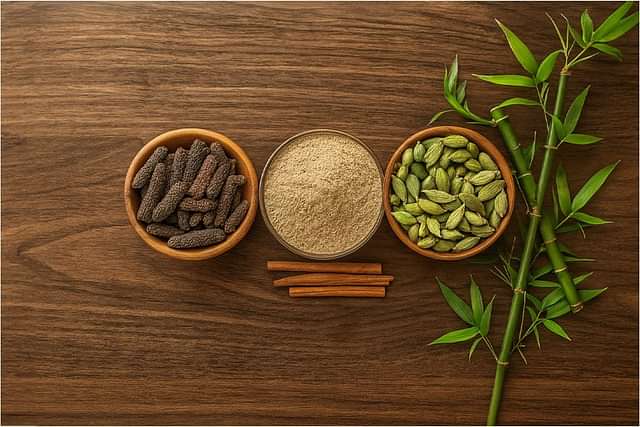
The name Sitopaladi comes from two Sanskrit words. “Sitopala” means rock sugar, the largest ingredient in the formula, and “adi” means “and others”, referring to the herbs blended with it. The name therefore describes the recipe itself, a base of rock sugar combined with supporting herbs.
The formulation is described in classical Ayurvedic texts, most notably the Sharangadhara Samhita, and it also appears in the Bhaishajya Ratnavali. It has been used for centuries as a household remedy during seasonal coughs and colds (Makhija et al., 2013).
In Ayurvedic terms, Sitopaladi Churna is described as having a sweet and pungent taste (Madhura and Katu rasa), a mild warming potency (Ushna virya) and a sweet post-digestive effect (Madhura vipaka). It is understood to pacify aggravated Kapha and Vata, the two doshas associated in Ayurveda with mucus and dryness in the chest. This is the traditional basis for using it during a cough or cold.
Key Facts
| Feature | Details |
| Formulation name | Sitopaladi Churna |
| Formulation type | Churna (a fine oral powder) |
| Classical reference | Sharangadhara Samhita; also described in the Bhaishajya Ratnavali |
| Composition | Sitopala (rock sugar), Vamshalochana (bamboo manna), Pippali (long pepper), Ela (cardamom), Twak (cinnamon)
|
| Classical proportion | 16 : 8 : 4 : 2 : 1 by weight, in the order above |
| Also known as | Sitopaladi Choorna, Sitopaladi Choornam, Sitopaladi Powder |
| Key active compounds | Piperine, cinnamaldehyde and 1,8-cineole, the marker compounds of the formulation |
| Dosha action | Pacifies Kapha and Vata |
| Traditional uses | Supporting respiratory comfort during a seasonal cough or cold, and supporting digestion and appetite |
| Common forms | Powder (churna); less commonly tablets or capsules
|
| General dosage | Adults 1 to 3 g, once or twice daily with honey or warm water, or as advised by an Ayurvedic doctor |
| Best taken | After meals, with honey and ghee in unequal quantities, or with lukewarm water |
| Key safety note | Roughly half the powder is sugar. People with diabetes should consult a doctor first. It is not a treatment for asthma or any lung disease. |
Alternative Names of Sitopaladi Churna
Sitopaladi Churna is a Sanskrit formulation name, so it is spelled rather than translated differently across India. The common spellings are listed below.
- Sitopaladi Choorna
- Sitopaladi Choornam
- Sitopaladi Chooran
- Sitopaladi Churnam
- Sitopaladi Powder (English)
Chemical Constituents of Sitopaladi Churna
Each herb in the formula contributes its own naturally occurring compounds. Laboratory analysis identifies three of these as marker compounds, used to check the quality of a batch (Pawar et al.).
- Piperine: The main alkaloid in pippali (long pepper), and a standard marker compound for the formulation.
- Cinnamaldehyde: The main aromatic compound in twak (cinnamon bark), and a second marker compound.
- 1,8-cineole: An aromatic compound from ela (cardamom), and the third marker compound.
- Silica: The compound bamboo manna (vamshalochana) is best known for.
- Sucrose: From rock sugar, which forms the bulk of the powder by weight.
- Volatile oils, flavonoids and tannins: Present in smaller amounts across the herbs.
Physico-chemical standards for the powder, such as ash and moisture values, have been published to support quality testing (Aswatha Ram et al., 2012).
Composition of Sitopaladi Churna
Sitopaladi Churna is made from five ingredients blended in a fixed classical proportion. Rock sugar forms the base, and the herbs are added in decreasing quantities.
- Sitopala (rock sugar): The sweet base of the formula, traditionally used to soothe the throat.
- Vamshalochana (bamboo manna, Bambusa arundinacea): A silica-rich substance traditionally used to support the lungs.
- Pippali (long pepper, Piper longum): Traditionally used to help clear mucus and support digestion.
- Ela (cardamom, Elettaria cardamomum): Aromatic seed traditionally used to ease congestion.
- Twak (cinnamon, Cinnamomum zeylanicum): An aromatic bark traditionally used for its warming quality.
Medicinal Properties of Sitopaladi Churna
The medicinal properties of Sitopaladi Churna are as follows:
- Expectorant: May help loosen and clear mucus from the airways, easing cough and chest congestion.
- Antihistaminic: Contains compounds such as piperine that may help calm mild allergic responses like sneezing or a runny nose.
- Anti-inflammatory: May help soothe mild inflammation in the throat and respiratory tract.
- Antioxidant: May help protect body cells from oxidative stress.
- Immunomodulatory: May support the body's natural immune response.
- Mild antimicrobial activity: Some constituents have shown antibacterial and antifungal action in laboratory studies, though clinical evidence in humans remains limited.
Key Health Benefits of Sitopaladi Churna
Sitopaladi Churna is traditionally taken for a few everyday complaints, described below. It is a supportive remedy and does not treat any disease, so see a doctor if symptoms are severe or do not settle.
 Soothes a Common Cough
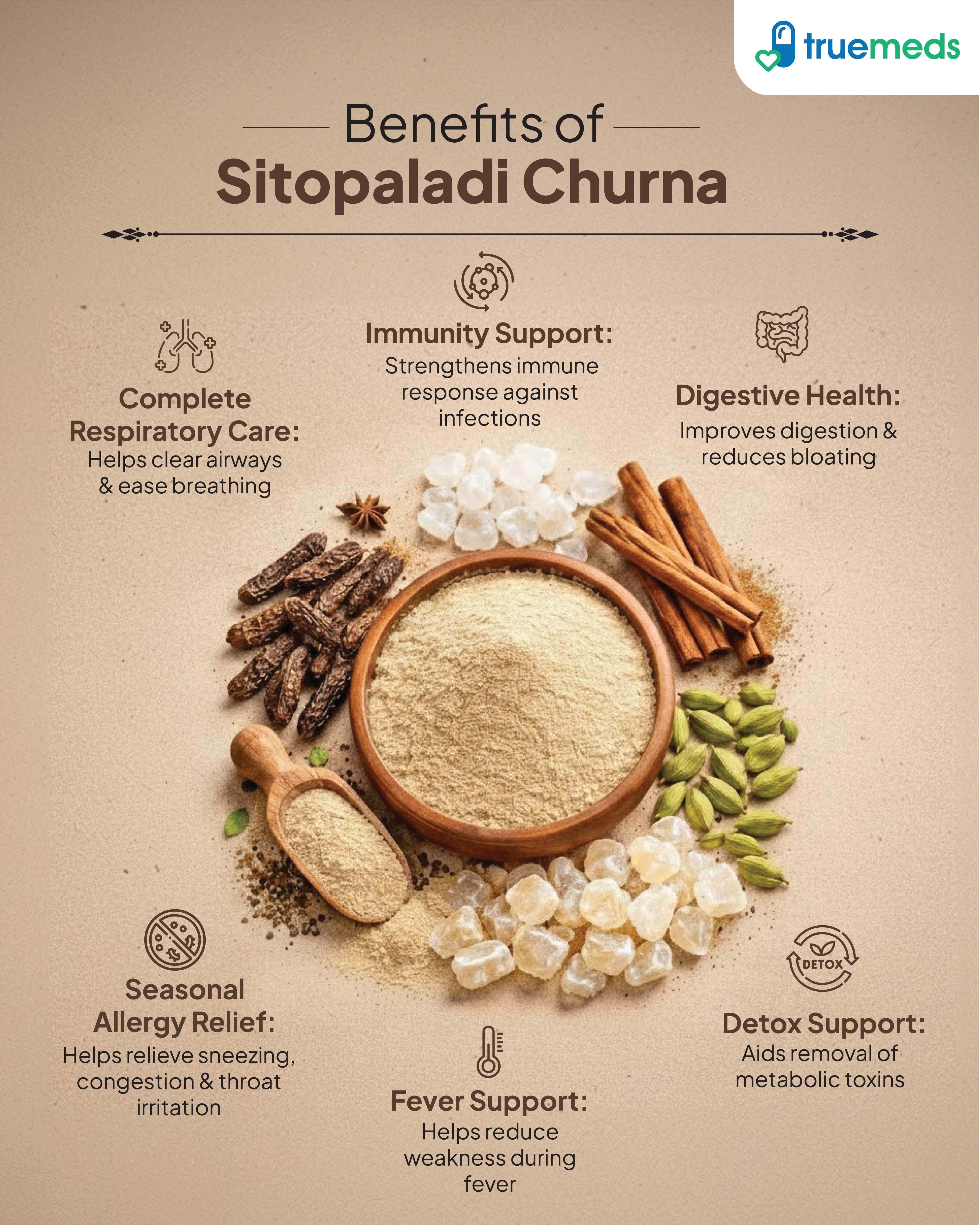
Sitopaladi Churna is best known for easing a common cough. The rock sugar and bamboo manna help coat and soothe an irritated throat, while the warming herbs help loosen mucus so it clears more easily. It is traditionally used for both dry and chesty coughs during a seasonal cold.
Eases Congestion During a Cold
The aromatic herbs, long pepper, cardamom and cinnamon, are traditionally used to help open a blocked nose and chest. By supporting the clearing of mucus, the powder may make breathing feel more comfortable during an ordinary seasonal cold.
Soothes Throat Irritation
The sweet base of the formula is demulcent, which means it forms a soothing layer over an irritated throat. This is why it is traditionally taken with honey, which is also soothing, and it may bring short term comfort during a sore, scratchy throat.
Supports Everyday Digestion
Long pepper and cardamom are carminative herbs, traditionally used to ease bloating and wind. In Ayurveda the powder is taken to support digestive fire (Agni), linked with a healthy appetite and comfortable digestion. This use is traditional rather than clinically proven.
Supports Appetite During Recovery
Sitopaladi Churna is traditionally given to people recovering from a cold whose appetite has dropped. The pungent herbs are used in Ayurveda to stimulate interest in food and support digestion during recovery. See a doctor if poor appetite lasts more than a few days.
See a doctor if a cough lasts more than three weeks, or if you have breathing difficulty, chest pain, a high fever, or you cough up blood. Do not rely on Sitopaladi Churna in these situations.
Common Uses for Sitopaladi Churna
Sitopaladi Churna is an all-purpose Ayurvedic medicine used for all such conditions. Here are some of the most common uses:
During a Seasonal Cough or Cold
This is the most common use of Sitopaladi Churna. It is traditionally taken at the first sign of a cough, cold or scratchy throat, and continued for a few days while symptoms settle.
While Recovering From a Cold
It is often taken during recovery, when a cough lingers or the appetite has not fully returned, as a supportive measure alongside rest and fluids.
During Seasonal Change
In many Indian households, it is used traditionally when the weather turns and coughs and colds are common. This is a traditional practice, not a proven way to prevent illness.
After Meals for Digestive Comfort
It is sometimes taken after food to ease a feeling of heaviness or bloating, following the Ayurvedic idea of supporting digestive fire.
Ask an Ayurvedic doctor how long to take it, and see a doctor if symptoms do not improve.
Precautions While Taking Sitopaladi Churna
Sitopaladi Churna is generally well tolerated, but some people need to take extra care. Read the points below before using it.
- Diabetes: Rock sugar makes up roughly half the powder by weight, so it may raise your blood sugar. Speak to your doctor first and monitor your levels.
- Asthma or any diagnosed lung condition: Do not use it in place of your prescribed medicine or inhaler. Speak to your doctor before adding it.
- Pregnancy and breastfeeding: Speak to your doctor first, as safety information is limited.
- Children: Give it only on a doctor's advice, at a dose suited to the child's age and weight. It is not recommended below the age of two without medical guidance.
- Heart or kidney conditions: Speak to your doctor before use.
- Alcohol: It is sensible to avoid alcohol while you are unwell and taking any herbal medicine.
- When to see a doctor: Seek medical advice if a cough lasts more than three weeks, or if you have breathing difficulty, chest pain, a high fever, or you cough up blood.
This is general information and not medical advice. Always consult a doctor before starting herbal medicine.
How to Use Sitopaladi Churna
Sitopaladi Churna comes in a few forms, each taken slightly differently. Follow the method for the form you have.
Taking the Powder With Honey and Ghee
This is the classical method for a cough or sore throat. Mix half to one teaspoon of powder with honey and ghee in unequal quantities, never in equal parts, and take it after meals once or twice a day. Ayurveda considers honey and ghee in equal amounts an unsuitable combination, which is why the quantities must differ.
Mixing the Powder With Warm Water
If you prefer not to use honey and ghee, stir half to one teaspoon into a cup of lukewarm water and drink it after food. Lukewarm water is preferred to cold.
Stirring the Powder Into Warm Milk
Some people take it with warm milk, particularly at night for a dry cough. Stir half to one teaspoon into a cup of warm milk and drink it after food.
Swallowing the Tablet or Capsule Form
For tablet or capsule formulations, swallow it with lukewarm water after food, following the dose on the pack or advised by your practitioner.
Do not exceed the dose on the pack. If symptoms do not improve within a few days, or get worse, see a doctor.
Herbs Traditionally Used With Sitopaladi Churna
In Ayurvedic practice, Sitopaladi Churna is rarely taken alone. The herbs and adjuvants below are traditionally given with it. Always ask an Ayurvedic doctor before combining herbal products.
Herbs | How it is traditionally used with Sitopaladi Churna |
Honey (Madhu) | Honey is the most common adjuvant, or anupana, for this powder. It is used traditionally to carry the churna, soothe the throat and support its expectorant action. Never give honey to a baby under one year old. |
Ghee (Ghrita) | Ghee is combined with honey in unequal quantities as the classical adjuvant for a dry cough. Ayurveda regards equal parts honey and ghee as an unsuitable combination, so the amounts must always differ. |
Tulsi (Holy Basil) | Tulsi is traditionally given alongside Sitopaladi Churna during a seasonal cough or cold. It is valued in Ayurveda for supporting the chest and throat, and the two are often taken together as a warm drink. |
Yashtimadhu (Liquorice) | Yashtimadhu is traditionally combined with the churna to soothe a dry, irritating cough. It is a demulcent herb, used to coat and calm an irritated throat, which complements the sweet base of the formula. |
Vasa (Malabar Nut) | Vasa is a classical Ayurvedic herb for the chest, traditionally used alongside Sitopaladi Churna when a cough feels heavy with mucus, as it is described as helping to clear the airways. |
Ginger (Shunthi) | Ginger is traditionally taken with the churna to support digestion and ease congestion. It is a warming herb, often added to the warm water or milk the powder is mixed into. |
Recommended Dosage of Sitopaladi Churna
The right dose depends on age, health and tolerance. The guidance below is a starting point only. Always confirm the dose with a qualified Ayurvedic doctor, especially for a child or an older person.
- Children (2 to 12 years): 0.5 to 1 g, about a quarter to a half teaspoon, once or twice daily with honey or warm water. Give only on a doctor's advice. Not recommended below the age of two without medical guidance.
- Teenagers (13 to 18 years): 1 to 2 g, about a half to one teaspoon, once or twice daily with honey or warm water.
- Adults: 1 to 3 g, about a half to one teaspoon, once or twice daily, with honey and ghee in unequal quantities or with lukewarm water, after food.
- Older adults (over 65): 1 to 2 g, about a half to one teaspoon, once or twice daily. Start at the lower end, particularly with diabetes or a heart or kidney condition.
Note: The dosage information provided is based on commonly referenced Ayurvedic practice and is intended for general information only. It is not a substitute for personalised medical advice or an official prescribing guideline. The appropriate dose and duration should always be determined by a qualified Ayurvedic practitioner, particularly for children, pregnant or breastfeeding women, older adults, and individuals with underlying medical conditions or those taking other medicines.
Side Effects of Sitopaladi Churna
Most people tolerate Sitopaladi Churna well. The side effects below are possible, particularly at higher doses.
1. Raised Blood Sugar
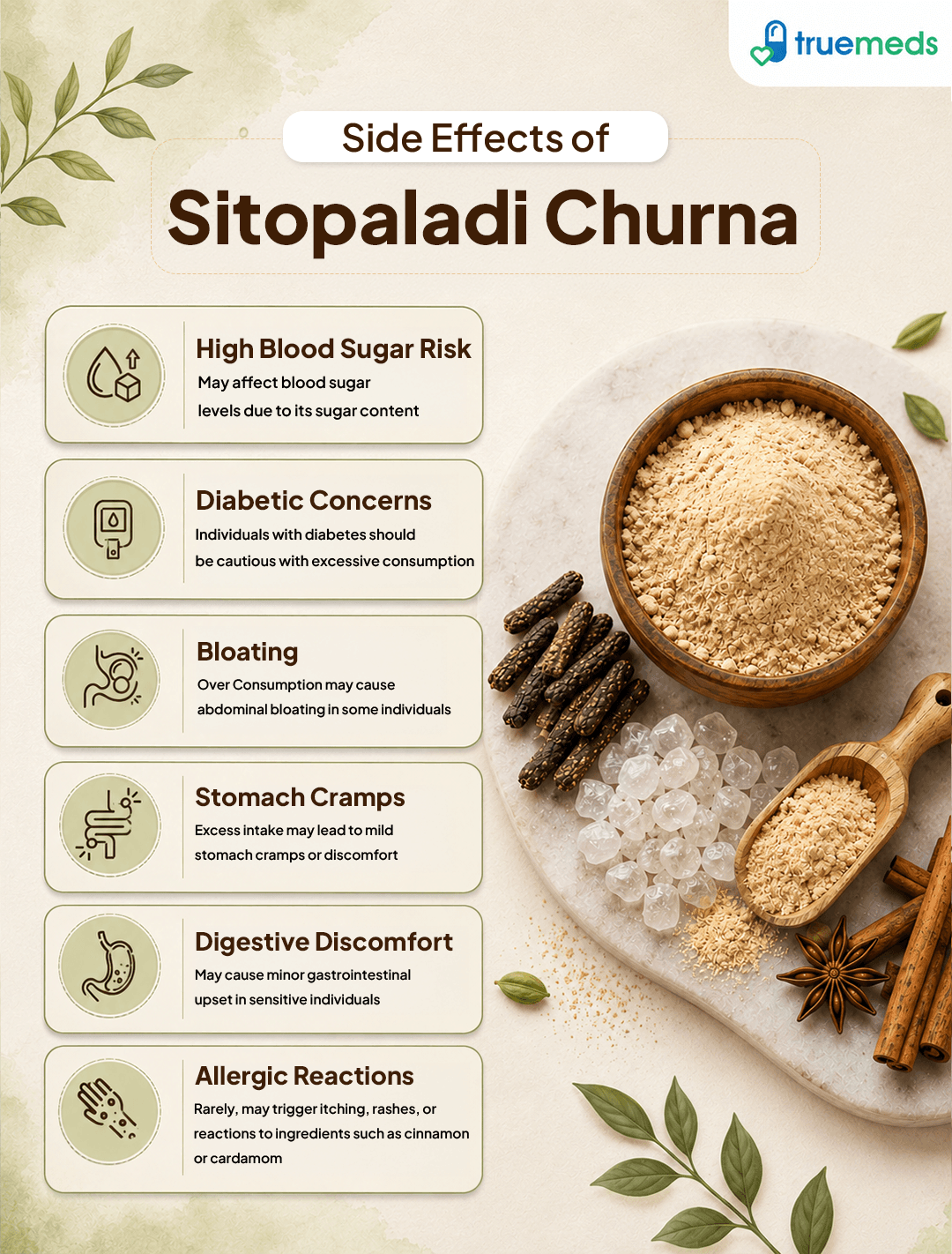
The powder is roughly half sugar by weight, so it may raise blood glucose. This matters most for people with diabetes or prediabetes, who should check with a doctor before taking it.
2. Digestive Upset
Taking more than the recommended amount may cause bloating, stomach cramps or loose stools. Reduce the dose or stop, and speak to a doctor if it continues.
3. Heartburn or Burning Sensation
The formula contains warming, pungent herbs. Some people, particularly those prone to acidity, may notice mild heartburn.
4. Allergic Reaction
Rarely, someone may react to cinnamon, cardamom or another ingredient. Stop taking it and seek medical help if you develop a rash, itching, swelling or difficulty breathing.
Interaction of Sitopaladi Churna With Other Drugs
Tell your doctor you are taking Sitopaladi Churna if you use any of the medicines below.
Diabetes Medicines
Sitopaladi Churna contains sugar and may increase blood glucose levels. If you have diabetes or take diabetes medicines, consult your doctor before use and monitor your blood glucose levels.
Blood Thinning Medicines
Cinnamon contains coumarin compounds, which in theory may add to the effect of blood-thinning medicines such as warfarin. Tell your doctor if you take one.
Medicines Taken by Mouth in General
Long pepper contains piperine, a confirmed marker compound of this formulation (Pawar et al.). Piperine can affect how the body absorbs and processes some medicines, so check with your doctor if you take regular prescription medicine.
Other Ayurvedic Medicines
Speak to an Ayurvedic doctor before combining it with other Ayurvedic preparations, so ingredients do not overlap or react.
Note: This is not a complete list. Always tell your doctor about any herbal product you take.
Storage of Sitopaladi Churna
Storing the powder properly keeps it effective and stops it from spoiling.
- Keep it in a tightly closed, airtight container.
- Store it in a cool, dry place away from direct sunlight.
- Keep it away from moisture. The powder is largely sugar and will clump or spoil if it gets damp, so always use a dry spoon.
- Keep it out of the reach of children.
- Do not use it after the expiry date printed on the pack.
Key Takeaways
The main points to remember about Sitopaladi Churna are summarised below.
- It is a classical Ayurvedic powder of rock sugar, bamboo manna, long pepper, cardamom and cinnamon.
- It is traditionally used to soothe an ordinary cough, ease congestion during a seasonal cold and support digestion.
- It is a supportive remedy, not a treatment. It does not treat asthma, bronchitis or any lung disease and must never replace prescribed medicine or an inhaler.
- Roughly half the powder is sugar, so anyone with diabetes should speak to a doctor before taking it.
- It is usually taken after food with honey and ghee in unequal quantities, or with lukewarm water.
- Possible side effects include raised blood sugar, digestive upset, heartburn and, rarely, an allergic reaction.
- See a doctor if a cough lasts more than three weeks, or if you have breathing difficulty, chest pain, a high fever, or you cough up blood.
- Research is mostly laboratory-based. Good-quality clinical trials in humans are lacking.
Disclaimer: This information is general and is not medical advice. Sitopaladi Churna is a supportive remedy and does not treat any disease. Speak to a doctor before use.
FAQs
What is Sitopaladi Churna made of?
What is Sitopaladi Churna used for?
How do I take Sitopaladi Churna?
Can I take Sitopaladi Churna every day?
Can children take Sitopaladi Churna?
Is Sitopaladi Churna safe if I have diabetes?
Can Sitopaladi Churna be taken with water?
Does Sitopaladi Churna help with asthma?
When should I see a doctor instead?
References
- Makhija, I. K., Shreedhara, C. S., & Ram, H. N. A. (2013). Mast cell stabilization potential of Sitopaladi churna: An Ayurvedic formulation. Pharmacognosy Research, 5(4), 306–308. https://doi.org/10.4103/0974-8490.118824
- Aswatha Ram, H. H. S., Makhija, I., & Shreedhara, C. (2012). Physico-chemical standardization of Sitopaladi churna. Ancient Science of Life, 31(3), 107. https://doi.org/10.4103/0257-7941.103187
- Shivani, S., Rakhshi, I., Pawar, R. K., Sharma, S., Sharma, R. K., Singh, K. C., Department of chemistry, R.S.S. (P.G.) College, Pilkhuwa, Hapur (U.P.), India, & Pharmacopoeial Laboratory for Indian Medicine, Ghaziabad 201 002 (U.P.), India. (2013). Development of HPTLC method for the determination of piperine in sitopladi churna - an Ayurvedic formulation. Int. J. Pharm. Phytopharmacol. Res., 46–51. https://eijppr.com/storage/models/article/SVyUoF69EScWAbqUj72kzKvOQkpxeuTpSjSax29mAlsv7PnEwfri6hFDVSdE/development-of-hptlc-method-for-the-determination-of-piperine-in-sitopladi-churna-an-ayurvedic-for.pdf
- National Center for Complementary and Integrative Health. (n.d.). Cinnamon: Usefulness and safety. National Institutes of Health. https://www.nccih.nih.gov/health/cinnamon





Explore other categories
Latest health articles





Top Health Essentials




Top-selling ayurvedic products














Disclaimer
Top-Selling Medicines:
...View more
Top-OTC medicines:
...View more
Top-selling healthcare devices:
...View more
Company
About UsHealth ArticleHealth StoriesHealth LibraryDiseases & Health ConditionsAyurvedaUnderstanding Generic MedicinesAll MedicinesAll BrandsNeed HelpFAQSecuritySavings CalculatorAdvertise with UsSubscribe
Registered Office Address
Grievance Officer
Download Truemeds


Contact Us
Our customer representative team is available 7 days a week from 9 am - 9 pm.
v4.28.18

2026 - Truemeds | All rights reserved. Our content is for informational purposes only. See additional information.

Our Payment Partners




