

- Medicines
- Lab Tests
- Personal Care
- Skin Cream
- Sunscreen
- Face Wash
- Skin and Body Soap
- Acne Care
- Body Lotions
- Moisturising Lotion
- Moisturising Cream
- Mosquito Repellent
- Moisturising Gel
- Body Wash
- Hair Oils
- Hair Shampoo
- Hair Conditioners
- Hair Supplements
- Hair Colour
- Hair Serum
- Hair Mask
- Hair Solutions
- Baby Diapers and Wipes
- Baby Lotion and Moisturising Cream
- Baby Bath Essentials
- Baby Skin Care
- Baby and Infant Food
- Baby Healthcare
- Women Multivitamins
- Ovulation Test Kit and Women Intimate Care
- Sanitary Pads
- Nutritional Drinks
- Condoms
- Lubricants
- Massage Gels
- Personal Body Massagers
- Men Performance Booster
- Sexual Health Supplements
- Massage Oils
- Ayurveda
- Tooth Paste
- Mouth Ulcer Gel
- Mouthwash
- Toothache and Gum Pain
- Tooth Brush
- Gargle Solution
- Orthopaedic Supports
- Adult Diapers
- Footwear
- Mobility and Support Accessories
- Urinary Support and Care
- Health Conditions
- Bone and Joint Care
- Digestive Care
- Eye Care
- Pain Relief
- Smoking Cessation
- Liver Care
- Stomach Care
- Cold and Cough
- Heart Care
- Kidney Care
- Piles, Fissures & Fistula
- Respiratory Care
- Mental Wellness
- Derma Care
- Pre and Probiotics
- Acidity
- Gas
- Constipation
- Loose Motion/Diarrhoea
- Digestive Fibres
- Digestive Enzymes
- Eye Lubricant Drops
- Lens Solution
- Safety Eye Wear
- Eye Cream
- Eye Vitamins and Supplements
- Eye Drops
- Eye Ointment and Gel
- Nicotine Patch
- Nicotine Gum
- Nicotine Lozenges
- Cough Syrups
- Chest Rubs and Balms
- Nasal Spray
- Lozenges
- Inhalant Capsules
- Cold and Cough Tablets
- Vitamins & Supplements
- Diabetes Care
- Healthcare Devices
- Homeopathic Medicine
- Health Guide
Strawberries
Strawberry (Fragaria × ananassa) is a sweet, red fruit of the Rosaceae family, eaten fresh and used in desserts, salads, juices and smoothies. It supplies vitamin C, folate, potassium and a small amount of dietary fibre, together with plant pigments such as anthocyanins. Strawberry is eaten as a low-energy fruit as part of a balanced diet and is valued for its flavour and nutrient content. It is a food and not a medicine.
 50
Last updated on : 27 Oct, 2026
Read time : 18 mins
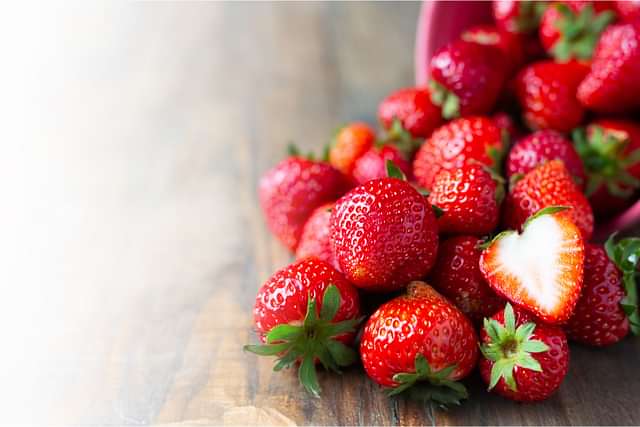
What is Strawberry?
The genus name Fragaria comes from the Latin word for strawberry, and the species name ananassa refers to the pineapple-like aroma of the ripe fruit. The cultivated garden strawberry arose about 300 years ago, when two wild American species, Fragaria virginiana and Fragaria chiloensis, hybridised (Edger et al., 2019).
As a relatively recent hybrid, the garden strawberry does not appear in the classical Ayurvedic texts, which are many centuries older. Its Ayurvedic role is therefore described only in contemporary Ayurvedic dietetic sources.
Key Facts
| Feature | Details |
| Botanical name | Fragaria × ananassa |
| Family | Rosaceae |
| Also known as | Garden strawberry |
| Origin | A hybrid of two wild American species that arose about 300 years ago (Edger et al., 2019) |
| Part eaten | The ripe fruit, which is the enlarged flower base carrying small seed-like fruits on its surface |
| Key nutrients | Vitamin C 58.8 mg, folate 24 µg, potassium 153 mg and dietary fibre 2 g per 100 g of raw strawberry (USDA, 2019) |
| Common forms | Fresh, frozen, dried, juice, smoothies and jam |
| Typical serving | Seven medium strawberries, or about 80 g, count as one fruit portion for adults (NHS, n.d.-a) |
| Best eaten | Fresh and ripe, washed under running water just before eating (FDA, n.d.) |
| Key safety note | Strawberry can cause allergic reactions. Swelling of the lips, mouth, throat or tongue, or difficulty breathing, needs emergency medical care (NHS, n.d.-c). |
Alternative Names of Strawberry
Strawberry is known by the following names.
- Botanical name: Fragaria × ananassa
- English names: Strawberry, garden strawberry
- Hindi: स्ट्रॉबेरी (Strawberry)
Chemical Constituents of Strawberry
Strawberry contains the following nutrients and plant compounds, which contribute to its colour, taste and nutritional value (Cianciosi et al., 2025).
- Anthocyanins: Red plant pigments, mainly of the pelargonidin type, which give the fruit its colour.
- Ellagic acid and ellagitannins: Phenolic compounds found in strawberry.
- Flavonols: Plant compounds such as quercetin and kaempferol derivatives.
- Vitamin C (ascorbic acid): 58.8 mg per 100 g of raw fruit (USDA, 2019).
- Folate: 24 µg per 100 g of raw fruit (USDA, 2019).
- Organic acids: Mainly citric acid and malic acid, which give the fruit its tart taste.
- Natural sugars: Mainly fructose and glucose (USDA, 2019).
Nutritional Value of Strawberry
The table below lists the nutrients in 100 g of raw strawberries (USDA, 2019).
Nutrient | Amount per 100 g |
Energy | 32 kcal |
Carbohydrate | 7.68 g |
Total sugars | 4.89 g |
Protein | 0.67 g |
Fat | 0.30 g |
Dietary fibre | 2.0 g |
Vitamin C | 58.8 mg |
Folate | 24 µg |
Potassium | 153 mg |
Calcium | 16 mg |
Iron | 0.41 mg |
Medicinal Properties of Strawberry
The following properties have been reported for strawberry compounds.
- Antioxidant: Strawberry anthocyanins, ellagic acid and vitamin C may help neutralise free radicals, which are unstable molecules that can damage body cells. This action has been shown mainly in laboratory studies.
- Anti-inflammatory: Some studies report lower markers of inflammation after strawberry intake. Human evidence is limited, and results are not consistent across trials.
Most of the evidence for these properties comes from laboratory and animal studies and small human trials, and further research is needed to confirm long-term effects (Cianciosi et al., 2025). The amount of these compounds varies with the variety, ripeness and storage of the fruit. These properties describe how plant compounds behave in the body. They do not show that strawberry can treat or prevent any disease, and strawberries should not be used in place of medical treatment.
Key Health Benefits of Strawberry
Strawberries provide dietary fibre, vitamin C and plant compounds such as anthocyanins and other polyphenols. These nutrients support normal body functions, while research has investigated the possible effects of strawberry consumption on cardiovascular health, blood glucose regulation and cognitive function. However, the strength of the evidence varies, and strawberries should be considered part of a balanced diet rather than a treatment for health conditions.
1. May Support Cardiovascular Health
Strawberries provide potassium, which contributes to the maintenance of normal blood pressure, as well as polyphenols that have been studied for their potential effects on blood vessel function and oxidative stress. Some clinical studies have reported improvements in specific cardiovascular risk markers following strawberry consumption. However, results across trials are inconsistent, and strawberries have not been established as a means of preventing heart attacks or treating high blood pressure or high cholesterol (Kido et al., 2020).
2. May Help with Blood Glucose Management
Strawberries contain dietary fibre, which supports digestion, while their carbohydrate content contributes to blood glucose levels after eating. Their relatively low glycaemic index means that they may produce a more gradual blood glucose response than some higher-glycaemic foods, although the effect depends on portion size and the composition of the meal. Strawberries can be included in a balanced eating plan for people with diabetes, but there is insufficient evidence to establish that they independently regulate blood glucose or improve insulin sensitivity.
3. May Support Weight Management
Strawberries are relatively low in energy and provide dietary fibre, which can contribute to feelings of fullness after meals. Including whole strawberries in place of higher-energy snacks may help reduce overall energy intake while adding nutrients to the diet. However, their effect on body weight depends on portion sizes, preparation methods and overall dietary habits. Dried strawberries may contain more concentrated sugars and calories per unit of weight than fresh strawberries, particularly when sugar has been added.
4. Contributes to Normal Immune Function
Strawberries provide vitamin C, which contributes to normal immune function and helps protect cells from oxidative stress. The vitamin also supports collagen formation and helps the body absorb iron from plant foods. However, although these nutrients support normal physiological processes, eating strawberries has not been established as a way to prevent colds, flu or other infections.
5. Has Been Studied for Cognitive Function
Strawberries contain anthocyanins and other polyphenols that have been investigated for their potential effects on oxidative stress and processes involved in brain function. A small randomised controlled trial in older adults reported improvements in some measures of learning and memory following daily consumption of freeze-dried strawberry powder for 90 days. However, the findings are preliminary, and further research involving larger groups and longer follow-up periods is needed to confirm these effects (Miller et al., 2021). Strawberries have not been established as a means of preventing dementia or age-related cognitive decline.
6. Contributes Folate to Everyday Dietary Intake
Folate is a B vitamin needed for cell division and red blood cell formation. Strawberries provide approximately 24 µg per 100 g. Folate from food does not replace the folic acid supplement that doctors advise before conception and in early pregnancy (USDA, 2019; NIH ODS, n.d.-a; NHS, n.d.-d).
7. Provides Water and Dietary Fibre With Low Energy Content
Raw strawberries are about 91% water and provide 2 g of dietary fibre and 32 kcal per 100 g. Fibre adds bulk to the diet and supports regular bowel movements. This is a modest amount of fibre, so strawberries should be eaten with other fibre-rich foods (USDA, 2019).
8. Contributes Potassium for Fluid Balance and Muscle Function
Potassium is a mineral that helps maintain fluid balance and supports normal nerve and muscle function. Strawberries provide 153 mg of potassium per 100 g, which is a modest contribution to daily intake. People advised to restrict potassium should ask their doctor about suitable portion sizes (USDA, 2019; NIH ODS, n.d.-c).
Disclaimer: Strawberries are a food. It is not a treatment for any disease, and it should not replace medical advice or prescribed medicines.
Common Uses of Strawberry
Strawberry is used in the following ways in cooking, food preparation and home care.
Eating Fresh as a Fruit Portion
Fresh strawberries are washed and eaten whole or sliced, alone or with breakfast cereal, oats or yoghurt. Seven medium strawberries, or about 80 g, count as one fruit portion for adults (NHS, n.d.-a).
Adding to Salads and Savoury Dishes
Sliced strawberries are added to green salads, often with spinach, nuts or soft cheese, to give a sweet and slightly tart flavour. Dressings and cheese add salt and fat to the dish.
Blending Into Smoothies and Juices
Strawberries are blended with milk, yoghurt or water to make smoothies and juices. Blending releases the sugars in the fruit, so adults are advised to limit all juices and smoothies to a combined total of 150 ml a day (NHS, n.d.-b).
Preparing Desserts, Jams and Preserves
Strawberries are cooked with sugar to make jams and jellies, or used in cakes and ice cream. These products usually contain added sugar, so they are best eaten occasionally and in small amounts.
Using Dried or Frozen Strawberries
Dried and frozen strawberries are used when fresh fruit is out of season. A portion of dried fruit is about 30 g and is best eaten at mealtimes because it can stick to the teeth (NHS, n.d.-b).
Applying to Skin in Homemade Preparations
Strawberry pulp is sometimes used in homemade face masks. These preparations are not established medical treatments for skin conditions and can cause irritation or allergic reactions. Avoid applying strawberry pulp to the skin if you have a known strawberry allergy or experience irritation.
Precautions While Taking Strawberry
Most people can eat strawberries safely, but the following precautions apply.
- Food allergy: Strawberry can cause an allergic reaction in some people. Symptoms include itching, hives, swelling and, in severe cases, difficulty breathing. People with a known strawberry allergy should avoid it (NHS, n.d.-c).
- Emergency symptoms: Sudden swelling of the lips, mouth, throat or tongue, or difficulty breathing, requires emergency medical care. Call the emergency number (112 in India) immediately (NHS, n.d.-c).
- Oral allergy symptoms: Some people with a pollen allergy develop an itchy mouth or throat after eating raw fruit, and strawberries may be one trigger. This is called oral allergy syndrome. A doctor can advise on testing and management (NHS, n.d.-c).
- Washing: Wash strawberries thoroughly under running water before eating to remove dirt and bacteria. Do not use soap, detergent or commercial produce wash (FDA, n.d.).
- Diabetes: Raw strawberries contain natural sugars, about 4.89 g per 100 g (USDA, 2019). People with diabetes should follow their doctor's or dietitian's advice on fruit portions and should not change or stop medicines because of dietary changes.
- Kidney disease: Strawberries contain potassium, 153 mg per 100 g (USDA, 2019). People who have been advised to restrict potassium should ask their doctor or dietitian about suitable portions.
- Young children: Cut strawberries into small pieces or mash them for babies and young children to reduce the risk of choking.
This information is general. Consult a doctor before making major changes to your diet if you have a medical condition or take regular medicines.
How to Use Strawberry
Strawberry can be eaten in several forms. The steps below apply to each form.
Eating Fresh Strawberries
- Choose firm, bright red berries and discard any that are soft, mouldy or damaged.
- Rinse the berries under running water just before eating (FDA, n.d.).
- Remove the green top and eat the berries whole or sliced.
Preparing Frozen Strawberries
- Check the pack for added sugar.
- Use the berries straight from the freezer in smoothies, or thaw them in the refrigerator for desserts and breakfast dishes.
- Do not refreeze berries that have fully thawed unless the packaging instructions or safe food-handling guidance indicate that it is safe to do so.
Choosing Dried Strawberries
- Read the label and choose products without added sugar where possible.
- Eat about 30 g, which counts as one fruit portion.
- Eat dried fruit at mealtimes and not as a snack between meals, because it can stick to teeth (NHS, n.d.-b).
Making Strawberry Juice or Smoothies
- Wash and hull the strawberries.
- Blend them with water, milk or yoghurt, without adding sugar.
- Drink a small glass of up to 150 ml, preferably with a meal. This is the daily limit for all juices and smoothies combined (NHS, n.d.-b).
Recommended Dosage of Strawberry
No official daily dose has been set for strawberry. The guidance below follows national fruit and vegetable recommendations, in which one portion is the amount for one serving.
Children
The portion depends on the child's age and size and is smaller than the adult portion (NHS, n.d.-e). Offer a few strawberries, cut into small pieces for young children. Ask a paediatrician for advice if the child has a food allergy.
Teenagers
Portion size depends on age and body size. Older teenagers may eat an adult portion of about 80 g, or seven medium strawberries (NHS, n.d.-a).
Adults
One portion is about 80 g, or seven medium strawberries, as part of five portions of fruit and vegetables each day. A portion of dried strawberries is about 30 g. All juices and smoothies together should not exceed 150 ml a day (NHS, n.d.-a; NHS, n.d.-b). Eating a variety of fruits and vegetables as part of daily meals is advised (ICMR-NIN, 2024).
Older Adults
The adult portion is generally suitable. Soft, sliced or mashed strawberries may be easier for people who have difficulty chewing or swallowing. People with diabetes or kidney disease, and those taking regular medicines, should follow their doctor's advice on fruit intake.
Medicinal Note: This guidance is general and is not a prescription. Consult a doctor or dietitian for advice that suits your health condition.
Side Effects of Strawberry
Strawberry is generally well tolerated by most people. The following side effects may occur in some people.
Allergic Reactions
Itching, hives, swelling of the face or lips and difficulty breathing may occur in people who are allergic to strawberries. Severe symptoms need emergency medical care (NHS, n.d.-c).
Itching or Tingling in the Mouth
Raw strawberries may cause an itchy mouth or throat in people with oral allergy syndrome. A doctor can advise on testing and management (NHS, n.d.-c).
Digestive Discomfort
Eating large amounts may cause stomach discomfort, wind or loose stools in some people, potentially due to the fibre and naturally occurring sugars and acids. Reducing the portion size may help relieve these symptoms.
Skin Reactions From Topical Use
Applying strawberry to the skin may cause redness, itching or a rash, particularly in people who are allergic to the fruit. Stop use and wash the area if irritation occurs.
Interaction of Strawberry With Other Drugs
No clinically significant interaction between usual dietary amounts of strawberries and medicines has been established in the sources reviewed. The points below are precautions and not proven interactions.
Medicines for Diabetes
Strawberries contain natural sugars, and juices or smoothies release these sugars. People who take insulin or tablets for diabetes should keep fruit intake consistent and follow their doctor's advice (USDA, 2019).
Blood-Thinning Medicines
Strawberries contain only a small amount of vitamin K, 2.2 µg per 100 g (USDA, 2019). People who take warfarin should keep their diet consistent and tell their doctor about major changes in fruit or vegetable intake.
Medicines That Affect Potassium
Some medicines, such as ACE inhibitors and potassium-sparing diuretics, can raise blood potassium. Strawberries contain 153 mg of potassium per 100 g (USDA, 2019). People who need to monitor their blood potassium levels should ask their doctor about suitable portions.
Note: Tell your doctor or pharmacist about any food or supplement you use regularly. This information is general and does not replace medical advice.
Storage of Strawberry
Correct storage helps keep strawberries safe to eat.
- Fresh strawberries: Keep them in the refrigerator, and wash them under running water just before eating (FDA, n.d.).
- Cut strawberries: Store them in a covered container in the refrigerator and eat them promptly (FDA, n.d.).
- Spoiled berries: Throw away strawberries that look rotten, and cut away damaged or bruised areas before eating the remaining fruit, provided it is otherwise sound (FDA, n.d.).
- Frozen strawberries: Keep them frozen until use, and follow the storage instructions on the pack.
- Dried strawberries: Keep them in a sealed container in a cool, dry place, and follow the storage instructions on the label.
Key Takeaways
- Strawberry is a low-energy fruit that provides vitamin C, folate, potassium and a small amount of dietary fibre (USDA, 2019).
- Its plant compounds, such as anthocyanins, have shown antioxidant activity in studies, but evidence of long-term health effects in people is limited (Cianciosi et al., 2025).
- About seven medium strawberries, or 80 g, count as one fruit portion for adults (NHS, n.d.-a).
- Strawberry can cause allergic reactions. Swelling of the lips, mouth, throat or tongue, or difficulty breathing, needs emergency medical care (NHS, n.d.-c).
- Wash strawberries under running water before eating, and limit all juices and smoothies to 150 ml a day in total (FDA, n.d.; NHS, n.d.-b).
- Strawberry is a food and not a medicine. People with diabetes, kidney disease or a strawberry allergy, and those who take regular medicines, should ask a doctor or dietitian about suitable portions.
FAQs
What are the benefits of strawberry in pregnancy?
What are the benefits of dried strawberries?
What are the benefits of strawberries for females?
What are the benefits of strawberries for hair?
How many Strawberries should you eat?
How do you get seeds from fresh Strawberries?
Do strawberries need full sun to grow?
How often do strawberry plants need to be watered?
Can we apply strawberries to our face?
How many calories does a Strawberry have?
How can I make a Strawberry face mask at home?
Are Strawberries safe for diabetes?
Can strawberries cause an allergic reaction?
Do strawberries help the body absorb iron?
References
- Cianciosi, D., Armas Diaz, Y., Qi, Z., Yang, B., Chen, G., Cassotta, M., Gracia Villar, S., Dzul Lopez, L. A., Rivas Garcia, L., Forbes Hernandez, T. Y., Zhang, D., Mazzoni, L., Mezzetti, B., Battino, M., & Giampieri, F. (2025). Strawberry as a health promoter: An evidence-based review. Where are we 10 years later? Food & Function, 16(14), 5705–5732. https://doi.org/10.1039/D5FO01888A
- Edger, P. P., Poorten, T. J., VanBuren, R., Hardigan, M. A., Colle, M., McKain, M. R., Smith, R. D., Teresi, S. J., Nelson, A. D. L., Wai, C. M., Alger, E. I., Bird, K. A., Yocca, A. E., Pumplin, N., Ou, S., Ben-Zvi, G., Brodt, A., Baruch, K., Swale, T., ... Knapp, S. J. (2019). Origin and evolution of the octoploid strawberry genome. Nature Genetics, 51(3), 541–547. https://doi.org/10.1038/s41588-019-0356-4
- Indian Council of Medical Research–National Institute of Nutrition. (2024). Dietary guidelines for Indians. https://www.nin.res.in/dietaryguidelines/pdfjs/locale/DGI24thJune2024fin.pdf
- National Health Service. (n.d.-a). 5 A DAY. NHS Healthier Families. https://www.nhs.uk/healthier-families/food-facts/5-a-day/
- National Health Service. (n.d.-b). 5 A DAY portion sizes. https://www.nhs.uk/live-well/eat-well/5-a-day/portion-sizes/
- National Health Service. (n.d.-c). 5 A DAY: What counts? https://www.nhs.uk/live-well/eat-well/5-a-day/5-a-day-what-counts/
- National Health Service. (n.d.-d). Food allergy. https://www.nhs.uk/conditions/food-allergy/
- National Health Service. (n.d.-e). Vitamins, supplements and nutrition in pregnancy. https://www.nhs.uk/pregnancy/keeping-well/vitamins-supplements-and-nutrition/
- National Institutes of Health, Office of Dietary Supplements. (n.d.-a). Folate: Fact sheet for health professionals. https://ods.od.nih.gov/factsheets/Folate-HealthProfessional/
- National Institutes of Health, Office of Dietary Supplements. (n.d.-b). Potassium: Fact sheet for health professionals. https://ods.od.nih.gov/factsheets/Potassium-HealthProfessional/
- National Institutes of Health, Office of Dietary Supplements. (n.d.-c). Vitamin C: Fact sheet for health professionals. https://ods.od.nih.gov/factsheets/VitaminC-HealthProfessional/
- U.S. Department of Agriculture, Agricultural Research Service. (2019). Strawberries, raw (FDC ID 167762) [Data set]. FoodData Central. https://fdc.nal.usda.gov/food-details/167762/nutrients
- U.S. Food and Drug Administration. (n.d.). Selecting and serving produce safely. https://www.fda.gov/food/buy-store-serve-safe-food/selecting-and-serving-produce-safely



Explore other categories
Latest health articles




Top Health Essentials



Top-selling ayurvedic products

















Disclaimer
Top-Selling Medicines:
...View more
Top-OTC medicines:
...View more
Top-selling healthcare devices:
...View more
Company
About UsHealth ArticleHealth StoriesHealth LibraryDiseases & Health ConditionsAyurvedaUnderstanding Generic MedicinesAll MedicinesAll BrandsNeed HelpFAQSecuritySavings CalculatorAdvertise with UsSubscribe
Registered Office Address
Grievance Officer
Download Truemeds


Contact Us
Our customer representative team is available 7 days a week from 9 am - 9 pm.
v4.28.24

2026 - Truemeds | All rights reserved. Our content is for informational purposes only. See additional information.

Our Payment Partners




