

- Medicines
- Personal Care
- Skin Cream
- Sunscreen
- Face Wash
- Skin and Body Soap
- Acne Care
- Body Lotions
- Moisturising Lotion
- Moisturising Cream
- Mosquito Repellent
- Moisturising Gel
- Body Wash
- Hair Oils
- Hair Shampoo
- Hair Conditioners
- Hair Supplements
- Hair Colour
- Hair Serum
- Hair Mask
- Hair Solutions
- Baby Diapers and Wipes
- Baby Lotion and Moisturising Cream
- Baby Bath Essentials
- Baby Skin Care
- Baby and Infant Food
- Baby Healthcare
- Women Multivitamins
- Ovulation Test Kit and Women Intimate Care
- Sanitary Pads
- Nutritional Drinks
- Condoms
- Lubricants
- Massage Gels
- Personal Body Massagers
- Men Performance Booster
- Sexual Health Supplements
- Massage Oils
- Ayurveda
- Tooth Paste
- Mouth Ulcer Gel
- Mouthwash
- Toothache and Gum Pain
- Tooth Brush
- Gargle Solution
- Orthopaedic Supports
- Adult Diapers
- Footwear
- Mobility and Support Accessories
- Urinary Support and Care
- Health Conditions
- Bone and Joint Care
- Digestive Care
- Eye Care
- Pain Relief
- Smoking Cessation
- Liver Care
- Stomach Care
- Cold and Cough
- Heart Care
- Kidney Care
- Piles, Fissures & Fistula
- Respiratory Care
- Mental Wellness
- Derma Care
- Pre and Probiotics
- Acidity
- Gas
- Constipation
- Loose Motion/Diarrhoea
- Digestive Fibres
- Digestive Enzymes
- Eye Lubricant Drops
- Lens Solution
- Safety Eye Wear
- Eye Cream
- Eye Vitamins and Supplements
- Eye Drops
- Eye Ointment and Gel
- Nicotine Patch
- Nicotine Gum
- Nicotine Lozenges
- Cough Syrups
- Chest Rubs and Balms
- Nasal Spray
- Lozenges
- Inhalant Capsules
- Cold and Cough Tablets
- Vitamins & Supplements
- Diabetes Care
- Healthcare Devices
- Homeopathic Medicine
- Health Guide
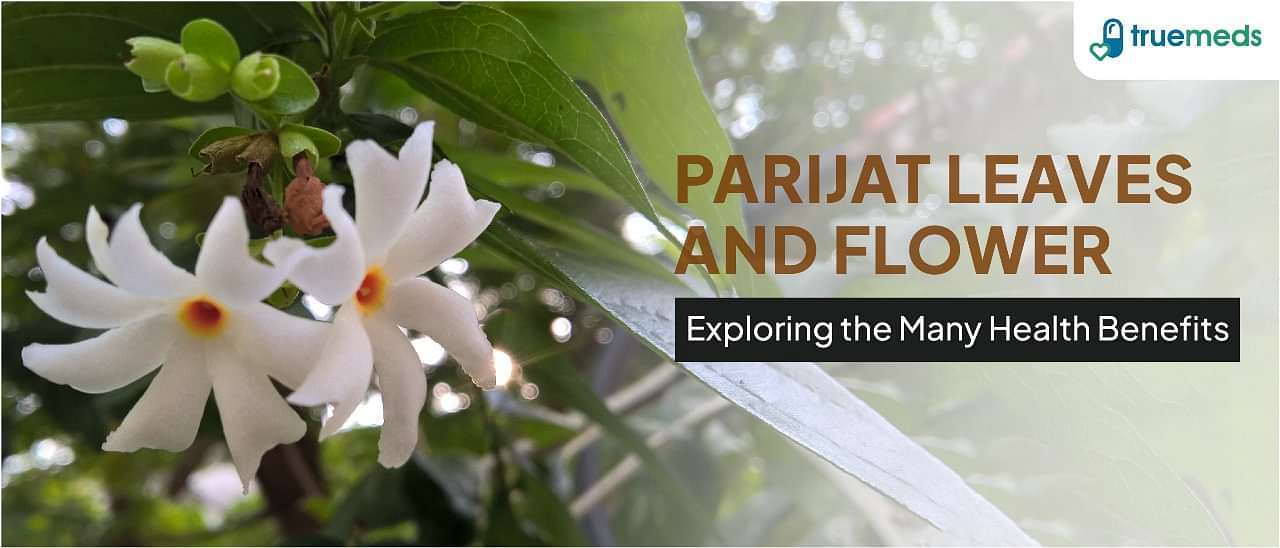
Exploring the Health Benefits of Parijat Leaves
Last updated on : 30 Nov, 2025
Read time : 6 min
The parijat plant, commonly referred to as Night Jasmine (scientifically Nyctanthes arbor-tristis), is more than just a small shrub with fragrant, nocturnal blooms. It’s a treasury of medicinal properties revered in traditional Ayurvedic medicine. This remarkable plant serves as a therapeutic treasure trove, with its leaves, flowers, stems, and roots each playing a vital role in natural healthcare practices, particularly in India. Parijat is traditionally known in Ayurveda for its Katutikta Rasa (pungent-bitter taste) and Ushna Virya (heating potency) and is often used to balance Vata and Kapha doshas.
Health Benefits of Parijat Leaves
The parijat plant (Nyctanthes arbor-tristis) is a well-regarded herb in Ayurveda known for its potential health benefits. Its various parts are used in traditional healing practices. Here are some of the traditional benefits of the parijat plant:
1. Fever Management
The parijat plant is traditionally recognized for its Jwarahara (antipyretic) properties, making it a supportive herb in the management of fevers [1]. This includes its traditional use in conditions like Malaria, Dengue, and Chikungunya. Extracts from the leaves and bark are believed to help manage fever symptoms. Clinical exploratory studies have suggested that Nyctanthes arbor-tristis may possess antiparasitic and disease-modifying activity in malaria, which warrants further investigation [2]. A common method of use is boiling the parijat leaves to create a decoction for managing fever symptoms. It is essential to consult a healthcare professional for diagnosis and appropriate treatment of fever.
2. Traditional Use in Joint Discomfort and Sciatica
Parijat leaves are traditionally believed to have anti-inflammatory potential (Shothahara) and are often used in traditional practice to support joint health and ease discomfort [3]. It is commonly thought to be a supportive natural remedy for discomfort associated with conditions like Osteoarthritis and Sciatica. Ayurvedic practitioners may recommend a decoction of the leaves or a topical application of an oil-based mixture to promote comfort in affected areas. A study on rats demonstrated that an ethanolic extract of the leaves exhibited significant anti-inflammatory activity, supporting its traditional use [3].
3. Respiratory Support for Dry Cough
Parijat leaves may offer supportive relief for dry cough and respiratory issues due to their traditional use as a bronchodilator [1]. Brewing them into a tea with ginger may help soothe throat irritation and reduce coughing. This traditional preparation is used to help ease breathing difficulties associated with cough, cold, and mild bronchitis. It is important to consult with a healthcare professional to ensure the suitability of this remedy for your specific condition.
4. Anti-allergic, Antiviral, and Antibacterial Properties
The parijat plant is traditionally recognized for its broad-spectrum protective potential. Extracts from the plant can traditionally inhibit the growth of various harmful pathogens. This is supported by research indicating the presence of phytochemicals that demonstrate in vitro anti-allergic, antiviral, and antibacterial activities [1]. While Parijat leaves are often included in traditional health formulations, it’s important to consult a healthcare professional before using them for any specific infection.
5. Immunity Support
The Parijat plant is traditionally believed to possess immunostimulatory properties, which may support the body’s natural defense mechanisms (Vyadhikshamatva) [1]. A decoction made by boiling ground Parijat leaves in water is commonly used in traditional practices to help enhance general resistance to infections and support overall well-being.
6. Blood Sugar Management Support
In Ayurveda, Parijat is used to help balance Kapha dosha and manage Ama (toxic buildup), which is often implicated in metabolic disorders like Prameha (Ayurvedic term for diabetes). Its bitter (tikta) properties are traditionally linked to improving metabolic function. Research on the flower extract in male mice has shown potential hypoglycemic and hypolipidemic activities [4]. However, it is crucial to understand that Parijat is used as an adjunct and should not replace prescribed medication for managing diabetes. Blood sugar levels must be monitored closely, and use should be done in consultation with a physician.
7. Hair and Scalp Nourishment
A decoction made from parijat seeds is traditionally used to support the management of dandruff and head lice. Moreover, a hair tonic derived from Parijat leaves is traditionally believed to help reduce hair fall, strengthen the hair roots, and may help slow down premature greying. Regular use of parijat may lend nourishment to your hair and promote a healthy scalp environment.
8. Traditional Support in Malaria Recovery
While standard antimalarial treatment is essential for a malarial infection, some traditional and exploratory studies suggest that extracts from Parijat leaves may play a supportive role in managing the fever and other symptoms associated with malarial parasites [2]. The plant’s known chemical constituents may help modulate the parasitic load in its early stages. It’s crucial to emphasize that patients must consult a healthcare provider for appropriate diagnostics and evidence-based treatment of Malaria.
Conclusion
Parijat, scientifically known as Nyctanthes arbor-tristis, is a potent medicinal plant offering a range of traditional health benefits. It is traditionally used in managing conditions such as fevers, joint discomfort, and respiratory issues, highlighting its significant role in natural healing practices [1]. Through its various forms, including decoction, powder, and juice, one can traditionally incorporate parijat into their health regime. However, it is vital to approach herbal remedies with caution and respect for potential interactions. Always consult your doctor or a certified Ayurvedic practitioner if you are on prescription medication, managing chronic health conditions, or pregnant/breastfeeding, to confidently and safely tap into the traditional supportive power of Parijat.
Frequently Asked Questions (FAQs)
What is the significance of the Parijat flower?
The parijat flower is valued for its medicinal properties, including traditional use for its mild laxative and bitterness for digestive support. Phytochemical research suggests it contains compounds with anti-inflammatory, antibacterial, and antioxidant effects [1].
How to use Parijat leaves for joint pain?
To traditionally use parijat leaves for joint discomfort, a common method is to boil approximately 5-7 fresh, clean leaves in two cups of water until the quantity reduces to about one cup, creating a decoction (Kwath). Drinking this may help with its believed anti-inflammatory properties and alleviate joint discomfort.
What is the nutrition of Parijat?
Parijat is recognized for being rich in phytochemicals, including Nyctanthin, D-mannitol, tannins, and essential oils [1]. It contains antioxidant compounds and trace amounts of minerals and vitamins, contributing to its medicinal properties. The focus in Ayurveda is on its therapeutic compounds rather than traditional nutritional macros.
Can we drink a decoction of Parijat leaves?
Yes, a decoction (Kwath) of parijat leaves is a traditional preparation widely consumed in Ayurveda. This decoction is commonly used to help with various issues such as fevers and coughs, as advised by a practitioner.
References
[1] Pandel, T., Gurunani, S., & Kaikade, A. (2023). Comprehensive review on Parijat (Nyctanthes arbor-tristis). International Journal of Pharmaceutical Research and Applications, 8(3), 1215–1224. https://doi.org/10.35629/7781-080312151224
[2] Godse, C. S., Tathed, P. S., Talwalkar, S. S., Vaidya, R. A., Amonkar, A. J., Vaidya, A. B., & Vaidya, A. D. B. (2016). Antiparasitic and disease-modifying activity of Nyctanthes arbor-tristis Linn. in malaria: An exploratory clinical study. Journal of Ayurveda and Integrative Medicine, 7(4), 238–248. https://doi.org/10.1016/j.jaim.2016.08.003
[3] Saxena, R. S., Gupta, B., Saxena, K. K., Singh, R. C., & Prasad, D. M. (1984). Study of anti-inflammatory activity in the leaves of Nyctanthes arbor tristis Linn.—an Indian medicinal plant. Journal of Ethnopharmacology, 11(3), 319–330. https://doi.org/10.1016/0378-8741(84)90077-1
[4] Rangika, B. S., Dayananda, P. D., & Peiris, D. C. (2015). Hypoglycemic and hypolipidemic activities of aqueous extract of flowers from Nycantus arbor-tristis L. in male mice. BMC Complementary and Alternative Medicine, 15(1), Article 271. https://doi.org/10.1186/s12906-015-0807-0













Disclaimer
Our healthcare experts have carefully reviewed and compiled the information presented here to ensure accuracy and trustworthiness. It is important to note that this information serves as a general overview of the topic and is for informational purposes only. It is not intended to diagnose, prevent, or cure any health problem. This page does not establish a doctor-patient relationship, nor does it replace the advice or consultation of a registered medical practitioner. We recommend seeking guidance from your registered medical practitioner for any questions or concerns regarding your medical condition.
Recent Articles






Company
About UsHealth ArticleHealth StoriesHealth LibraryDiseases & Health ConditionsAyurvedaUnderstanding Generic MedicinesAll MedicinesAll BrandsNeed HelpFAQSecuritySavings CalculatorSubscribe
Registered Office Address
Grievance Officer
Download Truemeds


Contact Us
Our customer representative team is available 7 days a week from 9 am - 9 pm.
v4.15.1

2026 - Truemeds | All rights reserved. Our content is for informational purposes only. See additional information.

Our Payment Partners




