

- Medicines
- Personal Care
- Skin Cream
- Sunscreen
- Face Wash
- Skin and Body Soap
- Acne Care
- Body Lotions
- Moisturising Lotion
- Moisturising Cream
- Mosquito Repellent
- Moisturising Gel
- Body Wash
- Hair Oils
- Hair Shampoo
- Hair Conditioners
- Hair Supplements
- Hair Colour
- Hair Serum
- Hair Mask
- Hair Solutions
- Baby Diapers and Wipes
- Baby Lotion and Moisturising Cream
- Baby Bath Essentials
- Baby Skin Care
- Baby and Infant Food
- Baby Healthcare
- Women Multivitamins
- Ovulation Test Kit and Women Intimate Care
- Sanitary Pads
- Nutritional Drinks
- Condoms
- Lubricants
- Massage Gels
- Personal Body Massagers
- Men Performance Booster
- Sexual Health Supplements
- Massage Oils
- Ayurveda
- Tooth Paste
- Mouth Ulcer Gel
- Mouthwash
- Toothache and Gum Pain
- Tooth Brush
- Gargle Solution
- Orthopaedic Supports
- Adult Diapers
- Footwear
- Mobility and Support Accessories
- Urinary Support and Care
- Health Conditions
- Bone and Joint Care
- Digestive Care
- Eye Care
- Pain Relief
- Smoking Cessation
- Liver Care
- Stomach Care
- Cold and Cough
- Heart Care
- Kidney Care
- Piles, Fissures & Fistula
- Respiratory Care
- Mental Wellness
- Derma Care
- Pre and Probiotics
- Acidity
- Gas
- Constipation
- Loose Motion/Diarrhoea
- Digestive Fibres
- Digestive Enzymes
- Eye Lubricant Drops
- Lens Solution
- Safety Eye Wear
- Eye Cream
- Eye Vitamins and Supplements
- Eye Drops
- Eye Ointment and Gel
- Nicotine Patch
- Nicotine Gum
- Nicotine Lozenges
- Cough Syrups
- Chest Rubs and Balms
- Nasal Spray
- Lozenges
- Inhalant Capsules
- Cold and Cough Tablets
- Vitamins & Supplements
- Diabetes Care
- Healthcare Devices
- Homeopathic Medicine
- Health Guide
Dashmularishta
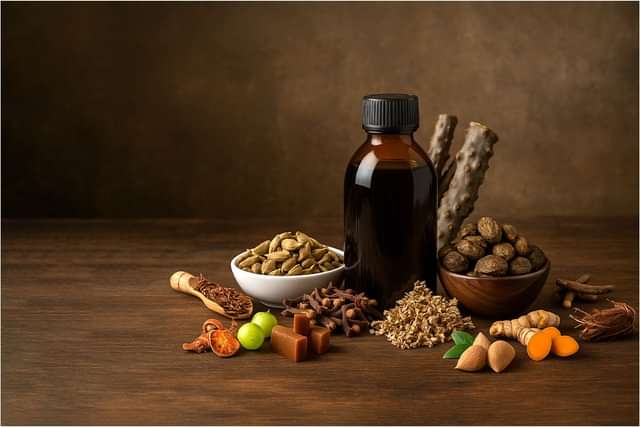
Dashmularishta is a classical Ayurvedic fermented liquid preparation, known as an arishta, made from Dashamoola, a group of ten medicinal roots, along with supporting herbs, jaggery and honey. It is traditionally used in Ayurveda to support recovery after childbirth, for Vata-related joint pain and body aches, to support digestion and appetite, and to help restore strength after illness or prolonged weakness.
 50
50Last updated on : 08 Sep, 2026
Read time : 22 mins
What is Dashmularishta?
"Dashamoola" means ten roots and "arishta" means a fermented preparation made from a herbal decoction. Put together, the name describes a fermented decoction built on the ten-root group. Those ten are divided into Brihat Panchamoola, the roots of five larger trees, being Bilva, Agnimantha, Shyonaka, Patala and Gambhari, and Laghu Panchamoola, the roots of five smaller plants, being Shalaparni, Prishniparni, Brihati, Kantakari and Gokshura.
The formulation is described in the Sharangadhara Samhita, in the chapter dealing with asavas and arishtas, and again in the Bhaishajya Ratnavali. Indian manufacturers prepare it to the standard laid down in the Ayurvedic Formulary of India. The decoction is fermented in a sealed vessel with jaggery, honey and Dhataki flowers over several weeks, which produces a small amount of alcohol naturally. That alcohol contributes to preservation and may help extract and carry compounds that are less soluble in water. Ayurvedic classification of Dashmularishta:
- Rasa (taste): madhura (sweet), tikta (bitter), kashaya (astringent) and katu (pungent)
- Guna (quality): laghu (light), ushna (hot) and teekshna (piercing)
- Virya (potency): ushna, meaning hot in action
- Vipaka (taste after digestion): katu, meaning pungent
- Dosha action: chiefly Vata-shamaka, meaning it is traditionally considered to balance Vata; it is also traditionally considered Kapha-reducing and may aggravate Pitta because of its Ushna Virya
- Varga (classical group): Sandhana Kalpana, the group of fermented preparations, listed under Asava-Arishta
Key Facts
| Feature | Details |
| Formulation name | Dashmularishta (Dashamoolarishta)
|
| Formulation type | Classical Ayurvedic arishta, a fermented liquid preparation |
| Classical reference | Sharangadhara Samhita, Madhyama Khanda, chapter on asavas and arishtas; also Bhaishajya Ratnavali.
|
| Composition | Dashamoola (ten roots): Bilva, Agnimantha, Shyonaka, Patala, Gambhari, Shalaparni, Prishniparni, Brihati, Kantakari and Gokshura, together with supporting herbs such as Guduchi, Haritaki, Bibhitaka, Amalaki, Chitraka, Lodhra, Shatavari, Ashwagandha, Manjishtha and Jatamansi |
| Classical proportion | The ten roots are taken in equal parts to make the decoction base. Jaggery (guda), honey (madhu), and Dhataki flowers are traditionally used to facilitate fermentation of the sweetened herbal decoction
|
| Also known as | Dashamoolarishta, Dasamoolarishtam, Dashmoolarishta, Dashamula Arishta
|
| Key active compounds | Various phytochemicals have been identified in the individual ingredients, including aegeline and lupeol from Bilva; baicalein, chrysin, oroxylin A and ellagic acid from Shyonaka; gangetin and gangetinin from Shalaparni; solasodine from Brihati and Kantakari; steroidal saponins including protodioscin from Gokshura; and compounds such as gallic acid, shikimic acid, epicatechin and naringenin in combined root extracts. Fermentation also produces ethanol.
|
| Dosha action | Chiefly Vata-shamaka. Traditionally considered to reduce Kapha and may increase Pitta because of its hot potency
|
| Traditional uses | Recovery after childbirth, Vata-related joint and body pain, poor appetite and sluggish digestion, weakness following illness, and long-standing cough with chest heaviness
|
| Common forms | Usually available as a liquid arishta preparation.
|
| General dosage | 12 to 24 ml for adults, mixed with an equal quantity of water, twice daily after food, or as directed by a qualified Ayurvedic practitioner
|
| Best taken | After meals, diluted with an equal quantity of water |
| Key safety note | Contains self-generated alcohol and sugar from jaggery and honey. It may not be suitable during pregnancy, for people with poorly controlled diabetes, liver disease or alcohol dependence, or for those taking metronidazole, tinidazole or disulfiram. |
Alternative Names of Dashmularishta
Dashmularishta is a Sanskrit name that is transliterated rather than translated, so the variations below are spelling variants of the same formulation, rather than different regional medicines.
- Sanskrit / Devanagari: दशमूलारिष्ट (Dashamoolarishta)
- Common Indian spellings: Dashmularishta, Dashamularishta, Dashmoolarishta, Dashamoolarishta
- Southern India, Malayalam and Tamil usage: Dasamoolarishtam, Dasamoolarishtham
- Compound form of the name: Dashamula Arishta, written as two words
Composition of Dashmularishta
The formulation is built in three layers: the ten-root decoction, the supporting herbs added to it, and the fermentation base.
| Layer | What it contains |
| Brihat Panchamoola (five greater roots) | Bilva (Aegle marmelos), Agnimantha (Premna integrifolia), Shyonaka (Oroxylum indicum), Patala (Stereospermum suaveolens) and Gambhari (Gmelina arborea) |
| Laghu Panchamoola (five lesser roots) | Shalaparni (Desmodium gangeticum), Prishniparni (Uraria picta), Brihati (Solanum indicum), Kantakari (Solanum xanthocarpum) and Gokshura (Tribulus terrestris) |
| Supporting herbs | Around 40 to 50 additional herbs, including Guduchi (Tinospora cordifolia), Haritaki (Terminalia chebula), Bibhitaka (Terminalia bellirica), Amalaki (Emblica officinalis), Chitraka (Plumbago zeylanica), Pippali (Piper longum), Lodhra (Symplocos racemosa), Shatavari (Asparagus racemosus), Ashwagandha (Withania somnifera), Manjishtha (Rubia cordifolia) and Jatamansi (Nardostachys jatamansi) |
| Fermentation base | Jaggery (guda), honey (madhu) and the flowers of Dhataki (Woodfordia fruticosa), which are traditionally used to support fermentation |
Chemical Constituents of Dashmularishta
The compounds below have been identified in the roots that make up Dashamoola and in extracts of the combined preparation.
- Aegeline and lupeol from Bilva root, which have been studied for their antioxidant and anti-inflammatory activity in preclinical research
- Baicalein, chrysin, oroxylin A and ellagic acid from Shyonaka root bark, a group of flavonoid compounds
- Gangetin, gangetinin and desmodin from Shalaparni, which belong to a class of compounds called pterocarpans
- Solasodine and related steroidal alkaloids from Brihati and Kantakari
- Steroidal saponins, including protodioscin, from Gokshura
- Iridoid glycosides from Agnimantha and Patala
- Gallic acid, shikimic acid, epicatechin and naringenin, identified by mass spectrometry in extracts of the combined ten-root preparation (Abraham et al., 2020)
- Tannins, phenols and carbohydrates, identified in various members of the root group through phytochemical screening
- Ethanol, generated naturally during fermentation, alongside sugars derived from jaggery and honey
Medicinal Properties of Dashmularishta
Ayurvedic and laboratory literature describes Dashmularishta as having the following traditional and studied actions on the body.
- Anti-inflammatory: may help modulate inflammatory processes, based mainly on laboratory and preclinical studies
- Analgesic: has been associated with reduced pain responses in preclinical studies
- Antispasmodic: is traditionally believed to help relax muscle spasms and cramping
- Carminative: may help relieve trapped wind and bloating
- Digestive stimulant (deepana): is traditionally believed to support appetite and digestion
- Antioxidant: has shown antioxidant activity in laboratory studies
- Antimicrobial: laboratory studies suggest activity against some bacteria
- Antiplatelet: laboratory studies suggest reduced platelet aggregation, which may be relevant if you take blood-thinning medicines
- Rasayana (rejuvenative): traditionally believed to support strength and recovery after prolonged illness
Most of this evidence comes from laboratory and animal studies on Dashamoola rather than from large human trials of the finished formulation, so the actions listed here should be understood as potential mechanisms or traditional uses rather than proven treatment effects in humans.
Health Benefits of Dashmularishta
Dashmularishta uses and health benefits range from supporting digestive health to aiding recovery after childbirth. Some of the critical health benefits of the herbal remedy are as follows:
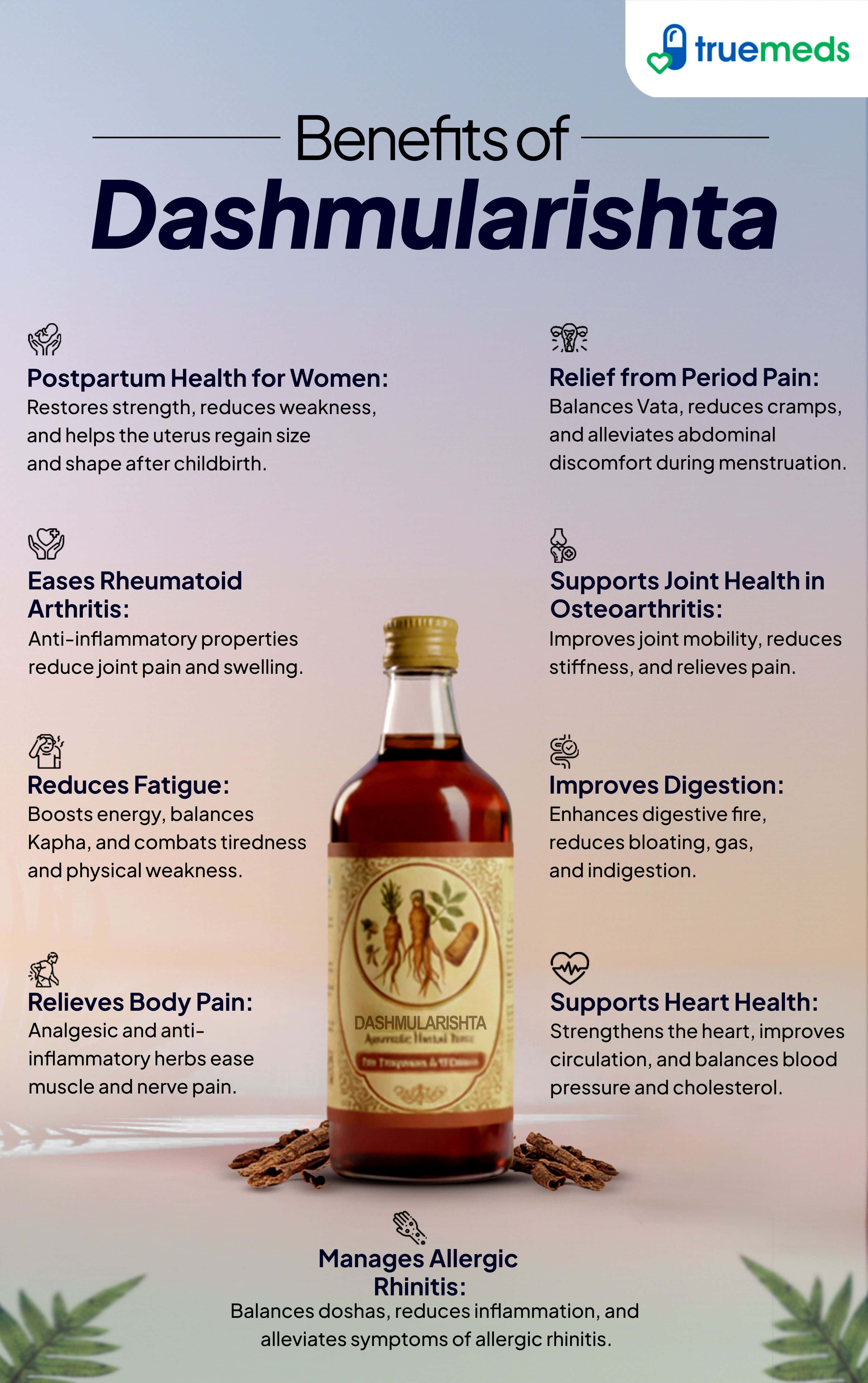
1. Re-establishing Normal Health in Women After Childbirth
Dashmularishta is a traditional Ayurvedic remedy, commonly used in postnatal care to support women’s recovery after childbirth. It helps rejuvenate the reproductive system, strengthen uterine muscles, and promote milk flow in lactating mothers. The anti-inflammatory and strengthening properties aid in preventing postnatal complications such as weakness, digestive issues, and fatigue.
By balancing Vata dosha, which is often aggravated after delivery, Dashmularishta reduces body aches, alleviates fatigue, and restores energy levels. Its Vata-balancing and strength-providing properties make it ideal for post-partum recovery, addressing common symptoms like fatigue, insomnia, loss of appetite, and irritability.
Tip:
- Take 15ml to 20ml Dashmularishta or as directed by the physician
- Mix with lukewarm water
- Consume after meals, once or twice a day
2. Relief from Period Pain
By balancing the Vata and Pitta doshas, Dashmularishta may help reduce menstrual cramps (dysmenorrhea) and promote regular menstrual flow.The herbs in this formulation improve uterine circulation and support healthy hormonal balance, helping manage PMS-related discomfort and irritability.
3. Eases Rheumatoid Arthritis
Dashmularishta is an adjunct herbal remedy used in the management of inflammatory conditions like Rheumatoid Arthritis (Amavata). The herbs help reduce the accumulation of 'Ama' (toxins) and may decrease joint stiffness and swelling. It should be noted that Dashmularishta is a supportive therapy and not a standalone cure for autoimmune conditions.
4. Supports Joint Health in Osteoarthritis
Dashmularishta helps relieve pain in patients suffering from osteoarthritis and creates muscular bone strength with minimal cartilage degeneration, thus providing lasting long-term pain relief from stiffness.
5. Reduces Fatigue
Since Dashmularishta is viewed as a tonic that acts by rejuvenation, it is a good medicine for chronic fatigue and the activation of energy status. The herbs in the tonic fight against physical exhaustion by improving the circulation mechanism with support to the body's immune response.
6. Improves Digestion
Dashmularishta is generally recommended for indigestion and other gastric conditions. The medication tends to soften the bowels, relieve digestive issues, and help prevent bloating and constipation. It aids in the fermentation of all ingredients that boost gut health and favor the growth of good bacteria.
7. Relieves Body Pain
Dashmularishta contains analgesic properties that may interfere with the pain receptors and can help prevent pain and other aches, such as headaches, body aches, and muscle soreness. The constituents of Dashmularishta reduce Vata-induced pain, which mainly involves sharp and throbbing pain.
8. Support Heart Health
The presence of herbs with antioxidant and cardio-protective properties helps support healthy blood circulation and balance blood pressure levels. It may also aid in reducing stress-induced cardiovascular strain, promoting relaxation and balanced heart function.
9. Allergic Rhinitis
The anti-inflammatory and Vata-kapha balancing properties in Dashamoolarishta may help manage the symptoms in case of allergic rhinitis.
10. Immunity Booster
Dashmularishta supports the immune system. Hence, it helps to improve the body's natural defences against infections and diseases.
Common Uses of Dashmularishta
The situations below describe when an Ayurvedic practitioner would typically use this formulation, as distinct from how it is thought to work.
During the Weeks Following Delivery
Classical postnatal care, called sutika paricharya, includes Vata-balancing preparations once the mother has begun eating normally again. Dashmularishta is traditionally used during this period, with the timing and duration determined by a practitioner.
Through Cold and Damp Weather, When Vata Rises
Ayurveda considers Vata to increase in cold, dry and windy conditions, which is when stiffness and aching may become more noticeable. The formulation is considered to have ushna (hot) potency, so it may be used more often in these conditions and with greater caution in hot weather or where Pitta is already high.
Alongside Treatment Prescribed by a Doctor
Where someone is already under treatment for a joint or digestive complaint, Dashmularishta is sometimes used as supportive care. It is not a replacement for that treatment, and the treating doctor should be told about it because of its alcohol and sugar content.
While Recovering From a Long Illness
Convalescence, with poor appetite and low energy, is a traditional context for using Rasayana preparations. Dashmularishta may be used in short courses to support appetite and recovery, rather than as a long-term daily supplement.
As Part of a Practitioner-Led Course
Because it is fermented, contains alcohol and is high in sugar, this is not a formulation for open-ended self-treatment. It is normally used for a defined period with a review, and stopped or adjusted based on the practitioner's assessment.
Precautions While Taking Dashmularishta
Read these before starting the medicine, and tell your doctor or Ayurvedic practitioner about every other medicine and supplement you take.
- Do not take it during pregnancy. It contains self-generated alcohol, and there is no known safe level of alcohol consumption during pregnancy. Its effects during pregnancy have also not been adequately studied.
- Speak to your doctor before taking it while breastfeeding. Alcohol passes into breast milk, and there is limited safety evidence for Dashmularishta during breastfeeding. Some practitioners may use the unfermented Dashamoola decoction instead.
- Speak to your doctor before taking it if you have diabetes, particularly if it is not well controlled. Jaggery and honey contribute sugar to the preparation, which may affect blood glucose levels.
- Speak to your doctor before taking it if you have liver disease or a history of alcohol dependence. Its alcohol content may make it unsuitable in these situations.
- Do not take it with metronidazole, tinidazole or disulfiram. Combining alcohol with these medicines can cause an unpleasant reaction, including flushing, vomiting, a racing heartbeat and low blood pressure.
- Tell your doctor if you take blood thinners or aspirin. Laboratory work shows Dashamoola may reduce platelet aggregation (Parekar et al., 2015), so there may be an increased risk of bleeding when combined with medicines that affect blood clotting.
- Do not give it to a child without medical advice. The alcohol content is a key safety concern. Any paediatric use should be decided and supervised by a qualified healthcare professional.
- Take care if you have acidity, gastritis or a stomach ulcer. This is traditionally considered a hot-potency (ushna virya) preparation and may worsen symptoms such as burning or reflux in some people.
- Stop taking it and seek medical advice if you develop a rash, itching, swelling or breathing difficulty. These can signal an allergic reaction to one of the many herbs in the formula.
- Avoid additional alcohol while taking it. Do not drive or operate machinery if you experience dizziness, drowsiness or light-headedness.
- Do not take more than the amount prescribed, and do not continue it indefinitely without a review.
Disclaimer: This list covers the most common precautions and is not exhaustive. It does not replace advice from a registered medical practitioner or Ayurvedic physician who knows your medical history.
How to Take Dashmularishta
This formulation is made in one form only, a liquid, so the steps below cover that single form from measuring through to finishing the course.
Measuring the Dose
Use the measuring cap supplied with the bottle rather than a kitchen spoon, which is not accurate enough for a medicine. Shake the bottle gently before pouring. Measure only the amount recommended by your practitioner or stated on the product label.
Diluting Before You Drink It
Add an equal quantity of plain water to the measured dose and drink it straight away. Diluting may make the taste more tolerable and reduce stomach discomfort. Do not dilute it with milk, juice or any drink containing alcohol.
Timing It Around Meals
Take it after food, not on an empty stomach. It is usually taken twice a day, after lunch and after the evening meal. Taking it before food may increase the risk of stomach discomfort or acidity in some people.
What to Avoid While You Are Taking It
Do not drink alcohol during the course. Follow any dietary advice given by your practitioner, but prioritize the product-specific instructions and medicine-interaction precautions.
Finishing the Course
Take it for the period your practitioner has set and return for review at the end of it. Do not extend the course on your own. If your symptoms have not improved by the review date, have them reassessed rather than continuing the preparation without advice.
Herbs Traditionally Used With Dashmularishta
Ayurvedic practitioners may prescribe one of the herbs below alongside Dashmularishta, chosen according to the individual's symptoms and Ayurvedic assessment.
| Herb | Why it is used alongside |
| Shatavari (Asparagus racemosus) | Shatavari is traditionally paired with Dashmularishta in postnatal care, where it is used as a cooling and nourishing herb alongside the hot potency of the arishta. It is usually given as a powder or in milk. |
| Ashwagandha (Withania somnifera) | Ashwagandha is commonly given alongside for weakness and sleep disturbance after illness. Ayurveda classes it as a Vata-settling Rasayana, so its action is considered to complement the traditional use of the arishta. |
| Shunthi, dry ginger (Zingiber officinale) | Dry ginger is added where digestion is sluggish and appetite poor. It is a warming, carminative herb traditionally used to support digestion and reduce bloating, and small amounts may be taken with warm water before meals. |
| Guduchi (Tinospora cordifolia) | Guduchi is used where heat or inflammatory symptoms are present, as it is traditionally considered cooling and Tridoshahara. It also appears within the formulation itself. |
| Jatamansi (Nardostachys jatamansi) | Jatamansi is given where poor sleep or restlessness accompanies weakness, particularly after childbirth. It is classed as a calming, Vata-settling herb and is usually taken in the evening on a practitioner's instruction. |
These combinations are based on traditional practice and are not fixed prescriptions. Which herb suits you, and in what amount, is a decision for a qualified Ayurvedic practitioner.
Recommended Dosage of Using Dashmularishta
The amounts below are the general ranges used in Ayurvedic practice. Your own dose depends on your age, your digestion and any other medicine you take, so it must be set by a registered practitioner.
| Age group | General range | Notes |
| Children (under 12 years) | Only on prescription | Not to be given without a qualified Ayurvedic practitioner determining the dose. The preparation contains alcohol, so no general figure is provided here for use without professional advice. |
| Teenagers (12 to 17 years) | Only on prescription | Same position as for children. A practitioner may prescribe a reduced adult dose, but this must be individually assessed and supervised. |
| Adults (18 to 64 years) | 12 to 24 ml, twice daily | Mixed with an equal quantity of water and taken after food. Use the dose recommended by your practitioner or stated on the product label. |
| Older adults (65 years and above) | 12 ml twice daily, or as advised | Start low. Age-related changes in liver function, the possibility of taking multiple medicines and greater sensitivity to alcohol may require a lower dose or closer monitoring. |
If you miss a dose, take the next dose at the usual time and carry on as normal. Do not take a double dose to make up for it.
Disclaimer: These ranges are general information only and are not a prescription. Dosage must be set by a qualified medical practitioner or Ayurvedic physician who knows your medical history and your current medicines.
Side Effects of Dashmularishta
Some people may experience side effects, particularly if it is taken before food or at higher doses. The effects below are possible adverse effects.
Burning or Acidity in the Stomach
The formulation is traditionally considered hot in potency, so some people may notice burning, reflux or a sour taste, particularly if they take it before food. Taking it after a meal and diluting it properly may reduce stomach discomfort. Tell your practitioner if it does not improve.
Loose Stools or Stomach Upset
Cramping, loose stools or general stomach discomfort can occur, especially in the first few days or at the higher end of the dose range. Persistent or severe diarrhoea should be assessed by a healthcare professional rather than managed by continuing the preparation.
Rise in Blood Sugar
Jaggery and honey contribute sugar to the preparation. Anyone with diabetes or prediabetes may experience changes in blood glucose, so blood glucose should be monitored if a practitioner has judged the medicine appropriate to use.
Allergic Reactions
The formula contains a large number of herbs, so an allergic reaction is possible. Rash, itching, swelling of the face or lips, or difficulty breathing requires stopping the medicine and seeking urgent medical attention.
Effects Linked to the Alcohol Content
The preparation contains self-generated alcohol. Drowsiness, flushing or light-headedness may occur in some people, particularly those who are sensitive to alcohol or are taking medicines that can cause drowsiness, such as sedatives or some antihistamines.
Easier Bruising or Bleeding
Laboratory work shows Dashamoola may reduce platelet aggregation (Parekar et al., 2015). Anyone noticing unusual bruising, nosebleeds or bleeding gums, particularly alongside aspirin or a blood thinner, should stop the preparation and seek medical advice.
When to seek medical help: Seek urgent medical attention for swelling of the face, lips or tongue, difficulty breathing, a rash that spreads quickly, vomiting that will not settle, or any bleeding that does not stop. Report milder effects that last more than a few days to your practitioner.
Interaction of Dashmularishta With Other Drugs
Tell your doctor and your Ayurvedic practitioner about everything you take, including over-the-counter medicines and supplements. The combinations below may be particularly important.
Metronidazole, Tinidazole and Disulfiram
Taking alcohol with these medicines can cause flushing, throbbing headache, nausea, vomiting, a racing heartbeat and a fall in blood pressure. Because this preparation contains self-generated alcohol, it should not be taken with these medicines. Follow your doctor's advice on how long to wait after completing treatment before taking it.
Blood Thinners and Antiplatelet Medicines
Laboratory work shows Dashamoola may reduce platelet aggregation and has been studied in combination with aspirin (Parekar et al., 2015). Alongside warfarin, clopidogrel or aspirin, there may be an increased risk of bruising or bleeding.
Diabetes Medicines and Insulin
The sugar from jaggery and honey may affect blood glucose control, which is relevant if you take metformin, a sulfonylurea or insulin. Blood glucose should be monitored, and your diabetes treatment should not be changed without medical advice.
Sedatives, Antihistamines and Other Medicines That Cause Drowsiness
Alcohol adds to the sedating effect of sleeping tablets, anti-anxiety medicines, older antihistamines, some painkillers and some cough preparations. The combination may increase drowsiness and impair your ability to drive or operate machinery.
Medicines That Affect the Liver
Regular alcohol intake, even in small amounts, may be relevant for people taking medicines that can affect the liver. If you take paracetamol regularly, medicines for tuberculosis, methotrexate, or any medicine your doctor monitors with liver blood tests, discuss this with your doctor before starting Dashmularishta.
Other Asavas and Arishtas
Taking more than one asava or arishta can increase total alcohol and sugar exposure. A practitioner should review the combined intake. A practitioner should review the combined alcohol and sugar intake rather than each product on its own.
Disclaimer: This is not a complete list of interactions. Always check with your doctor or pharmacist before combining this preparation with any prescription medicine.
Storage of Dashmularishta
- Correct storage helps maintain the quality of the preparation and reduces the risk of spoilage.
- Keep the bottle in a cool, dry place, away from direct sunlight and heat sources such as a stove or windowsill.
- Close the cap tightly after every use. Keeping the bottle properly sealed helps protect the preparation from contamination and deterioration.
- Do not refrigerate unless the label says so, and do not decant it into another container.
- Keep it out of the sight and reach of children. The sweet taste may make accidental swallowing more likely, and the preparation contains alcohol.
- Check the expiry date on the label before each course and do not use the bottle beyond it.
- Discard the product if mould is visible or the container is damaged.
Key Takeaways
- Dashmularishta is a classical fermented Ayurvedic preparation built on Dashamoola, the ten-root group, described in the Sharangadhara Samhita and the Bhaishajya Ratnavali.
- It is traditionally considered Vata-shamaka and ushna in potency, and is traditionally used for recovery after childbirth, Vata-related joint and body aches, poor appetite and weakness after illness.
- Most of the supporting research is laboratory or animal work on Dashamoola rather than human trials of the finished preparation, so the evidence base is limited in humans.
- It contains self-generated alcohol and sugar from jaggery and honey.
- It may not be suitable during pregnancy, for people with poorly controlled diabetes, liver disease or alcohol dependence, or when taking metronidazole, tinidazole or disulfiram.
- Tell your doctor if you take blood thinners, aspirin, diabetes medicines or anything that causes drowsiness, as these may interact with the preparation.
- Stop it and seek medical help for rash, swelling of the face or lips, difficulty breathing, persistent vomiting or unusual bleeding.
- It is not a substitute for treatment your doctor has prescribed, and it should be taken under the guidance of a qualified Ayurvedic practitioner.
FAQs
Does Dashmularishta contain alcohol?
Can it be taken during pregnancy?
Is it safe to take while breastfeeding?
Can someone with diabetes take it?
Can it be given to children?
Does it interact with prescription medicines?
How long can it be taken?
How should it be stored?
References
- Parekar, R. R., Bolegave, S. S., Marathe, P. A., & Rege, N. N. (2015). Experimental evaluation of analgesic, anti-inflammatory and anti-platelet potential of Dashamoola. Journal of Ayurveda and Integrative Medicine, 6(1), 11–18. https://pmc.ncbi.nlm.nih.gov/articles/PMC4395922/
- Abraham, B., Reshmitha, T. R., Navami, M. M., George, L., Venugopalan, V. V., & Nisha, P. (2020). Phytochemical rich extract from the spent material generated from industrial Dashamoola preparation (a medicinal Ayurvedic decoction) with antioxidant, antidiabetic, and anti-inflammatory potential. Industrial Crops and Products, 151, Article 112451. https://www.sciencedirect.com/science/article/abs/pii/S0926669020303678
Explore other categories
Latest health articles





Top Health Essentials



Top-selling ayurvedic products














Disclaimer
Top-Selling Medicines:
...View more
Top-OTC medicines:
...View more
Top-selling healthcare devices:
...View more
Company
About UsHealth ArticleHealth StoriesHealth LibraryDiseases & Health ConditionsAyurvedaUnderstanding Generic MedicinesAll MedicinesAll BrandsNeed HelpFAQSecuritySavings CalculatorAdvertise with UsSubscribe
Registered Office Address
Grievance Officer
Download Truemeds


Contact Us
Our customer representative team is available 7 days a week from 9 am - 9 pm.
v4.28.13

2026 - Truemeds | All rights reserved. Our content is for informational purposes only. See additional information.

Our Payment Partners