

- Medicines
- Personal Care
- Skin Cream
- Sunscreen
- Face Wash
- Skin and Body Soap
- Acne Care
- Body Lotions
- Moisturising Lotion
- Moisturising Cream
- Mosquito Repellent
- Moisturising Gel
- Body Wash
- Hair Oils
- Hair Shampoo
- Hair Conditioners
- Hair Supplements
- Hair Colour
- Hair Serum
- Hair Mask
- Hair Solutions
- Baby Diapers and Wipes
- Baby Lotion and Moisturising Cream
- Baby Bath Essentials
- Baby Skin Care
- Baby and Infant Food
- Baby Healthcare
- Women Multivitamins
- Ovulation Test Kit and Women Intimate Care
- Sanitary Pads
- Nutritional Drinks
- Condoms
- Lubricants
- Massage Gels
- Personal Body Massagers
- Men Performance Booster
- Sexual Health Supplements
- Massage Oils
- Ayurveda
- Tooth Paste
- Mouth Ulcer Gel
- Mouthwash
- Toothache and Gum Pain
- Tooth Brush
- Gargle Solution
- Orthopaedic Supports
- Adult Diapers
- Footwear
- Mobility and Support Accessories
- Urinary Support and Care
- Health Conditions
- Bone and Joint Care
- Digestive Care
- Eye Care
- Pain Relief
- Smoking Cessation
- Liver Care
- Stomach Care
- Cold and Cough
- Heart Care
- Kidney Care
- Piles, Fissures & Fistula
- Respiratory Care
- Mental Wellness
- Derma Care
- Pre and Probiotics
- Acidity
- Gas
- Constipation
- Loose Motion/Diarrhoea
- Digestive Fibres
- Digestive Enzymes
- Eye Lubricant Drops
- Lens Solution
- Safety Eye Wear
- Eye Cream
- Eye Vitamins and Supplements
- Eye Drops
- Eye Ointment and Gel
- Nicotine Patch
- Nicotine Gum
- Nicotine Lozenges
- Cough Syrups
- Chest Rubs and Balms
- Nasal Spray
- Lozenges
- Inhalant Capsules
- Cold and Cough Tablets
- Vitamins & Supplements
- Diabetes Care
- Healthcare Devices
- Homeopathic Medicine
- Health Guide
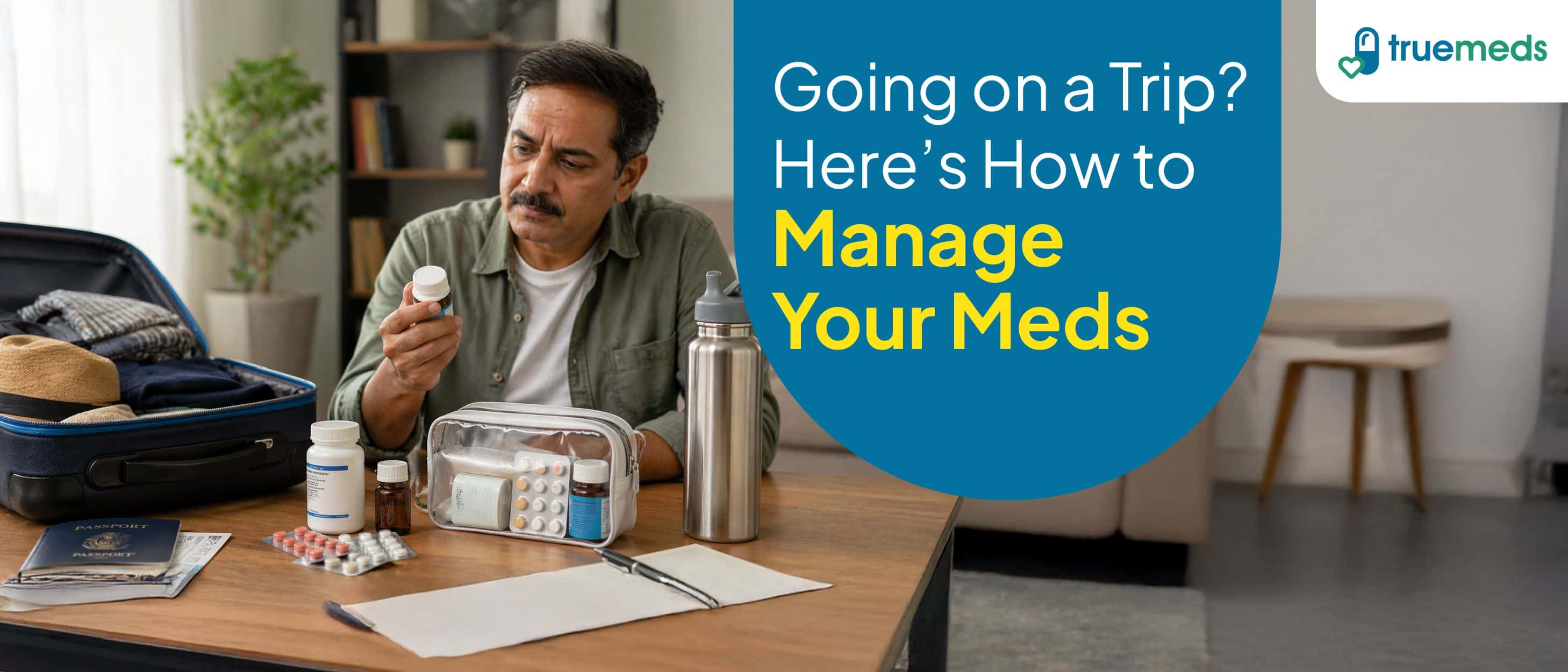
How to Manage Medication During Travel
Last updated on :06 Jul, 2026
Read time :10 min
Travelling often disrupts the medication routines that patients with chronic conditions depend on every day. A missed dose in a different time zone, medicines packed in checked luggage, exposure to extreme heat during travel, or running out of medicines in a new city or country can all affect treatment and lead to avoidable health complications. Whether you are travelling for a short domestic trip or an international holiday, planning ahead can help you continue your medicines safely and avoid unnecessary stress during your journey.
1. Planning Before You Travel
a. Visit your doctor first
After your travel plans are fixed, you should visit your doctor as early as possible, at least two weeks prior to domestic and four to eight weeks prior to international travel requiring vaccinations or controlled medicine documentation [1]. If you have a chronic disease like diabetes, hypertension, or heart disease or are using multiple medications, discuss all in detail during your visit. Be sure to ask for the current prescription and a copy of your most recent medical history.
b. Make Sure to Pack All Relevant Health Documents
While travelling, you are also advised to keep all your prescription medications in their original pharmacy containers [2]. You should also carry a letter from your prescribing doctor. Especially when travelling internationally, this becomes very important when you need to bring an injectable medication, a controlled substance such as an opioid pain reliever, some anxiety medications, or injectable medications [1], [2]. When travelling in India, certain medicines classified under Schedule H and Schedule H1 of the Drugs and Cosmetics Act require a valid prescription and should not be carried without proper documentation.
Required travel medication documentation includes:
- Name of medication, brand name, and generic name, along with the recommended dose and contact information for your doctor.
- A letter from the prescribing doctor stating the medical reason for taking each medicine, especially if it is a controlled substance.
- Copy of all prescriptions, both printed and digital. Leave a copy with your friend or a family member at home, in case you misplace it.
c. Pack More than you think you will need
Pack an extra supply of medications needed in case of flight cancellations, delays, changes in plans, lost baggage, or prescription problems when travelling abroad [1].
Pack your medical kit for travel that contains your prescription and over-the-counter medicines required during your trip. A good practice is to divide your medication into two groups; one group should be carried in your cabin luggage and another group in your checked luggage. If the airline loses your checked luggage, it will not cost as much to replace those medications as if they were all packed in the luggage that was lost.
2. Store Medications Safely While Travelling
Heat, humidity, and light may damage medications, potentially reducing effectiveness, sometimes without visible changes. Certain formulations, such as injections, change with the slightest of temperature variations. Keep such medications in your hand luggage to ensure their safety from extreme temperatures. Carry prescriptions for liquids, injections, or needles, and check airline security rules before departure.
When travelling with medications that require refrigeration, such as insulin, carry an insulated travel bag that will keep them within the required temperature range. Before flying, it is also recommended to inform the airline representatives that you are carrying medications that require controlled temperatures.
Avoid leaving medicines inside a parked car, glove compartment, or near a window during daytime travel, especially during Indian summer months. Excess heat may reduce the effectiveness of medicines such as insulin and certain thyroid medications.
3. Managing your medication regimen across multiple time zones
Crossing multiple time zones can affect your dose schedule. Some medicines require careful timing when crossing time zones, including insulin, contraceptive pills, anti-seizure medicines, and Parkinson’s medicines. Therefore, it would be best to speak with your doctor about how you can reschedule your medications according to that particular time zone. Set an alarm to help you keep track of the intervals, but do not double up the dose. It is better to develop a gradual transition plan as guided by your doctor.
4. What to Do If You Run Out of Medication Abroad
In case you run out of medications, remember to:
- Contact your doctor back at home. Your doctor may be able to send a digital prescription.
- Contact your travel insurance company. Many policies have provisions that cover prescription medications.
- Always know the generic name of your medication. Many Indian patients recognise their medicines mainly by brand names such as Thyronorm rather than Levothyroxine, or Crocin rather than Paracetamol, while the same medicines may be sold under completely different brand names abroad. Before travelling, write down the generic (chemical) name of every medicine you take so it is easier to identify alternatives if required.
Managing High-Risk Medicines During Travel
1. Insulin
Insulin may be damaged by extreme heat or freezing temperatures during travel. Keep them in hand luggage and store them within the manufacturer’s recommended temperature range. If crossing time zones, ask your doctor how to adjust dosing times safely [3].
2. Blood Thinners (Apixaban and Rivaroxaban)
Blood thinners such as apixaban and rivaroxaban must be taken consistently at the prescribed time to reduce the risk of blood clots. Missing doses may increase the risk of stroke, deep vein thrombosis, or pulmonary embolism, while taking extra doses may increase bleeding risk. Take them at the same time each day and seek medical advice promptly if a dose is missed. [4].
3. Controlled Medicines (Opioids, ADHD Stimulants, Benzodiazepines)
Some countries restrict or prohibit controlled medicines even when legally prescribed. Carry them in original labelled packaging with a prescription and doctor’s letter, and check destination and transit-country rules before travel. Never pack these medicines only in checked luggage [5].
4. Epilepsy Medicines
Taking less than prescribed anti-epileptic medication increases the chance that a seizure will happen unexpectedly. Pack enough supplies to last through the entire trip, as well as extra for potential travel delays. Take oral medications on a consistent schedule while travelling across time zones. If you miss taking an oral medicine and have a seizure, seek immediate medical assistance [6].
5. Oral Contraceptives
Some forms of birth control, especially Combined oral contraceptive pills (COCPs) usually allow a delay window of up to 12 hours before contraceptive protection may be affected. However, progestin-only tablets (POPs) generally have a much shorter delay window of around 3 hours and therefore require stricter timing.
When crossing multiple time zones, it could be difficult to take the correct dosage, which is why planning ahead of time is essential. So plan in advance and use backup contraception if advised after missed or late doses. Check the patient information guide provided by the manufacturer or contact your doctor [7].
Road Travel Safety While Taking Medicines
If you’re planning to drive during your vacation, it is important to know about medications that may make you feel drowsy or dizzy, which could impair your ability to drive safely. The effects of medication may be greater when first taking it or when increasing the dosage. Be especially cautious when driving after dark if you are taking sedating antihistamines, sleeping pills, anti-anxiety medicines, opioid painkillers, anti-nausea medicines, or certain antidepressants. Read the warning labels or read the information provided in your medication package prior to travelling.
Do not drive a car or other type of vehicle if you experience drowsiness, lightheadedness, or cannot focus. Follow your doctor’s advice as to how many hours after taking sedative medications should pass before resuming the safe operation of a motor vehicle. Plan to take regular breaks while driving for extended periods.
When to Seek Immediate Medical Help While Travelling
Seek immediate care if:
- You have missed multiple doses of a high-risk medicine such as insulin, an antiepileptic medication, a blood thinner, or a long-term steroid and are experiencing symptoms.
- You experience a seizure, severe allergic reaction, chest pain, sudden confusion, difficulty breathing, or loss of consciousness.
- You suspect an accidental overdose.
- You are a warfarin user who has missed doses and develops signs of a blood clot, sudden leg pain or swelling, chest pain, or breathlessness [4].
Before travelling, it is helpful to note the name, address, and contact number of a nearby hospital or clinic at your destination, particularly if you are travelling internationally or to areas where language barriers or unfamiliar healthcare systems may delay access to medical care.
Conclusion
When travelling with prescription medications, there are several things that need to be planned for; however, they do not necessarily have to be complex. There is a simple checklist involved when travelling with medications. Simply begin by planning your medications as part of your overall travel schedule rather than planning them once you arrive at your destination. Make sure to talk to your doctor regarding your upcoming travel plans at least 4 to 8 weeks prior. Ensure that you pack all necessary prescriptions. Know the generic versions of your branded medicines. Take measures to protect your heat-sensitive medications from heat damage. Ask your doctor how to continue medications in different time zones. Lastly, be prepared if you run out of medications.
Disclaimer: This article is intended for general educational and informational purposes only. It does not constitute medical advice, diagnosis, or a substitute for professional medical consultation. Always seek the guidance of your doctor with any questions about your medications or health before, during, and after travel.
References
[1] World Health Organization: WHO. (2019, November 6). Travel and health. https://www.who.int/health-topics/travel-and-health
[2] Traveling Abroad with Medicine | Travelers’ Health | CDC. (n.d.). CDC.gov. https://wwwnc.cdc.gov/travel/page/travel-abroad-with-medicine
[3] Aleidi, F. A., Alomair, S., Alharbi, H., AlSalamah, N., & AlEnazi, L. (2025). Stability of refrigerated medications at room temperature: Implications for transport, delivery, and patient safety. Cureus, 17(9), e93213. https://doi.org/10.7759/cureus.93213
[4] California Correctional Health Care Services. (2024, June). Anticoagulation care guide (Version June 2024). CCHCS. https://cchcs.ca.gov/wp-content/uploads/sites/60/Anticoagulation-Care-Guide.pdf
[5] Centers for Disease Control and Prevention. (2026, January). Traveling with prohibited or restricted medications. In CDC Yellow Book 2026: Health information for international travel. National Institutes of Health. https://www.ncbi.nlm.nih.gov/books/NBK620937/
[6] Liu, X., et al. (2023). Handling delayed or missed dose of antiseizure medications: A model-informed individual remedial dosing. Epilepsy & Behavior, 138, 109032. https://pmc.ncbi.nlm.nih.gov/articles/PMC9990430
[7] Curtis, K. M., Nguyen, A. T., Tepper, N. K., Zapata, L. B., Snyder, E. M., Hatfield-Timajchy, K., Kortsmit, K., Cohen, M. A., Whiteman, M. K., & Contributors. (2024). U.S. selected practice recommendations for contraceptive use, 2024. MMWR Recommendations and Reports, 73(3), 1–77. https://doi.org/10.15585/mmwr.rr7303a1
[8] Gov.In. (n.d.). The drugs and cosmetics act and rules. Retrieved from https://cdsco.gov.in/opencms/export/sites/CDSCO_WEB/Pdf-documents/acts_rules/2016DrugsandCosmeticsAct1940Rules1945.pdf
















Disclaimer
Our healthcare experts have carefully reviewed and compiled the information presented here to ensure accuracy and trustworthiness. It is important to note that this information serves as a general overview of the topic and is for informational purposes only. It is not intended to diagnose, prevent, or cure any health problem. This page does not establish a doctor-patient relationship, nor does it replace the advice or consultation of a registered medical practitioner. We recommend seeking guidance from your registered medical practitioner for any questions or concerns regarding your medical condition.
Recent Articles


Company
About UsHealth ArticleHealth StoriesHealth LibraryDiseases & Health ConditionsAyurvedaUnderstanding Generic MedicinesAll MedicinesAll BrandsNeed HelpFAQSecuritySavings CalculatorAdvertise with UsSubscribe
Registered Office Address
Grievance Officer
Download Truemeds


Contact Us
Our customer representative team is available 7 days a week from 9 am - 9 pm.
v4.28.3

2026 - Truemeds | All rights reserved. Our content is for informational purposes only. See additional information.
Our Payment Partners