

- Medicines
- Personal Care
- Skin Cream
- Sunscreen
- Face Wash
- Skin and Body Soap
- Acne Care
- Body Lotions
- Moisturising Lotion
- Moisturising Cream
- Mosquito Repellent
- Moisturising Gel
- Body Wash
- Hair Oils
- Hair Shampoo
- Hair Conditioners
- Hair Supplements
- Hair Colour
- Hair Serum
- Hair Mask
- Hair Solutions
- Baby Diapers and Wipes
- Baby Lotion and Moisturising Cream
- Baby Bath Essentials
- Baby Skin Care
- Baby and Infant Food
- Baby Healthcare
- Women Multivitamins
- Ovulation Test Kit and Women Intimate Care
- Sanitary Pads
- Nutritional Drinks
- Condoms
- Lubricants
- Massage Gels
- Personal Body Massagers
- Men Performance Booster
- Sexual Health Supplements
- Massage Oils
- Ayurveda
- Tooth Paste
- Mouth Ulcer Gel
- Mouthwash
- Toothache and Gum Pain
- Tooth Brush
- Gargle Solution
- Orthopaedic Supports
- Adult Diapers
- Footwear
- Mobility and Support Accessories
- Urinary Support and Care
- Health Conditions
- Bone and Joint Care
- Digestive Care
- Eye Care
- Pain Relief
- Smoking Cessation
- Liver Care
- Stomach Care
- Cold and Cough
- Heart Care
- Kidney Care
- Piles, Fissures & Fistula
- Respiratory Care
- Mental Wellness
- Derma Care
- Pre and Probiotics
- Acidity
- Gas
- Constipation
- Loose Motion/Diarrhoea
- Digestive Fibres
- Digestive Enzymes
- Eye Lubricant Drops
- Lens Solution
- Safety Eye Wear
- Eye Cream
- Eye Vitamins and Supplements
- Eye Drops
- Eye Ointment and Gel
- Nicotine Patch
- Nicotine Gum
- Nicotine Lozenges
- Cough Syrups
- Chest Rubs and Balms
- Nasal Spray
- Lozenges
- Inhalant Capsules
- Cold and Cough Tablets
- Vitamins & Supplements
- Diabetes Care
- Healthcare Devices
- Homeopathic Medicine
- Health Guide
Multani Mitti
Multani Mitti, also known as Fuller's Earth, is a natural absorbent clay long used in Ayurvedic and traditional South Asian skincare. It is applied externally as a face or hair mask to help absorb excess oil and impurities from oily or acne-prone skin, and to cleanse the scalp of buildup that can contribute to dandruff. It is used for cosmetic, external purposes only and is not intended for internal use.
 50
50Last updated on : 18 Sep, 2026
Read time : 15 mins
What is Multani Mitti?
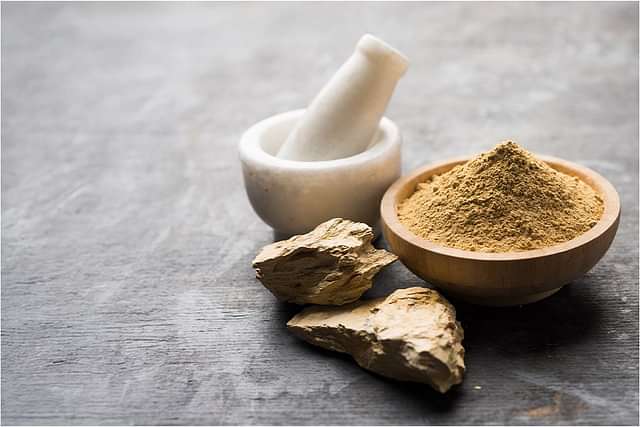
Multani Mitti takes its name from Multan, a city in present-day Pakistan, where this clay was traditionally mined and used for centuries. It is a naturally occurring clay, formed mainly from weathered volcanic ash and rich in hydrated aluminium silicates, which contribute to its absorbent properties. Multani Mitti has long been used across the Indian subcontinent and South Asia in traditional beauty practices, particularly as a face or hair mask to absorb excess oil and remove dirt and impurities from the skin and scalp.
Also known as Fuller's earth, Multani Mitti is not a classical Ayurvedic herb or dravya with a well-established classification in major Ayurvedic texts. Its contemporary use in Ayurvedic and traditional skincare is based mainly on its absorbent, cleansing and cooling properties. It does not have an established classical classification based on attributes such as Rasa, Guna, Virya, Vipaka or Dosha karma.
Key Facts
| Feature | Details |
| Source / type | Naturally occurring absorbent clay (not a plant or a classical formulation), mainly composed of hydrated aluminium silicates
|
| Also known as | Fuller's Earth, Indian Healing Clay
|
| Ayurvedic category | Not one of the classically named Pancha Mrittika earths; traditionally used externally as Lepa
|
| Key constituents | Silica, alumina, iron oxide, lime, magnesium oxide
|
| Traditional uses | Face and hair masks in traditional South Asian skincare
|
| Common forms | Fine powder, mixed with water or another liquid before use
|
| General usage | About 1 to 2 teaspoons for a face mask, or 3 to 4 tablespoons for a hair mask, made into a paste
|
| Best used | 2 to 3 times a week for oily skin, once a week for dry or sensitive skin; external use only
|
| Key safety note | For external, cosmetic use only. Not for eating. Avoid on broken or very dry skin without a moisturising agent. Patch test before first use, particularly if you have sensitive skin. |
Alternative Names of Multani Mitti
Multani Mitti is known by a small number of genuine names, since its name is a place-name rather than a translated botanical term:
- English: Fuller's Earth
- Hindi/Urdu: Multani Mitti
Chemical Constituents of Multani Mitti
Multani Mitti's cleansing and absorbent properties come mainly from its mineral content:
- Silica (silicon dioxide), the main constituent, making up roughly half the clay
- Alumina (aluminium oxide), the second major constituent
- Iron oxide, present in a smaller amount
- Lime (calcium oxide) and magnesium oxide, present in smaller amounts
Medicinal Properties of Multani Mitti
Based on its mineral composition and traditional use, Multani Mitti is traditionally used for the following effects on the skin:
- Adsorbent, its clay particles bind and absorb excess oil, dirt and surface impurities
- Mild astringent, traditionally believed to temporarily tighten the appearance of pores
- Cooling and soothing, traditionally used to soothe minor skin irritation and discomfort associated with mild sunburn
- Mechanical exfoliant, its texture helps lift away dead skin cells when gently massaged onto the skin
These actions are based mainly on the clay's physical and mineral properties and on long-standing traditional use, rather than on controlled clinical trials in humans. A 2019 dermatology review found no rigorous scientific evidence confirming these cosmetic effects and noted that any benefit reported by users may reflect satisfaction with the ritual of use rather than a measurable change in the skin (Kumar, 2019). Multani Mitti should be treated as a traditional cosmetic clay rather than a treatment for any skin condition.
Key Health Benefits of Multani Mitti
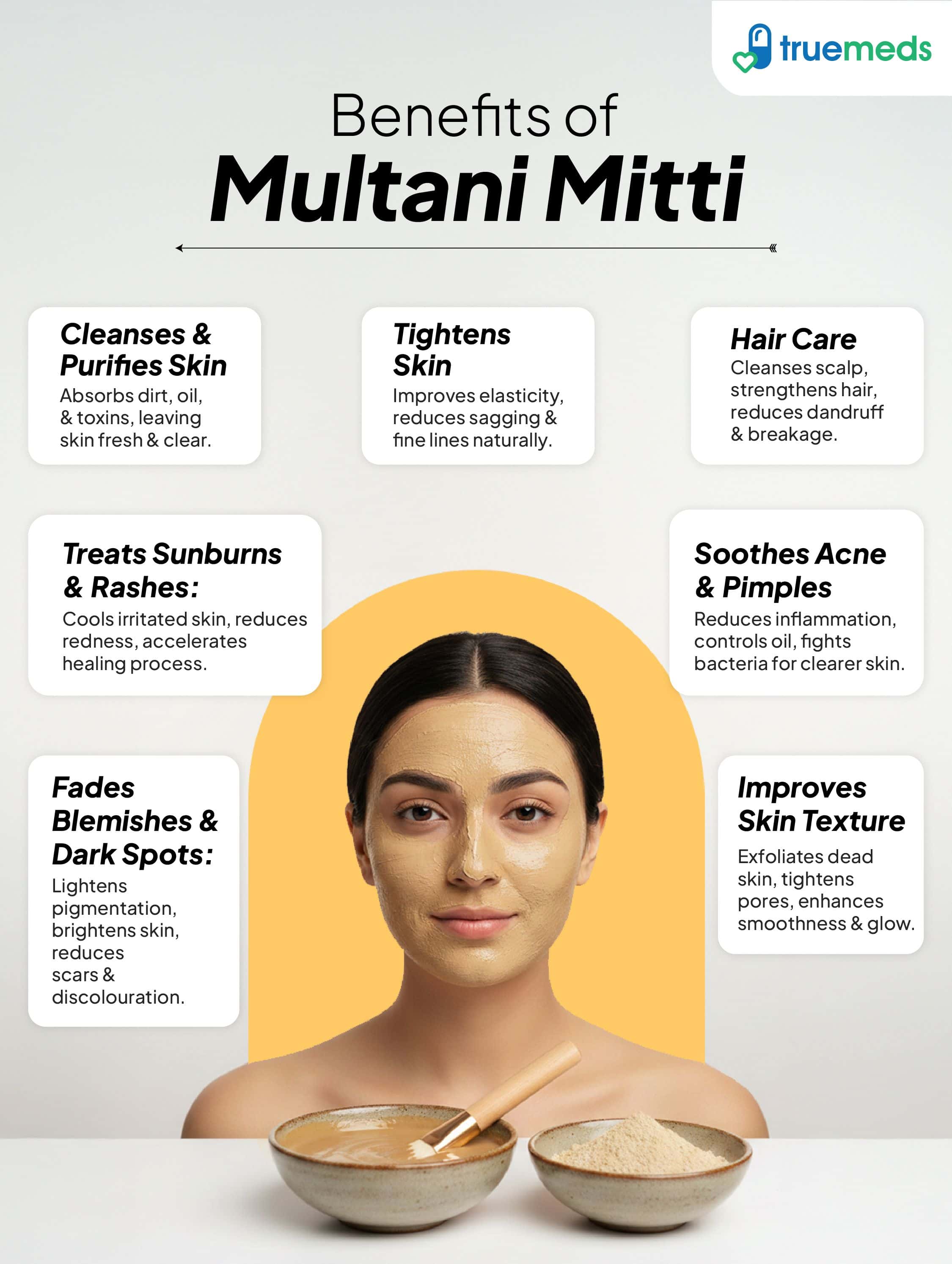
Multani Mitti is traditionally used in skin and scalp care, particularly for absorbing excess oil, cleansing the skin and providing a temporary soothing or tightening effect.
Helps Absorb Excess Oil and Impurities
Multani Mitti's clay particles are traditionally believed to bind to excess sebum, dirt and surface impurities, lifting them away when the mask is rinsed off. This is why it is a popular traditional choice for people with oily or acne-prone skin, though it does not treat the underlying causes of acne.
May Help Calm the Look of Acne-Prone Skin
The clay's cooling, mildly absorbent action is traditionally believed to help soothe the appearance of redness and reduce excess oil that can contribute to breakouts. It provides cosmetic, symptomatic support only; persistent or severe acne needs assessment by a dermatologist rather than a clay mask alone.
Traditional Use for Skin Texture
With regular use, Multani Mitti's mild exfoliating action is traditionally believed to help lift away dead skin cells, leaving skin feeling smoother. Reliable clinical evidence for a lasting change in skin texture is lacking (Kumar, 2019), so results vary between individuals.
Traditional Use for Uneven Skin Tone
Multani Mitti is traditionally used in the belief that it can help improve the appearance of minor blemishes and patchy pigmentation over time with regular use. This is a cosmetic, traditional-use claim rather than a proven treatment, and persistent dark spots should be assessed by a dermatologist.
Traditional Use for Mild Sunburn and Skin Irritation
Multani Mitti's natural cooling quality is traditionally used to help soothe the discomfort of mild sunburn and minor skin irritation when applied as a mask. Broken, blistered or severe sunburn is a medical issue and needs proper medical care rather than a home remedy.
Temporary Tightening Sensation
As the clay dries on the skin, it creates a temporary tightening, astringent sensation, which is why Multani Mitti is sometimes included in masks intended to give the skin a temporarily firmer appearance. There is no reliable evidence that it produces a lasting reduction in fine lines or wrinkles.
Traditional Use for Scalp and Hair Care
On the scalp, Multani Mitti is traditionally believed to absorb excess oil and help loosen flaky buildup associated with dandruff when used as an occasional hair mask. It is a cosmetic scalp-cleansing aid, not a treatment for a diagnosed scalp condition.
Common Uses of Multani Mitti
Multani Mitti is commonly used in traditional beauty and personal care, particularly in face and scalp masks, with some historical uses beyond skincare.
- Face masks, to help absorb excess oil and impurities from oily or acne-prone skin
- Hair and scalp masks, to help cleanse the scalp and absorb excess oil that may contribute to scalp buildup
- Traditional beauty practice across the Indian subcontinent, often combined with other ingredients such as rose water or sandalwood
- Historically, in the textile industry, to remove natural oils from raw wool, which is how it came to be known as "Fuller's Earth" in English
Precautions While Taking Multani Mitti
- Always do a patch test first: apply a small amount behind the ear or on the inner wrist, leave for 10 to 20 minutes, and check for redness, itching or swelling before using it on the face or scalp.
- Do not apply it directly to dry or sensitive skin without mixing in a moisturising ingredient such as honey, milk or a few drops of oil.
- Limit use to 2 to 3 times a week for oily skin, and once a week for dry or sensitive skin; more frequent use can dry or irritate the skin by removing its natural oils.
- Avoid inhaling the dry powder while mixing the paste, as with any fine mineral powder.
- People with eczema, rosacea, active severe acne or another diagnosed skin condition should check with a dermatologist before adding it to their routine.
- Multani Mitti is for external use only and must not be swallowed or eaten.
Note: This information is not a substitute for professional medical advice. Speak to a dermatologist before using Multani Mitti if you have a diagnosed skin condition, are pregnant or breastfeeding, or are using a prescription skin treatment.
How to Use Multani Mitti
Multani Mitti is usually applied as a paste or mask, with the method varying depending on the intended skin or scalp use.
For Oily Skin
Mix 1 to 2 tablespoons of Multani Mitti powder with enough rose water to form a smooth paste. Apply evenly to the face, avoiding the eye area, and leave for 15 to 20 minutes without letting it fully harden and crack. Rinse off with lukewarm water, gently massaging in circular motions, then pat the face dry.
For Dry Skin
Combine 1 to 2 tablespoons of Multani Mitti with 1 teaspoon of honey and 1 to 2 tablespoons of milk to make a creamy paste. Apply to the face and leave for 10 to 15 minutes. Rinse off with lukewarm water before it fully dries, then apply a moisturiser.
For Acne-Prone Skin
Mix 1 tablespoon of Multani Mitti with 1 teaspoon of neem powder and avoid adding lemon juice, as it may irritate the skin, particularly when exposed to sunlight. Apply to the affected areas only and leave for 5 to 10 minutes. Rinse with lukewarm water and apply a gentle, fragrance-free moisturiser. Avoid broken or actively inflamed skin.
For the Scalp and Hair
Mix 3 to 4 tablespoons of Multani Mitti with enough water to form a thick paste. Apply to the scalp and hair, focusing on the roots, and leave for up to 30 minutes. Rinse thoroughly, then shampoo and condition as usual. Limit this to about once a week.
Herbs Traditionally Used With Multani Mitti
Multani Mitti is often combined with other traditional ingredients in face and hair masks:
Ingredient | Traditional Use With Multani Mitti |
Neem (Azadirachta indica) | Neem powder is traditionally combined with Multani Mitti in face masks for acne-prone skin, valued for its traditional cleansing reputation. |
Sandalwood (Santalum album) | Sandalwood powder is traditionally paired with Multani Mitti for a cooling, soothing face mask, traditionally believed to help calm the skin. |
Rose water | Rose water is commonly used instead of plain water to mix the clay into a paste, traditionally valued for its soothing, mildly fragrant properties. |
Turmeric (Curcuma longa) | A small amount of turmeric is sometimes added to Multani Mitti masks in traditional practice, valued for its traditional use in skincare. |
Recommended Usage of Multani Mitti
How much to use, and how often, varies by age group and skin type:
Age group | Guidance |
Children (under 12) | Not recommended for regular cosmetic use without a paediatrician's or dermatologist's advice, since children's skin is more sensitive to drying and irritation. |
Teenagers | May be used for oily or acne-prone skin under adult supervision, limited to 2 to 3 times a week, always with a patch test first; persistent acne needs a dermatologist's assessment rather than home treatment alone. |
Adults | About 1 to 2 teaspoons for a face mask, or 3 to 4 tablespoons for a hair mask, mixed into a paste. Use 2 to 3 times a week for oily skin, once a week for dry or sensitive skin. |
Elderly | Skin tends to be thinner and drier with age, so use no more than once a week, always mixed with a moisturising ingredient, and stop if any dryness or irritation develops. |
Pregnancy and breastfeeding | Occasional topical cosmetic use in the amounts above is generally considered low risk, but evidence on safety during pregnancy and breastfeeding is limited. It should never be eaten. Anyone with a skin condition or concern should check with their doctor first. |
Side Effects of Multani Mitti
Multani Mitti is generally used externally, but improper or excessive use may cause some skin reactions or other concerns.
Skin Dryness
Because Multani Mitti is highly absorbent, it can remove natural oils from the skin, leaving it feeling tight, dry or flaky, particularly in people who already have dry or sensitive skin. Reducing how often it is used, and applying a moisturiser afterwards, may help reduce dryness.
Skin Irritation or Allergic Reaction
A small number of people may develop redness, itching or a rash after using Multani Mitti, which is why a patch test is recommended before the first full application. Anyone with swelling, blistering or breathing difficulty after use needs prompt medical attention.
Trace Mineral Content
An independent laboratory study found that Multani Mitti contains trace amounts of several elements, including lead, and noted that lead levels in particular were higher than would be considered acceptable for regular oral consumption (Waheed et al., 2012). This finding relates mainly to eating the clay rather than to normal external, cosmetic use, and is a further reason Multani Mitti should never be swallowed.
Interaction of Multani Mitti With Other Drugs
Multani Mitti is applied to the skin and is not expected to be absorbed into the body in significant amounts during normal use, so it is not known to interact with medicines taken by mouth. The following topical precautions apply:
Topical Acne and Prescription Skin Treatments
Using Multani Mitti alongside topical acne treatments such as benzoyl peroxide, retinoids or salicylic acid can increase overall dryness and irritation, since these treatments can also cause dryness or irritation. Anyone using a prescribed dermatological treatment should ask their dermatologist before adding Multani Mitti to their routine.
Other Exfoliating or Abrasive Skincare Products
Combining Multani Mitti with other physical or chemical exfoliants on the same day can increase the risk of dryness and irritation by over-stripping the skin's protective barrier. Space these products out, or use them on different days.
Note: This is not a complete list. Tell your dermatologist about all skincare products and treatments you use regularly, especially if you have a diagnosed skin condition.
Storage of Multani Mitti
Correct storage keeps the powder dry and suitable for use:
- Store in an airtight container in a cool, dry place, away from direct moisture and humidity.
- Keep the container tightly closed between uses to stop the powder from absorbing moisture from the air and clumping.
- Use a clean, dry spoon to remove powder each time, to avoid introducing moisture or contamination.
- Keep out of reach of young children, since it is not intended to be eaten.
Key Takeaways
- Multani Mitti (Fuller's Earth) is a natural absorbent clay traditionally used in South Asian skincare as a face and hair mask.
- It is traditionally believed to help absorb excess oil and impurities and to leave skin feeling clean, though a 2019 dermatology review found no rigorous scientific evidence confirming these cosmetic effects (Kumar, 2019).
- It commonly causes dryness with frequent use, and a small number of people may experience irritation or an allergic reaction, so a patch test is recommended before first use.
- It is for external, cosmetic use only. It must never be eaten, since laboratory testing has found lead at levels of concern for oral consumption in this clay (Waheed et al., 2012).
FAQs
Is Multani Mitti natural or artificial?
What is Multani Mitti's raw material?
What happens if Multani Mitti is eaten?
What is the active ingredient in Multani Mitti?
How can I use Multani Mitti for my face?
How can I use Multani Mitti for dandruff?
Is it fine to use Multani Mitti every day on oily skin?
How do I use Multani Mitti for pimples?
Should I moisturise after using Multani Mitti?
Is Multani Mitti with sandalwood good for the skin?
Can Multani Mitti be used on sunburn?
Can Multani Mitti be used on the hair?
References
- Kumar, P. (2019). Multani Mitti – Is it more than a placebo? Journal of Pakistan Association of Dermatologists, 29(3), 345–348. https://doi.org/10.66344/jpad.v29i3.1332
- Waheed, S., Faiz, Y., Rahman, S., & Siddique, N. (2012). Toxic element composition of Multani Mitti clay for nutritional safety. Journal of Radioanalytical and Nuclear Chemistry, 295(1), 143-150. https://doi.org/10.1007/s10967-012-1876-x
Explore other categories
Latest health articles





Top Health Essentials

Top-selling ayurvedic products













Disclaimer
Top-Selling Medicines:
...View more
Top-OTC medicines:
...View more
Top-selling healthcare devices:
...View more
Company
About UsHealth ArticleHealth StoriesHealth LibraryDiseases & Health ConditionsAyurvedaUnderstanding Generic MedicinesAll MedicinesAll BrandsNeed HelpFAQSecuritySavings CalculatorAdvertise with UsSubscribe
Registered Office Address
Grievance Officer
Download Truemeds


Contact Us
Our customer representative team is available 7 days a week from 9 am - 9 pm.
v4.28.18

2026 - Truemeds | All rights reserved. Our content is for informational purposes only. See additional information.

Our Payment Partners




