

- Medicines
- Personal Care
- Skin Cream
- Sunscreen
- Face Wash
- Skin and Body Soap
- Acne Care
- Body Lotions
- Moisturising Lotion
- Moisturising Cream
- Mosquito Repellent
- Moisturising Gel
- Body Wash
- Hair Oils
- Hair Shampoo
- Hair Conditioners
- Hair Supplements
- Hair Colour
- Hair Serum
- Hair Mask
- Hair Solutions
- Baby Diapers and Wipes
- Baby Lotion and Moisturising Cream
- Baby Bath Essentials
- Baby Skin Care
- Baby and Infant Food
- Baby Healthcare
- Women Multivitamins
- Ovulation Test Kit and Women Intimate Care
- Sanitary Pads
- Nutritional Drinks
- Condoms
- Lubricants
- Massage Gels
- Personal Body Massagers
- Men Performance Booster
- Sexual Health Supplements
- Massage Oils
- Ayurveda
- Tooth Paste
- Mouth Ulcer Gel
- Mouthwash
- Toothache and Gum Pain
- Tooth Brush
- Gargle Solution
- Orthopaedic Supports
- Adult Diapers
- Footwear
- Mobility and Support Accessories
- Urinary Support and Care
- Health Conditions
- Bone and Joint Care
- Digestive Care
- Eye Care
- Pain Relief
- Smoking Cessation
- Liver Care
- Stomach Care
- Cold and Cough
- Heart Care
- Kidney Care
- Piles, Fissures & Fistula
- Respiratory Care
- Mental Wellness
- Derma Care
- Pre and Probiotics
- Acidity
- Gas
- Constipation
- Loose Motion/Diarrhoea
- Digestive Fibres
- Digestive Enzymes
- Eye Lubricant Drops
- Lens Solution
- Safety Eye Wear
- Eye Cream
- Eye Vitamins and Supplements
- Eye Drops
- Eye Ointment and Gel
- Nicotine Patch
- Nicotine Gum
- Nicotine Lozenges
- Cough Syrups
- Chest Rubs and Balms
- Nasal Spray
- Lozenges
- Inhalant Capsules
- Cold and Cough Tablets
- Vitamins & Supplements
- Diabetes Care
- Healthcare Devices
- Homeopathic Medicine
- Health Guide
Kushmanda Rasayana
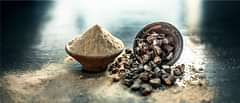
Kushmanda Rasayana, also called Kushmanda Avaleha, is a classical Ayurvedic avaleha, meaning a semi-solid preparation similar to a jam. It is made from ash gourd pulp and juice cooked with cow's ghee and sugar, then blended with warming spices and honey. It is traditionally used for persistent cough and chest complaints, and as a nourishing preparation during recovery from illness.
 50
50Last updated on : 11 Aug, 2026
Read time : 19 mins
What is Kushmanda Rasayana?
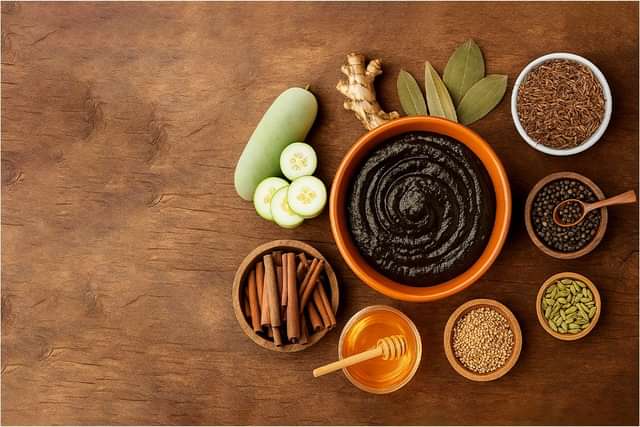
The formulation takes its name from its principal ingredient. Kushmanda is the Sanskrit name for ash gourd, Benincasa hispida, the pale green winter melon sold across India as petha. In Ayurveda, Rasayana refers to preparations traditionally used to promote nourishment, strength and general well-being. Because the finished preparation is a semi-solid confection, it is also called Kushmanda Avaleha, and it is sold in South India as Kooshmanda Rasayanam.
The preparation is described in Bhaishajya Ratnavali, in the chapter on Raktapitta, and in Sharangadhara Samhita, Madhyama Khanda. The classical indications recorded for it are Kasa (cough), Shwasa (breathlessness), Kshaya and Kshata (wasting and chest injury), Raktapitta, and general debility. Ash gourd itself is described as Madhura (sweet) in rasa and Sheeta (cooling) in virya, and as Balya, meaning traditionally considered strength-giving. The pungent ingredients, Pippali, Maricha and Shunthi, are added to support digestion of the preparation, since a sweet and heavy base can otherwise be difficult to digest. Modern research on the formulation has focused on persistent cough (Kale et al., 2018).
Key Facts
| Feature | Details |
| Formulation name | Kushmanda Rasayana |
| Formulation type | Avaleha or Leha, a semi solid herbal confection. Classed as a Rasayana preparation. |
| Classical reference | Described in Bhaishajya Ratnavali, chapter on Raktapitta, and in Sharangadhara Samhita, Madhyama Khanda. |
| Composition | Kushmanda (ash gourd) pulp and juice, Go-Ghrita, Sharkara, Madhu, Pippali, Maricha, Shunthi, Jeeraka, Dhanyaka, Twak, Ela and Tejapatra. |
| Also known as | Kushmanda Avaleha, Kushmandaka Rasayana, Kushmanda Lehyam, Kooshmanda Rasayanam.
|
| Key active compounds | Phenolics, flavonoids, triterpenes and polysaccharides from ash gourd. Piperine from long pepper and black pepper. Gingerols from dry ginger. Cinnamaldehyde from cinnamon.
|
| Traditional uses | Kasa (cough), Shwasa (breathlessness), Kshaya and Kshata (wasting and chest injury), Raktapitta, and general debility |
| Common forms | Sold as a ready made avaleha in glass or food grade jars. It is not available as a tablet or capsule. |
| General dosage | Commonly 6 g to 12 g daily in divided doses for adults. The CCRAS clinical study used 10 g twice daily for 12 weeks. |
| Best taken | After food, with lukewarm water or milk
|
| Key safety note | Contains sugar, ghee and honey. Consult a doctor before use if you have diabetes, raised blood lipids or are overweight. Do not give to infants under 12 months because of the honey content. |
Alternative Names of Kushmanda Rasayana
The name of this preparation is a transliteration from Sanskrit rather than a direct translation. The variations below represent spelling and regional forms of the same preparation, although some terms may refer to related ash gourd-based preparations rather than identical formulations.
- Petha in Hindi
- Chalkumra in Bengali
- Boodida Gummadikaya in Telugu
- Poosanikai in Tamil
- Kumbalanga in Malayalam
- Kushmanda Lehyam in Kerala
- Kooshmanda Rasayanam in Tamil Nadu
- Kushmanda Avaleha: The name used when the preparation is described according to its dosage form.
- Kushmandaka Rasayana: A spelling used in the CCRAS clinical study and by several manufacturers.
- Kushmanda Rasayanam and Kooshmaanda Rasaayanam: Transliteration variations commonly seen on product labels.
- Kushmand Pak: A related name used for a similar ash gourd-based confection.
Composition of Kushmanda Rasayana
Kushmanda Rasayana is built on a sweet, nourishing base with a small group of warming spices added to support digestion. The ingredients below are the ones described in the classical preparation.
- Kushmanda (Benincasa hispida), ash gourd fruit pulp and juice, which forms the bulk of the preparation
- Go-Ghrita, cow's ghee, used to cook the pulp and to carry the fat-soluble constituents
- Sharkara, sugar, which contributes to the consistency and sweetness of the preparation
- Madhu, honey, added after the preparation has cooled
- Pippali (Piper longum), long pepper
- Maricha (Piper nigrum), black pepper
- Shunthi (Zingiber officinale), dry ginger
- Jeeraka (Cuminum cyminum), cumin
- Dhanyaka (Coriandrum sativum), coriander
- Twak (Cinnamomum verum), cinnamon bark
- Ela (Elettaria cardamomum), green cardamom
- Tejapatra (Cinnamomum tamala), Indian bay leaf
Chemical Constituents of Kushmanda Rasayana
Because Kushmanda Rasayana is a multi-ingredient formulation, its constituents come from several ingredients rather than a single plant. The key groups of compounds commonly identified include:
- Ash gourd: Phenolic compounds, flavonoids, triterpenes and polysaccharides.
- Long pepper and black pepper: Piperine, the alkaloid responsible for their pungent taste.
- Dry ginger: Gingerols and shogaols.
- Cinnamon bark: Cinnamaldehyde and related volatile compounds.
- Cardamom and Indian bay leaf: Cineole and other volatile oil components.
- Cumin and coriander: Cuminaldehyde and linalool, respectively.
- Sugar and ghee (base ingredients): Sucrose from sugar, along with fatty acids and fat-soluble compounds from ghee.
Medicinal Properties of Kushmanda Rasayana
Kushmanda Rasayana has the following traditional Ayurvedic properties and researched effects, with the level of supporting evidence noted for each.
- Balya: Traditionally described as supporting strength.
- Rasayana: Traditionally described as supporting nourishment and restoration of body tissues.
- Brimhana: Traditionally described as supporting body nourishment and healthy weight.
- Antitussive: May help relieve a persistent cough.
- Deepana and Pachana: Traditionally described as supporting appetite and digestion.
- Antioxidant: Reported in laboratory studies on ash gourd.
- Anti-inflammatory: Reported in laboratory studies on ash gourd.
Among these properties, only the effect on a persistent cough has been evaluated in a clinical study of the finished formulation, and that study did not include a comparison group (Kale et al., 2018). The remaining properties are based on traditional Ayurvedic descriptions or laboratory studies of the individual ingredients.
Key Health Benefits of Kushmanda Rasayana
This preparation is traditionally used to support respiratory health and general nourishment. The section below explains each traditional use and the current level of evidence supporting it.
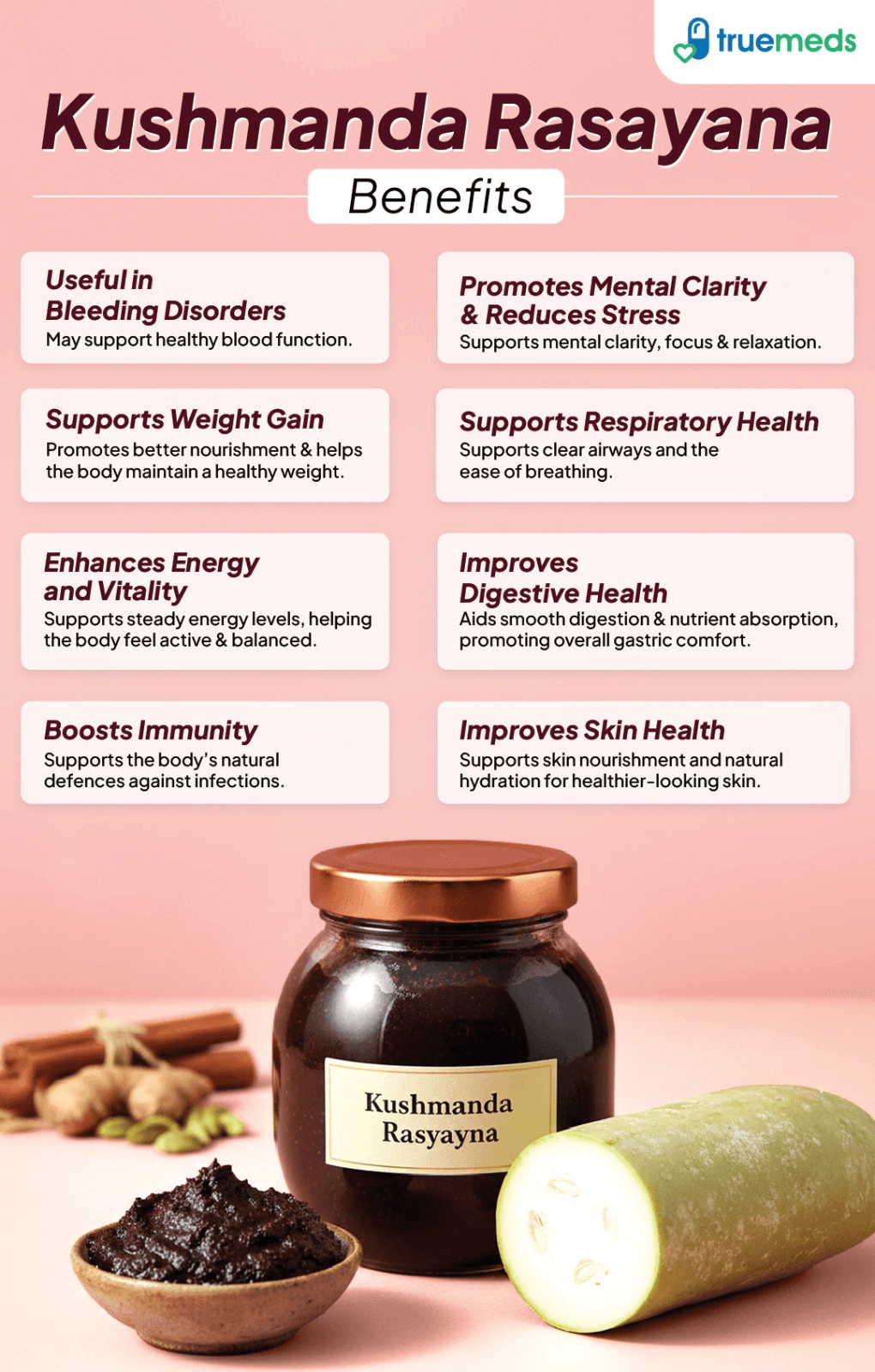
This preparation is traditionally used to support respiratory health and general nourishment. The section below explains each traditional use and the current level of evidence supporting it.
Support in Long-Standing Cough and Chest Complaints
In a multicentre study run by three CCRAS institutes, 193 people with chronic bronchitis took 10 g twice daily for 12 weeks and showed improvement in symptoms and in lung function measured as FEV1 (Kale et al., 2018). Everyone in the study received the medicine, so there was no comparison group. This limits the extent to which the improvement can be attributed to Kushmanda Rasayana.
Nourishment During Recovery From Illness
Traditionally, Ayurvedic texts describe this preparation for Kshaya and Kshata, terms that refer to wasting and depletion following illness or injury. The formulation contains ghee and sugar, making it energy dense, while ash gourd is traditionally described as Balya, meaning supportive of strength. This is a traditional Ayurvedic use and has not been established through modern clinical trials.
Appetite and Digestion
Long pepper, black pepper, dry ginger and cumin are classed in Ayurveda as Deepana and Pachana, meaning they are traditionally described as supporting appetite and digestion. They are included partly for this reason and partly so that a sweet, heavy preparation may be easier to digest. This is traditional reasoning, not a tested effect.
Weight Gain During Convalescence
The preparation is energy dense because of its ghee and sugar content, which is why it is used traditionally in Brimhana therapy for someone who is underweight after illness. The weight gain comes from the calories it supplies, not from any established effect on metabolism.
Disclaimer: Kushmanda Rasayana is a nourishing preparation and not a treatment for any diagnosed lung disease. If you have a persistent cough, breathlessness, coughing up blood, fever or unexplained weight loss, consult a registered medical practitioner rather than treating it yourself. Do not stop any prescribed inhaler or medicine in order to take it.
Common Uses of Kushmanda Rasayana
This preparation turns up in a few specific situations rather than as an everyday supplement. Here is when it is typically used.
During Recovery After a Chest Illness
It is given once an acute infection has settled, when a cough lingers and the person feels weak, rather than during the acute illness itself. It is not a substitute for treatment of the infection.
As a Prescribed Rasayana Course
Ayurvedic physicians prescribe Rasayana preparations as a defined course rather than on an open-ended basis, usually alongside dietary advice. The length of the course is set by the practitioner and reviewed at the end of it.
Where Appetite Is Poor and Body Weight Is Low
Used traditionally in Brimhana therapy for someone who is underweight after illness. Because it is energy dense, it is intended for that situation specifically and not as a general daily tonic.
Alongside Other Respiratory Preparations
It is sometimes given with a churna such as Sitopaladi or Talisadi, where one preparation is traditionally used for nourishment and the other for respiratory symptoms. Combinations of this kind should be arranged by a practitioner rather than assembled at home.
Precautions While Taking Kushmanda Rasayana
This preparation contains sugar, ghee and honey, making it a sweet, energy-dense formulation. Most of the precautions are related to these ingredients. Read the points below before using it.
- Do not give Kushmanda Rasayana to a baby under 12 months. It contains honey, which is not safe for infants because of the risk of infant botulism.
- Consult your doctor first if you have diabetes or prediabetes. The preparation is largely sugar and will affect blood glucose, and the amount of sugar per dose is not usually stated on the pack.
- Take medical advice if you have raised cholesterol or triglycerides, or have been told to reduce saturated fat, because the base is cow's ghee.
- Avoid using this preparation specifically for weight gain if you are trying to lose weight. It is an energy-dense formulation intended to provide additional calories, which may not be suitable during weight-loss efforts.
- Use it only on medical advice in pregnancy and while breastfeeding.
- Do not use it to treat unexplained bleeding of any kind, including bleeding from the back passage, the nose or heavy periods. Bleeding needs to be medically assessed to identify the cause, and self-treating it can delay a diagnosis that matters.
- Do not use it in place of an inhaler, antibiotic or any other prescribed treatment for a chest problem.
- Stop it and seek advice if a cough lasts more than three weeks, or if you cough up blood, lose weight without trying, have night sweats or run a fever.
- Check the pack for the full ingredient list if you have any food allergy, since commercial versions vary.
- Stop it and consult your doctor if you develop persistent nausea, loose stools, a rash or a marked loss of appetite
Disclaimer: This is general safety information and not a substitute for advice from a registered medical practitioner or a qualified Ayurvedic physician.
How to Use Kushmanda Rasayana
Kushmanda Rasayana is available as a ready-made semi-solid preparation. The points below explain how to use it and store the container properly.
Measuring the Dose
- Use the measuring spoon provided with the jar, or weigh the dose, as the amount in a teaspoon can vary depending on how full it is.
- Take the dose recommended by your practitioner rather than the maximum amount stated on the product label.
- If taking a daily dose, divide it into two smaller doses instead of taking it all at once, as this may be easier on the stomach.
Taking It With Water or Milk
- Swallow the measured paste and follow it with lukewarm water, or stir it into warm milk if you prefer.
- Do not stir it into very hot milk or boiling water. Honey is an ingredient in the preparation, and traditional Ayurvedic practice advises against heating honey directly or exposing it to high temperatures.
- Take it after food, particularly if your digestion is sensitive.
Herbs Traditionally Used With Kushmanda Rasayana
Kushmanda Rasayana is a nourishing base rather than a complete treatment, so practitioners usually pair it with something that acts more directly on the symptom. The preparations below are traditionally combined with it:
| Herb | Why it is combined with Kushmanda Rasayana |
| Sitopaladi Churna | Commonly prescribed alongside Kushmanda Rasayana in dry or persistent cough. The two are given together because one is a nourishing base and the other is traditionally used more directly for cough symptoms. |
| Vasavaleha | Vasavaleha is another Ayurvedic herbal confection, but it is prepared with Vasa (Adhatoda vasica) as the main ingredient instead of ash gourd. It is sometimes used alongside or instead of Kushmanda Rasayana when the cough is productive rather than dry. |
| Talisadi Churna | Talisadi Churna is a warming Ayurvedic powder traditionally used for cough with a feeling of heaviness in the chest. Ayurvedic practitioners may pair it with a Rasayana when both symptom relief and recovery after illness are needed. |
| Draksharishta | Draksharishta is a fermented Ayurvedic preparation made primarily from raisins and is traditionally used for debility and dry cough. It is sometimes given alongside a Rasayana during convalescence, particularly when appetite is poor. |
| Ashwagandha | Ashwagandha may be given alongside Rasayana preparations when weakness and poor sleep follow a prolonged illness. It is a separate Ayurvedic medicine and should not be assumed to be part of the Rasayana formulation. |
Recommended Dosage of Kushmanda Rasayana
Measure the dose by weight rather than by spoonfuls, as the amount in a spoonful of thick paste can vary considerably. The guidance below is general and does not replace the advice of your healthcare practitioner.
Infants Under 12 Months
Not suitable at any dose. The preparation contains honey, which must not be given to babies under one year because of the risk of infant botulism. There is no safe amount for this age group.
Children Aged 1 to 12 Years
Only on the advice of a doctor or a qualified Ayurvedic physician, who will set the dose based on the child's age and weight. Do not give an adult dose to a child, and do not use it as a routine daily supplement for a healthy child.
Teenagers Aged 13 to 17 Years
Usually a reduced adult dose, set by the practitioner. A teenager who is losing weight or has a cough lasting more than three weeks should be assessed by a doctor before any nourishing preparation is started.
Adults
Commonly 6 g to 12 g daily, taken in two divided doses after food with lukewarm water or milk. The CCRAS study in chronic bronchitis used a higher dose of 10 g twice daily for 12 weeks under supervision (Kale et al., 2018). Do not take the study dose on your own initiative.
Older Adults
Start at the lower end of the adult range. Older people are more likely to have diabetes or raised blood lipids, both of which matter with a sugar and ghee preparation, and are more likely to be taking other medicines that should be reviewed first.
Disclaimer: These dosages are general information only. Kushmanda Rasayana should be taken as advised by a registered medical practitioner or a qualified Ayurvedic physician, particularly by anyone with diabetes, and by children.
Side Effects of Kushmanda Rasayana
The CCRAS study reported no significant safety concerns during 12 weeks of use. The effects listed below are potential effects, with most relating to the formulation's sugar and ghee content.
Heaviness and Loss of Appetite
The most common complaint. A sweet, ghee-based preparation can feel heavy, particularly if digestion is already sluggish or if the dose is taken all at once. Splitting the dose and taking it after food may help reduce this discomfort.
Nausea and Loose Stools
These may occur if the dose is not well tolerated. Reduce it or stop and take advice rather than continuing at the same dose.
Raised Blood Glucose
Blood glucose may increase because sugar is a major ingredient. Anyone with diabetes or prediabetes who takes this should monitor their readings and tell their doctor they have started it.
Weight Gain
Weight gain may occur when the preparation is used for someone underweight, and may be unwanted otherwise. It is worth knowing in advance, since a daily energy-dense supplement adds up over a course of several weeks.
Allergic Reactions
Although uncommon, allergic reactions are possible with any multi-ingredient preparation. Stop using it and seek medical advice if you develop a rash, itching, swelling or wheezing after taking it.
Disclaimer: This list is not exhaustive, and the safety data for this preparation covers 12 weeks of supervised use. Report any unexpected reaction to your doctor or pharmacist and stop the preparation in the meantime.
Interaction of Kushmanda Rasayana With Other Drugs
Potential concerns relate mainly to the formulation’s sugar content and to possible interactions involving pepper-derived piperine. Tell your doctor and pharmacist that you are taking it.
Diabetes Medicines and Insulin
As this is a sugar-based preparation, regular use may increase blood glucose levels and affect diabetes management. If you have diabetes or are taking medicines to lower blood glucose, inform your doctor before starting it and monitor your blood glucose levels more closely.
Medicines Affected by Piperine
Long pepper and black pepper both contain piperine, which may affect the breakdown of some medicines in the liver and gut and can raise their levels in the blood. The amount in a normal dose is small, but tell your pharmacist if you take medicines that need careful dose control.
Treatments for a Chest Condition
Kushmanda Rasayana is used alongside treatment for a chest problem, not instead of it. Continue inhalers, antibiotics and any other prescribed medicine exactly as directed, and tell the prescriber you are also taking this preparation.
Other Sweet Ayurvedic Preparations
Chyawanprash, Draksharishta and similar preparations are also sugar based. Taking two or three together adds up quickly, which matters most for anyone watching their blood glucose or their weight.
Disclaimer: This is not a complete list of interactions. Tell your doctor and pharmacist about every prescription medicine, over-the-counter product and Ayurvedic preparation you take.
Storage of Kushmanda Rasayana
An avaleha is a sugar-based preparation, so it keeps well when it stays dry and spoils when it does not. Store it as follows.
- Keep the jar tightly closed in a cool, dry place away from direct sunlight.
- Use a clean, dry spoon each time, since water carried into the jar is a common cause of spoilage.
- Do not store it in the refrigerator unless the pack says to, because condensation on a cold jar may introduce moisture.
- Note the date you open the jar. Once opened, follow the manufacturer's storage and use instructions, even if the printed expiry date is later.
- Discard it if you see mould, if it smells fermented or sour, or if the texture becomes watery or gritty.
- Keep it out of reach and sight of children, particularly because it tastes like a sweet preserve.
- Buy sealed, batch-labelled jars from a licensed manufacturer rather than loose or repacked product.
Key Takeaways
- Kushmanda Rasayana is a classical Ayurvedic avaleha made from ash gourd cooked with cow's ghee and sugar, then blended with warming spices and honey.
- It is traditionally used for persistent cough, wasting and depletion after illness, and as a nourishing Rasayana during recovery.
- It is a nourishing preparation, not a treatment for any diagnosed lung disease, and it must not replace an inhaler, an antibiotic or any prescribed medicine.
- Because Kushmanda Rasayana contains a high amount of sugar and ghee, people with diabetes, high blood lipid levels or excess body weight should consult their doctor before using it.
- It must not be given to babies under 12 months because it contains honey.
- It should not be used to self-treat bleeding of any kind. Unexplained bleeding requires medical assessment to identify the cause.
- Consult a doctor rather than continuing a tonic if a cough lasts more than three weeks, or comes with blood, fever, night sweats or weight loss.
FAQs
What is Kushmanda Rasayana used for?
Can someone with diabetes take it?
Is it safe for children?
Does it help a long standing cough?
Will it make me put on weight?
How long can it be taken?
When and how should it be taken?
Should it be used for bleeding?
Who should avoid it?
References
- Kale, K., Bharati, P. L., Panda, A. K., Yadav, B., Jameela, S., Suryawanshi, M. N., Prakash, O., Ratha, K. K., Dua, P., Sharma, B. S., Khanduri, S., Rana, R., Singhal, R., Gupta, B., & Srikanth, N. (2018). Clinical efficacy and safety of Kushmandaka Rasayana in the management of chronic bronchitis: A prospective open-label multicentre study. Journal of Research in Ayurvedic Sciences, 2(4), 225–232. https://doi.org/10.5005/jp-journals-10064-0062
Other Ayurvedic Ingredients


Explore other categories
Latest health articles




Top Health Essentials


Top-selling ayurvedic products












Disclaimer
Top-Selling Medicines:
...View more
Top-OTC medicines:
...View more
Top-selling healthcare devices:
...View more
Company
About UsHealth ArticleHealth StoriesHealth LibraryDiseases & Health ConditionsAyurvedaUnderstanding Generic MedicinesAll MedicinesAll BrandsNeed HelpFAQSecuritySavings CalculatorAdvertise with UsSubscribe
Registered Office Address
Grievance Officer
Download Truemeds


Contact Us
Our customer representative team is available 7 days a week from 9 am - 9 pm.
v4.28.13

2026 - Truemeds | All rights reserved. Our content is for informational purposes only. See additional information.

Our Payment Partners




