

- Medicines
- Personal Care
- Skin Cream
- Sunscreen
- Face Wash
- Skin and Body Soap
- Acne Care
- Body Lotions
- Moisturising Lotion
- Moisturising Cream
- Mosquito Repellent
- Moisturising Gel
- Body Wash
- Hair Oils
- Hair Shampoo
- Hair Conditioners
- Hair Supplements
- Hair Colour
- Hair Serum
- Hair Mask
- Hair Solutions
- Baby Diapers and Wipes
- Baby Lotion and Moisturising Cream
- Baby Bath Essentials
- Baby Skin Care
- Baby and Infant Food
- Baby Healthcare
- Women Multivitamins
- Ovulation Test Kit and Women Intimate Care
- Sanitary Pads
- Nutritional Drinks
- Condoms
- Lubricants
- Massage Gels
- Personal Body Massagers
- Men Performance Booster
- Sexual Health Supplements
- Massage Oils
- Ayurveda
- Tooth Paste
- Mouth Ulcer Gel
- Mouthwash
- Toothache and Gum Pain
- Tooth Brush
- Gargle Solution
- Orthopaedic Supports
- Adult Diapers
- Footwear
- Mobility and Support Accessories
- Urinary Support and Care
- Health Conditions
- Bone and Joint Care
- Digestive Care
- Eye Care
- Pain Relief
- Smoking Cessation
- Liver Care
- Stomach Care
- Cold and Cough
- Heart Care
- Kidney Care
- Piles, Fissures & Fistula
- Respiratory Care
- Mental Wellness
- Derma Care
- Pre and Probiotics
- Acidity
- Gas
- Constipation
- Loose Motion/Diarrhoea
- Digestive Fibres
- Digestive Enzymes
- Eye Lubricant Drops
- Lens Solution
- Safety Eye Wear
- Eye Cream
- Eye Vitamins and Supplements
- Eye Drops
- Eye Ointment and Gel
- Nicotine Patch
- Nicotine Gum
- Nicotine Lozenges
- Cough Syrups
- Chest Rubs and Balms
- Nasal Spray
- Lozenges
- Inhalant Capsules
- Cold and Cough Tablets
- Vitamins & Supplements
- Diabetes Care
- Healthcare Devices
- Homeopathic Medicine
- Health Guide
Jatyadi Ghrita
Jatyadi Ghrita is a classical Ayurvedic formulation made by infusing herbs such as jasmine, neem and turmeric into purified ghee. It is traditionally applied externally to support the care of wounds, burns, ulcers and skin conditions, and is also used for anal fissures, fistula and piles-related discomfort, generally under the guidance of an Ayurvedic practitioner.
 50
50Last updated on : 15 Sep, 2026
Read time : 17 mins
What is Jatyadi Ghrita?
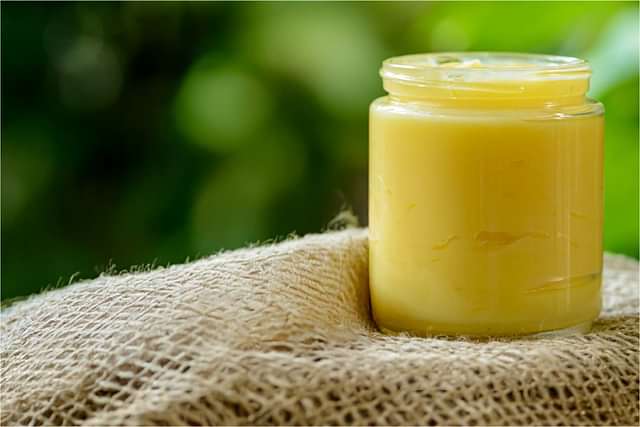
Jatyadi Ghrita takes its name from Jati (jasmine), one of its main herbal ingredients, and belongs to the Ghrita Kalpana (medicated ghee) category of classical Ayurvedic preparations. It is a polyherbal blend of herbs such as jasmine, neem and turmeric infused into purified ghee, and is described in classical Ayurvedic surgical literature as a preparation traditionally used for wound cleansing (Shodhana) and healing (Vrana Ropana).
Ghee-based preparations like this one are traditionally considered cooling in nature and are generally used to support tissue repair rather than to treat an underlying medical condition directly. It is traditionally prepared by simmering a paste of these herbs with purified ghee over several days, following classical Ayurvedic pharmaceutical methods.
Jatyadi Ghrita is traditionally applied externally for wounds, burns and a range of skin conditions, and is also used for anal fissures, fistula and piles-related discomfort to help ease discomfort and support wound care, generally alongside medical or Ayurvedic practitioner guidance.
Key Facts
| Feature | Details |
| Formulation name | Jatyadi Ghrita |
| Formulation type | Ghrita Kalpana (medicated ghee), for external use |
| Composition | A polyherbal blend of 17 herbal and mineral ingredients, including jasmine, neem, turmeric and manjistha, infused into purified ghee. |
| Classical proportion | Classical Ghrita Kalpana generally follows a 1:4:16 Sneha Paka ratio of Kalka (herb paste), Sneha (ghee) and Kwatha/Drava (liquid).
|
| Also known as | Jatyadi Ghritam, Jatyadi Ghee |
| Key active compounds | Potential marker compounds include azadirachtin and nimbin from neem, curcumin from turmeric, and berberine from Daruharidra, if included. Their presence and levels in the finished ghrita should be verified before publication. |
| Dosha action | Traditionally associated with Pitta pacification and wound and skin-tissue care through its Tikta, Ushna, Sodhana and Ropana properties. Exact Dosha action should be confirmed for the specific formulation.
|
| Traditional uses | Wound healing, burns, ulcers, skin conditions, anal fissures, fistula and piles discomfort
|
| Common forms | Medicated ghee for topical application
|
| General dosage | Apply a thin layer to the affected area, one to two times daily, or as directed by an Ayurvedic practitioner
|
| Best taken | For external use only. Not for internal consumption
|
| Key safety note | May cause mild irritation in sensitive skin. Do a patch test before first use, and consult a doctor before use in pregnancy or breastfeeding |
Alternative Names of Jatyadi Ghrita
Jatyadi Ghrita is a transliterated Sanskrit name rather than a translated one, so the list below covers its common spelling and naming variants rather than separate language translations.
- Jatyadi Ghritam (a common spelling variant, particularly in South India)
- Jatyadi Ghee (commonly used to describe the formulation)
Composition of Jatyadi Ghrita
Jatyadi Ghrita is a polyherbal formulation. The table below sets out its ingredients, based on a published pharmaceutical study of the formulation (Sharma & Rao, 2020).
| Sr. No. | Ingredient | Part used | Quantity (per 15 kg batch) |
| 1 | Jati (Jasminum officinale) | Leaves | 208.33 g |
| 2 | Nimba (Azadirachta indica) | Leaves | 208.33 g |
| 3 | Patola (Trichosanthes dioica) | Leaves/plant | 208.33 g |
| 4 | Naktamala (Pongamia pinnata) | Leaves | 208.33 g |
| 5 | Madhuka (Glycyrrhiza glabra) | Root | 208.33 g |
| 6 | Kushta (Saussurea lappa) | Root | 208.33 g |
| 7 | Haridra (Curcuma longa) | Rhizome | 208.33 g |
| 8 | Daruharidra (Berberis aristata) | Stem | 208.33 g |
| 9 | Manjishtha (Rubia cordifolia) | Stem | 208.33 g |
| 10 | Katurohini (Picrorhiza kurroa) | Rhizome | 208.33 g |
| 11 | Padmaka (Prunus cerasoides) | Heartwood | 208.33 g |
| 12 | Lodhra (Symplocos racemosa) | Stem bark | 208.33 g |
| 13 | Abhaya (Terminalia chebula) | Pulp | 208.33 g |
| 14 | Nilotpala (Nelumbo nucifera) | Flower | 208.33 g |
| 15 | Tutthaka (purified copper sulphate) | Mineral | 208.33 g |
| 16 | Sariva (Hemidesmus indicus) | Root | 208.33 g |
| 17 | Naktamala (Pongamia pinnata) | Seed | 208.33 g |
Chemical Constituents of Jatyadi Ghrita
Jatyadi Ghrita contains a range of naturally occurring plant compounds, contributed by its individual herbal ingredients.
- Curcumin (from turmeric)
- Nimbin and related limonoids (from neem)
- Chebulagic acid and related tannins (from Terminalia chebula)
- Purpurin and related anthraquinones (from manjistha)
Medicinal Properties of Jatyadi Ghrita
Jatyadi Ghrita is traditionally understood to have the following properties.
- Antibacterial
- Anti-inflammatory
- Wound-healing (Vranaropana)
- Antipruritic (may help ease itching)
- Emollient (skin-softening)
These properties are attributed to its blend of medicinal herbs, including neem, turmeric and manjistha, combined with a purified ghee base known for its soothing quality. Early laboratory research on the formulation has recorded antibacterial and anti-inflammatory activity in its extracts (Mandrika et al., 2021). As with many Ayurvedic formulations, these properties are supported mainly by traditional use and limited laboratory evidence rather than large-scale human trials, and should be understood in that context.
Key Health Benefits of Jatyadi Ghrita
Jatyadi Ghrita is traditionally used to support skin protection, wound care and comfort in certain skin and anorectal conditions. Its ingredients have shown antibacterial and anti-inflammatory activity in laboratory research, but clinical evidence in humans remains limited. It should be considered supportive care rather than a proven treatment for wounds, burns or skin conditions.
Antibacterial Action
Neem and turmeric, two of the key herbs in Jatyadi Ghrita, are traditionally recognised for their antibacterial properties, and a laboratory study on this formulation recorded antibacterial and anti-inflammatory activity in its extracts (Mandrika et al., 2021). This early laboratory evidence suggests that the formulation may have antibacterial activity, but it does not establish that Jatyadi Ghrita can prevent wound infections or improve healing in humans.
Anti-inflammatory Action
The herbs in Jatyadi Ghrita are traditionally valued for their anti-inflammatory properties, and the same laboratory study recorded anti-inflammatory activity in extracts of the formulation (Mandrika et al., 2021). This may indicate anti-inflammatory activity, although evidence from laboratory testing does not establish that it can reduce swelling or irritation in people with ulcers, burns or other skin conditions.
Moisturising and Skin-Protecting Quality
The ghee and beeswax base of Jatyadi Ghrita is traditionally valued for its moisturising quality. This may help soothe dry, cracked skin by forming a protective layer that helps retain moisture and reduce exposure to irritants, though this specific effect of Jatyadi Ghrita has not been established in clinical studies.
Supporting Tissue Repair
Jatyadi Ghrita is traditionally used to support the skin's natural tissue-repair process in wounds, ulcers and sores. Its traditional use may support wound care, but there is limited clinical evidence in humans to confirm its effectiveness for tissue repair. It should be used as part of a wider wound-care plan, alongside guidance from a doctor or Ayurvedic practitioner.
Easing Discomfort from Anorectal Conditions
Jatyadi Ghrita is traditionally applied to help ease discomfort associated with piles, anal fissures and, in some cases, pilonidal sinus. Its traditional use for soothing the anal area may support comfort, but evidence of its effectiveness for these conditions is limited in humans. It should be used alongside, not instead of, appropriate medical care for these conditions.
Supporting Even Skin Healing
Jatyadi Ghrita is traditionally believed to support more even skin healing by encouraging balanced tissue repair. This traditional use may make it a supportive option alongside proper wound care, though there is currently no established clinical evidence that it reduces scarring, so results can vary between individuals.
Common Uses for Jatyadi Ghrita
Jatyadi Ghrita is traditionally applied topically to support minor wounds, superficial burns, skin ulcers and certain anal or chronic skin conditions. It may also be used as supportive care for healing wounds and minor skin blemishes, but it should not replace appropriate medical treatment.
For Minor Cuts, Wounds and Sores
Jatyadi Ghrita is traditionally applied to minor cuts, open wounds and sores as part of routine wound care, usually after the area has been cleaned. Anything beyond a superficial injury should be assessed by a doctor first.
For Burns and Skin Ulcers
This ghee is traditionally used on superficial burns (Gupta et al., 2021) and skin ulcers (Jamadagni et al., 2016) as a soothing topical application. It is typically applied as a thin layer, and is not a substitute for medical treatment of deep or severe burns.
For Anal Fissures, Piles and Fistula
Jatyadi Ghrita is traditionally applied around the anal area for fissures, piles and fistula, usually alongside guidance from an Ayurvedic practitioner. It is used as a supportive, comfort-focused application rather than a stand-alone treatment for these conditions.
For Chronic Skin Conditions such as Eczema and Psoriasis
For ongoing skin conditions such as eczema and psoriasis, Jatyadi Ghrita is sometimes used as a supportive topical application alongside a dermatologist's or Ayurvedic practitioner's treatment plan, rather than as the main therapy for these conditions.
For Everyday Skin Blemishes
Jatyadi Ghrita is traditionally applied to minor skin blemishes as part of a topical skincare routine, generally as a short-term supportive measure rather than a treatment for an underlying acne condition.
For Post-Surgical Wound Care
Following minor surgical procedures, Jatyadi Ghrita is sometimes used on healing incisions under a doctor's or Ayurvedic practitioner's supervision, as part of the broader post-operative wound-care plan rather than in place of it.
Precautions While Using Jatyadi Ghrita
Keep the following points in mind to use Jatyadi Ghrita safely and appropriately.
- For External Use Only: Jatyadi Ghrita is intended for external use on the skin. Do not swallow it, as it is not formulated for internal use.
- Patch Test for Sensitive Skin: Before wider use, apply a small amount to a small area of skin and wait to check for redness, itching or swelling, particularly if you have sensitive skin or a history of allergies.
- Avoid Contact with Eyes and Mucous Membranes: Keep Jatyadi Ghrita away from the eyes, nose, mouth and other mucous membranes. If it accidentally gets into these areas, rinse with clean water and seek medical advice if irritation continues.
- Use in Pregnancy and Breastfeeding: Pregnant or breastfeeding women should consult a doctor or Ayurvedic practitioner before using Jatyadi Ghrita, as there is limited safety data specific to this formulation in pregnancy.
- Contains a Mineral Ingredient: Jatyadi Ghrita contains a small amount of purified copper sulphate (Tutthaka). Use it only as directed, and keep it out of reach of children to prevent accidental ingestion.
- Consultation for Chronic Conditions: If you have a chronic skin condition or are using other medicines, consult a doctor or Ayurvedic practitioner before using Jatyadi Ghrita, to make sure it does not interfere with your existing treatment.
- Avoid Applying to Unclean Wounds: Clean the affected area before applying Jatyadi Ghrita, as applying it to an unclean wound can increase the risk of infection.
Note: This information is for general awareness only and is not a substitute for professional medical advice.
How to Use Jatyadi Ghrita
Jatyadi Ghrita can be applied in a few different ways depending on the condition being managed. The methods for each common use are set out below.
1. For Wounds and Skin Conditions
Application steps:
- Wash the affected area with mild soap and water to reduce the risk of infection.
- Apply a thin layer of Jatyadi Ghrita to the clean, affected skin.
- For open wounds, cover the area with a sterile gauze dressing after application to help keep it clean.
2. For Piles and Anal Fissures
How to apply:
- Rinse the area with warm water and pat it dry gently.
- Wash your hands, then apply a small amount of Jatyadi Ghrita to the affected area.
- Use up to twice daily, or as advised by an Ayurvedic practitioner.
3. For Dry or Cracked Skin
Using it as a moisturiser:
- Take a pea-sized amount and apply it to dry areas such as the heels, elbows or lips.
- Massage gently until it is absorbed.
- Apply in the evening as part of a regular skincare routine if needed.
Herbs Traditionally Used With Jatyadi Ghrita
Jatyadi Ghrita is sometimes used together with other Ayurvedic preparations as part of a wider wound-care routine. A few of these are set out below.
| Preparation | Traditional role alongside Jatyadi Ghrita |
| Triphala Kwatha (decoction) | Triphala kwatha is traditionally used to gently cleanse a wound before Jatyadi Ghrita is applied, helping to prepare the skin as part of a combined wound-care routine. |
| Panchavalkala Kwatha | Sometimes used as a wound wash before Jatyadi Ghrita is applied, particularly in traditional Ayurvedic wound-care practice. |
| Yashtimadhu (liquorice) preparations | Yashtimadhu is occasionally used alongside Jatyadi Ghrita for its own soothing quality, particularly on sensitive or irritated skin. |
Recommended Dosage of Jatyadi Ghrita
Dosage needs can vary by age group. The guidance below is general; an Ayurvedic practitioner should confirm the appropriate amount and frequency for your situation.
- Children: Use in children should only be under the guidance of an Ayurvedic practitioner or doctor, with a patch test on a small area done first.
- Teenagers: The same general guidance as for adults applies, with a patch test recommended before first use, particularly for those with sensitive or acne-prone skin.
- Adults: Apply a thin layer to the affected area one to two times daily for general skin use, or up to twice daily for anal fissures and piles, unless a practitioner advises otherwise.
- Elderly: The same general guidance applies. Extra care is advised, as skin can be thinner and more fragile in older adults; a patch test is recommended, and any wound that has not started to heal within a few days should be reviewed by a doctor.
This information is for educational purposes only and should not be taken as medical advice. Dosage and suitability can differ for each individual. Self-medication may lead to adverse effects, so professional guidance is strongly recommended.
Side Effects of Jatyadi Ghrita
Jatyadi Ghrita is generally well tolerated for external use, though a small number of people may experience side effects.
Skin Irritation
Rare side effects include a rash or redness, particularly in people with sensitive skin. This may be a reaction to individual ingredients such as neem or turmeric.
Allergic Reactions
As with any topical product, some people may have an allergic reaction, such as itching, rash or swelling. A patch test before first use can help identify potential sensitivity early.
Photosensitivity
There is limited evidence that Jatyadi Ghrita causes photosensitivity. If you notice increased skin sensitivity or irritation after applying it, avoid direct sun exposure on the treated area and discontinue use.
Note: If you notice any of these reactions, stop use and speak to a doctor. This information is for general awareness only and does not replace professional medical advice.
Interaction of Jatyadi Ghrita with Other Drugs
Jatyadi Ghrita is used mainly on the skin, so it has limited potential for interactions with medicines taken by mouth. Even so, keep the following in mind.
Concurrent Topical Medicines
Avoid using Jatyadi Ghrita on the same area as other topical medicines without a healthcare provider's advice, as this could affect the absorption or effectiveness of the products.
Oral Medicines for Skin Conditions
If you are taking oral medicines for a skin condition, such as antibiotics or antifungals, check with a healthcare provider that using Jatyadi Ghrita alongside them is appropriate.
Known Hypersensitivity
Jatyadi Ghrita is best avoided if you have a known hypersensitivity to any of its ingredients. Always consider a patch test before first use, unless advised otherwise by a healthcare professional.
Note: This information is for general awareness only and is not a substitute for professional medical advice.
Storage of Jatyadi Ghrita
Store Jatyadi Ghrita in a cool, dry place, away from direct sunlight and heat, with the lid tightly closed after each use. Keep it out of reach of children. Do not use it after its expiry date, and stop using it if you notice any change in colour, smell or texture.
Key Takeaways
- Jatyadi Ghrita is a traditional Ayurvedic ghee formulation used for wounds, burns, ulcers and skin conditions, as well as for discomfort associated with anal fissures, fistula and piles. It is traditionally valued for its anti-inflammatory and antibacterial properties and is generally used to support skin healing rather than as a stand-alone treatment.
- It is generally well tolerated for topical use, though it may cause irritation in people with sensitive skin or a known allergy to any of its ingredients, so a patch test is recommended before first use.
- As a topical formulation, it has limited potential for interactions with medicines taken by mouth. It is still worth checking with a healthcare provider before combining it with other topical treatments, and it should be avoided if you have a known hypersensitivity to any of its ingredients.
FAQs
Is Jatyadi Ghrita good for the skin?
Can Jatyadi Ghrita be applied to an infected wound?
What are the side effects of Jatyadi Ghrita?
Can Jatyadi Ghrita be used for long periods of time?
Can Jatyadi Ghrita be used on burns?
Can Jatyadi Ghrita be used on the face?
Can Jatyadi Ghrita be used around the eyes?
References
- Mandrika, I., Kumar, S., Zandersone, B., Eranezhath, S. S., Petrovska, R., Liduma, I., Jezupovs, A., Pirags, V., & Tracevska, T. (2021). Antibacterial and anti-inflammatory potential of polyherbal formulation used in chronic wound healing. Evidence-Based Complementary and Alternative Medicine, 2021, Article 9991454. https://doi.org/10.1155/2021/9991454
- Sharma, P., & Rao, S. R. (2020). Pharmaceutico-analytical study of Jatyadi Ghrita and Jatyadi Ker Taila with special reference to their HPTLC fingerprint profile. International Journal of Ayurvedic and Herbal Medicine, 11(6), 22–26. https://doi.org/10.7897/2277-4343.1106179
- Gupta, V., Tyagi, A., Bhatnagar, A., Singh, S., Gaidhani, S. N., & Srikanth, N. (2021). Topical application of Jatyadi Ghrita and Jatyadi Taila accelerates wound healing in Sprague-Dawley rats: A study in gamma-radiation-induced skin wound model. International Journal of Radiation Biology, 97(7), 1003–1019. https://doi.org/10.1080/09553002.2021.1913526
- Jamadagni, P. S., Jamadagni, S., Mukherjee, K., Upadhyay, S., Gaidhani, S., & Hazra, J. (2016). Experimental and histopathological observation scoring methods for evaluation of wound healing properties of Jatyadi Ghrita. AYU, 37(3–4), 222–229. https://doi.org/10.4103/ayu.AYU_51_17

Explore other categories
Latest health articles





Top Health Essentials


Top-selling ayurvedic products












Disclaimer
Top-Selling Medicines:
...View more
Top-OTC medicines:
...View more
Top-selling healthcare devices:
...View more
Company
About UsHealth ArticleHealth StoriesHealth LibraryDiseases & Health ConditionsAyurvedaUnderstanding Generic MedicinesAll MedicinesAll BrandsNeed HelpFAQSecuritySavings CalculatorAdvertise with UsSubscribe
Registered Office Address
Grievance Officer
Download Truemeds


Contact Us
Our customer representative team is available 7 days a week from 9 am - 9 pm.
v4.28.14

2026 - Truemeds | All rights reserved. Our content is for informational purposes only. See additional information.

Our Payment Partners




