

- Medicines
- Personal Care
- Skin Cream
- Sunscreen
- Face Wash
- Skin and Body Soap
- Acne Care
- Body Lotions
- Moisturising Lotion
- Moisturising Cream
- Mosquito Repellent
- Moisturising Gel
- Body Wash
- Hair Oils
- Hair Shampoo
- Hair Conditioners
- Hair Supplements
- Hair Colour
- Hair Serum
- Hair Mask
- Hair Solutions
- Baby Diapers and Wipes
- Baby Lotion and Moisturising Cream
- Baby Bath Essentials
- Baby Skin Care
- Baby and Infant Food
- Baby Healthcare
- Women Multivitamins
- Ovulation Test Kit and Women Intimate Care
- Sanitary Pads
- Nutritional Drinks
- Condoms
- Lubricants
- Massage Gels
- Personal Body Massagers
- Men Performance Booster
- Sexual Health Supplements
- Massage Oils
- Ayurveda
- Tooth Paste
- Mouth Ulcer Gel
- Mouthwash
- Toothache and Gum Pain
- Tooth Brush
- Gargle Solution
- Orthopaedic Supports
- Adult Diapers
- Footwear
- Mobility and Support Accessories
- Urinary Support and Care
- Health Conditions
- Bone and Joint Care
- Digestive Care
- Eye Care
- Pain Relief
- Smoking Cessation
- Liver Care
- Stomach Care
- Cold and Cough
- Heart Care
- Kidney Care
- Piles, Fissures & Fistula
- Respiratory Care
- Mental Wellness
- Derma Care
- Pre and Probiotics
- Acidity
- Gas
- Constipation
- Loose Motion/Diarrhoea
- Digestive Fibres
- Digestive Enzymes
- Eye Lubricant Drops
- Lens Solution
- Safety Eye Wear
- Eye Cream
- Eye Vitamins and Supplements
- Eye Drops
- Eye Ointment and Gel
- Nicotine Patch
- Nicotine Gum
- Nicotine Lozenges
- Cough Syrups
- Chest Rubs and Balms
- Nasal Spray
- Lozenges
- Inhalant Capsules
- Cold and Cough Tablets
- Vitamins & Supplements
- Diabetes Care
- Healthcare Devices
- Homeopathic Medicine
- Health Guide
Chandraprabha Vati
Chandraprabha Vati is a classical Ayurvedic tablet, described in the Sharangadhara Samhita, made from about 37 ingredients. These include herbs such as Triphala and Guggulu; Shilajit; camphor; three types of lavana; and the mineral preparations Loha Bhasma and Swarna Makshika Bhasma. It is traditionally used for Prameha, the Ayurvedic group of urinary and metabolic disorders, and for difficult or painful urination. Classical texts also describe it as a Rasayana, a rejuvenative formulation traditionally used to support strength and vitality.
 50
50Last updated on : 14 Aug, 2026
Read time : 22 mins
What is Chandraprabha Vati?
Chandraprabha Vati means moonlight. Chandra is the moon and prabha is glow. Two explanations are given for it. The first is that Chandraprabha is a classical synonym for karpura, camphor, which heads the ingredient list and is pale and translucent. The second refers to the effect described in the texts, where a person taking it is said to regain a clear, moon-like appearance.
The formulation is set out in the Sharangadhara Samhita, in the Madhyama Khanda chapter on tablets, and appears again in the Bhaishajya Ratnavali under the treatment of Prameha, and in the Yogaratnakara, the Gada Nigraha and the Rasaratna Samuccaya. Versions differ slightly between these texts. Indian manufacturers prepare it to the standard set out in the Ayurvedic Formulary of India, Part I. Classical writers also call it Sarvaroga Prashamani, a name reflecting how broadly it was prescribed rather than evidence of its effectiveness for any single condition. Ayurvedic classification of Chandraprabha Vati:
- Formulation class: Vati or Gutika Kalpana, the group of Ayurvedic tablets and pills
- Rasa (taste): predominantly katu (pungent), tikta (bitter) and kashaya (astringent)
- Virya (potency): ushna, meaning hot in action
- Vipaka (taste after digestion): katu, meaning pungent
- Dosha action: described as tridosha shamaka, meaning traditionally considered to balance all three doshas, with the strongest action on Kapha and Vata
- Karma (actions): Rasayana (rejuvenative), Balya (strengthening), Mutrala (increases urine flow), and Deepana with Pachana (improves appetite and digestion)
- Classical indication group: Prameha, Mutrakrichhra (difficult urination), Ashmari (urinary stones) and Arshas (piles)
Key Facts
| Feature | Details |
| Formulation name | Chandraprabha Vati
|
| Formulation type | Classical Ayurvedic herbo-mineral tablet (vati or gutika) |
| Classical reference | Sharangadhara Samhita, Madhyama Khanda, chapter on tablets. Also described in Bhaishajya Ratnavali, Yogaratnakara, Gada Nigraha and Rasaratna Samuccaya. |
| Composition | About 37 ingredients. Herbs including Karpura, Vacha, Musta, Guduchi, Haridra, Daruharidra, Chitraka, Triphala, Trikatu, Trivrit, Danti, Twak, Ela, Patra, Vamshalochana and Guggulu. Minerals including Shuddha Shilajatu, Loha Bhasma and Swarna Makshika Bhasma. Two alkalis, Yavakshara and Sarjikshara. Three salts, Saindhava, Sauvarchala and Vida. Sita (sugar) as the base. |
| Classical proportion | Most ingredients are taken in equal parts, with Sita, Shilajatu and Guggulu in larger quantities as the base of the tablet. Proportions vary between classical texts. |
| Also known as | Chandraprabha Gutika, Chandraprabha Gulika, Chandraprabha Vatika
|
| Key active compounds | Camphor from Karpura; guggulsterones from Guggulu; curcumin from Haridra; berberine from Daruharidra; piperine from the Trikatu group; fulvic and humic acids from Shilajit; tannins and gallic acid from Triphala; iron oxides from Loha Bhasma; copper and iron sulphides from Swarna Makshika Bhasma |
| Dosha action | Described as tridosha shamaka, traditionally considered to balance all three doshas, with the strongest action on Kapha and Vata. Ushna virya, hot in potency |
| Traditional uses | Prameha, the classical group of urinary and metabolic disorders; difficult or painful urination; poor appetite and sluggish digestion; weakness after illness; Vata-related joint and back discomfort
|
| Common forms | Commonly available as tablets or vati, with strength and composition varying between manufacturers
|
| General dosage | 1 to 2 tablets twice daily after food with warm water, or as directed by a registered Ayurvedic practitioner |
| Best taken | After meals, with warm water. Avoid taking it on an empty stomach.
|
| Key safety note | Contains camphor, iron (Loha Bhasma), a copper-iron mineral (Swarna Makshika Bhasma) and a high salt and alkali load. Use in children, pregnancy and breastfeeding should be avoided unless specifically advised by a qualified healthcare professional. People with kidney disease, uncontrolled high blood pressure or iron overload conditions should consult a doctor before use. Keep out of reach of children |
Alternative Names of Chandraprabha Vati
Chandraprabha Vati is a Sanskrit name that is transliterated rather than translated, so the entries below are genuine spelling variants and classical synonyms for the same formulation.
- Sanskrit / Devanagari: Chandraprabha Vati
- Common spelling variants: Chandraprabha Vati, Chandraprabha Gutika, Chandraprabha Vatika, Chandrprabha Vati
- Southern India, Malayalam and Kannada usage: Chandraprabha Gulika
Composition of Chandraprabha Vati
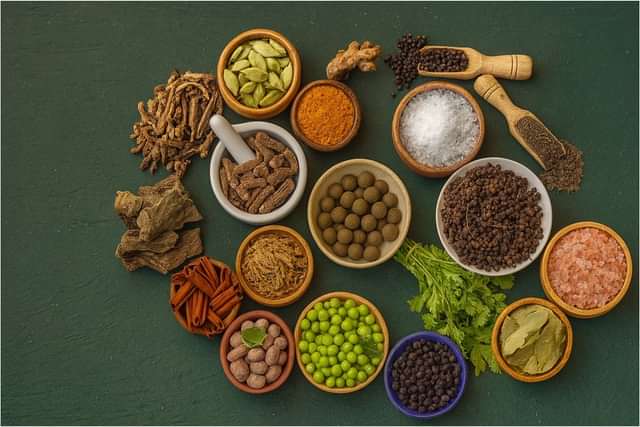
The formulation is built from four groups of ingredients: herbs, minerals and bhasmas, alkalis and salts, and a sweet base that binds the tablet.
| Group | Ingredients |
| Herbs and plant materials | Karpura or camphor (Cinnamomum camphora), Vacha (Acorus calamus), Musta (Cyperus rotundus), Bhunimba (Andrographis paniculata), Guduchi (Tinospora cordifolia), Devadaru (Cedrus deodara), Haridra (Curcuma longa), Ativisha (Aconitum heterophyllum), Daruharidra (Berberis aristata), Pippalimula (Piper longum root), Chitraka root (Plumbago zeylanica), Dhanyaka (Coriandrum sativum), Haritaki (Terminalia chebula), Bibhitaki (Terminalia bellirica), Amalaki (Emblica officinalis), Chavya (Piper chaba), Vidanga (Embelia ribes), Gajapippali (Scindapsus officinalis), Shunthi (Zingiber officinale), Maricha (Piper nigrum), Pippali (Piper longum), Trivrit (Operculina turpethum), Danti (Baliospermum montanum), Patra (Cinnamomum tamala), Twak (Cinnamomum zeylanicum), Ela (Elettaria cardamomum), Vamshalochana (bamboo exudate) and purified Guggulu (Commiphora wightii) |
| Minerals and bhasmas | Purified Shilajatu, Loha Bhasma (an iron preparation) and Swarna Makshika Bhasma (a copper and iron mineral preparation) |
| Alkalis (kshara) | Yavakshara and Sarjikshara |
| Salts (lavana) | Saindhava (rock salt), Sauvarchala and Vida |
| Base | Sita, refined sugar, which forms the bulk of the tablet |
Chemical Constituents of Chandraprabha Vati
The compounds below have been identified in the individual ingredients that make up this formulation.
- Camphor, the main constituent of Karpura and a key compound in the formulation
- Guggulsterones E and Z, the steroid compounds in purified Guggulu
- Curcumin and related curcuminoids from Haridra
- Berberine, an alkaloid from Daruharidra
- Piperine, from Maricha, Pippali, Pippalimula and Chavya
- Gingerols and shogaols from Shunthi
- Tannins, gallic acid, chebulinic acid and ellagic acid from the three Triphala fruits
- Embelin from Vidanga
- Andrographolide from Bhunimba
- Fulvic acid, humic acid and dibenzo-alpha-pyrones from Shilajit
- Beta-asarone from Vacha
- Plumbagin from Chitraka root
- Iron oxides, chiefly ferric and ferrosoferric oxide, from Loha Bhasma
- Copper and iron sulphides from Swarna Makshika Bhasma
- Potassium and sodium carbonates from Yavakshara and Sarjikshara
- Sodium chloride from the three lavanas, together with sulphur-containing compounds that give Sauvarchala and Vida their characteristic smell
Medicinal Properties of Chandraprabha Vati
Classical texts and published laboratory work describe Chandraprabha Vati as having the following actions.
- Mutrala (diuretic): may increase the flow of urine
- Deepana and Pachana: is traditionally believed to improve appetite and digestion
- Anti-inflammatory activity: laboratory findings involving certain ingredients suggest possible anti-inflammatory activity
- Antimicrobial: laboratory studies suggest activity against some organisms
- Antioxidant: laboratory studies suggest potential antioxidant activity
- Blood-glucose lowering in animals: reduced plasma glucose in rats with experimentally induced high blood sugar
- Lipid lowering in animals: reduced cholesterol and triglycerides in the same rat study
- Rasayana and Balya: traditionally believed to restore strength after depletion
- Anulomana (mild laxative): the Trivrit and Danti in the formula are traditionally considered to support bowel movement
The glucose and lipid findings come from a single study in rats. No human trial has tested this formulation for these effects, so they should be considered potential effects observed in animals rather than proven effects in humans.
Health Benefits of Chandraprabha Vati
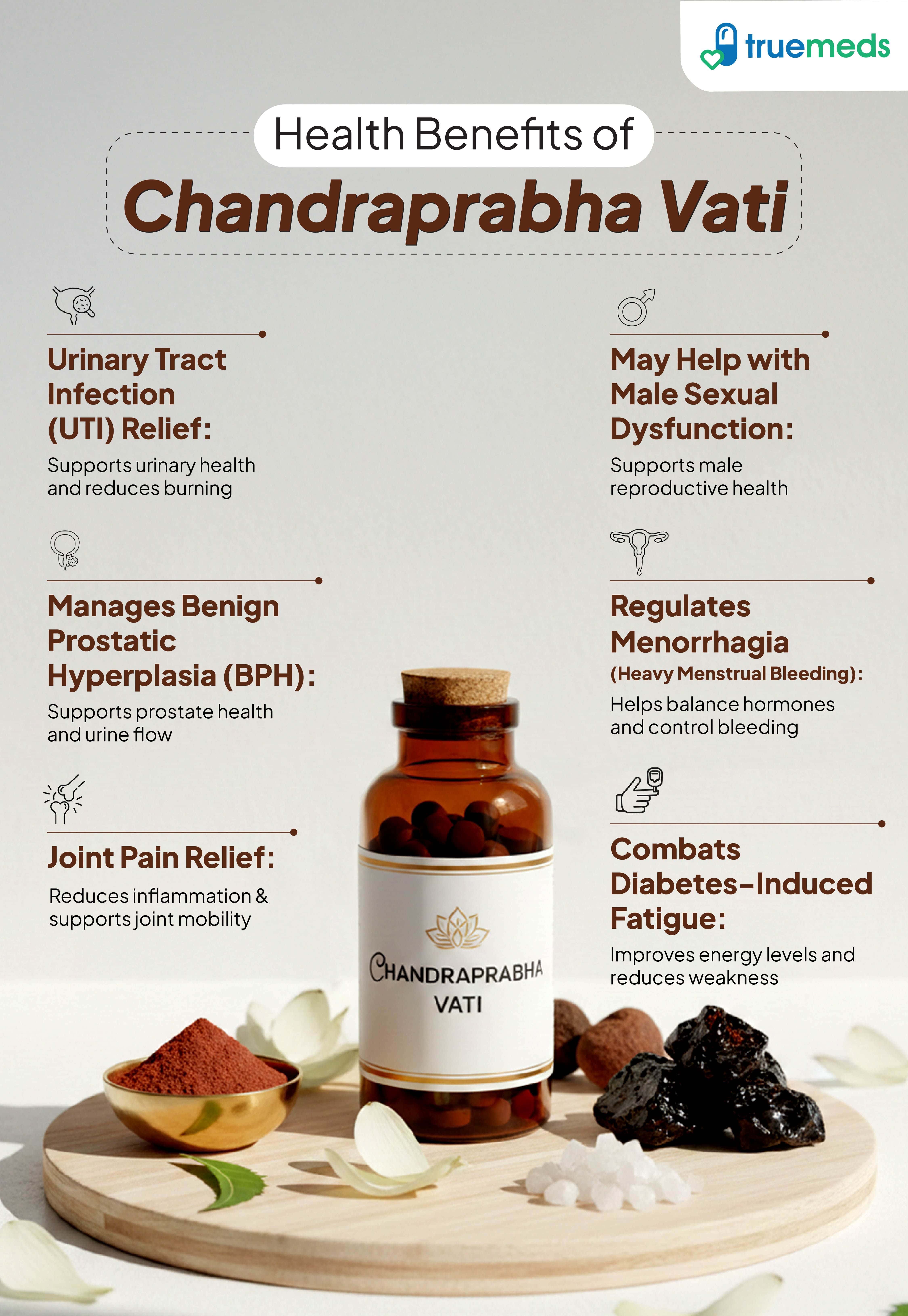
Chandraprabha Vati has several traditional Ayurvedic uses based on its ingredients and their described actions. Evidence from laboratory and animal studies is limited, and human trials of the finished formulation are lacking.
Supports Comfortable Passing of Urine
Ayurveda classifies several ingredients in this preparation as mutrala, meaning they are traditionally considered to support urine flow. Chandraprabha Vati is traditionally used when urination is slow, scanty or uncomfortable. It is supportive care only, and any burning, blood in the urine or fever requires prompt medical assessment.
Aids Appetite and Digestion
The Chandraprabha Vati formulation contains Trikatu, Chitraka and the three salts, which are traditionally described in Ayurveda as Deepana and Pachana, supporting appetite and digestion. This is the reasoning behind its traditional use where appetite is poor and digestion feels sluggish.
Helps Ease Vata-Related Joint and Back Discomfort
Guggulu and Shilajit are classed in Ayurveda as Vata-settling ingredients, and Guggulu has shown anti-inflammatory activity in laboratory testing. The formulation is traditionally used for everyday stiffness and low backache. It does not replace treatment prescribed for a diagnosed joint disease.
Supports Recovery of Strength After Illness
Classical texts place this preparation among Rasayana and Balya preparations, traditionally used to support strength and recovery after depletion. It is traditionally believed that supporting appetite and digestion may help with nourishment and recovery after a long illness.
Supplies Antioxidant Plant Compounds
Triphala, Haridra and Guduchi in the preparation contain tannins, curcumin and other polyphenols that show antioxidant activity in laboratory testing. This describes a possible mechanism rather than a proven benefit, because no human trial has measured antioxidant effects from Chandraprabha Vati.
Disclaimer: These describe traditional Ayurvedic use supported mainly by laboratory and animal research. Chandraprabha Vati is not a treatment for any diagnosed medical condition, does not replace medicine your doctor has prescribed, and should be taken only on the advice of a registered Ayurvedic practitioner.
Common Uses of Chandraprabha Vati
The situations below describe when an Ayurvedic practitioner would typically consider using this formulation, as distinct from how it is thought to work.
Within the Classical Category of Prameha
Prameha is the Ayurvedic group covering disorders of urine and metabolism. It is the classical indication for this formulation, and it is broader than any single modern diagnosis. A practitioner assesses whether the person's symptoms and condition fit this traditional indication before prescribing.
Where Passing Urine Is Slow or Uncomfortable
Mutrakrichhra, meaning difficult urination, is the second classical indication. The formulation may be used as supportive care while the underlying cause is assessed, not as a substitute for that investigation.
Alongside Treatment a Doctor Has Already Prescribed
Where someone is under treatment for a urinary or metabolic condition, this formulation is sometimes added as supportive care. Tell the treating doctor about the formulation so that its ingredients can be considered alongside prescribed medicines and existing health conditions.
During Recovery From a Long Illness
Convalescence, with poor appetite and low energy, is a classical indication for Rasayana preparations. Chandraprabha Vati is traditionally used in short courses with appropriate clinical review, rather than as an ongoing daily supplement.
Precautions While Taking Chandraprabha Vati
Before taking Chandraprabha Vati, tell your doctor and Ayurvedic practitioner about all other medicines and supplements you take.
- The formulation also contains an iron preparation. Accidental ingestion of multiple tablets may be harmful, so the container must be kept securely out of children’s reach.
- Keep the container out of the sight and reach of children, and close it properly after each dose. This is the single most important storage instruction for any iron-containing tablet.
- Avoid Chandraprabha Vati during pregnancy unless specifically prescribed following an individual medical assessment.
- Consult your doctor before taking it while breastfeeding. There is no safety data for this formulation in breastfeeding, and camphor can pass into breast milk.
- People with kidney disease should consult their doctor before use because the formulation contains several mineral ingredients, salts, and alkalis, and its safety has not been established in renal impairment.
- If you have high blood pressure or heart failure, consult your doctor before taking it. The formulation contains three rock salts and two alkalis, which together contribute sodium to your daily intake.
- Do not take it if you have an iron overload condition, such as haemochromatosis or thalassaemia, or if you receive regular blood transfusions. It contains an iron preparation.
- Tell your doctor if you take diabetes medicine or insulin. The formulation lowered blood glucose in animal studies, so blood sugar could potentially fall further when combined with glucose-lowering treatment.
- Stop it at least two weeks before planned surgery, and tell your surgeon. Guggulu may affect platelet function and blood clotting, although evidence is limited.
- Buy only from a licensed manufacturer that batch-tests for heavy metals. This is a herbo-mineral product, and the quality of the bhasmas depends on their preparation and quality control.
- Stop taking Chandraprabha Vati and seek medical advice if you develop a rash, itching, swelling of the face or lips, or difficulty breathing. These may be signs of an allergic reaction.
Disclaimer: This list covers the main precautions and is not exhaustive. It does not replace advice from a registered medical practitioner or Ayurvedic physician who knows your medical history.
How to Use Chandraprabha Vati
The steps below explain how to take the tablet and complete the prescribed course.
Taking the Tablet
Swallow the tablet whole with a glass of warm water. Do not crush or chew it. If swallowing whole is difficult, consult your practitioner rather than breaking the tablet yourself.
Timing It Around Meals
Take it after food, rather than on an empty stomach. The formulation is hot in potency and contains pungent herbs, alkalis and salts, so taking it before food may cause burning or acidity in some people.
Spacing It From Other Medicines
Leave at least two hours between this tablet and thyroid medicine, quinolone or tetracycline antibiotics, or bone-strengthening tablets. The iron in the formulation can reduce how much of those medicines your body absorbs.
What to Avoid While Taking It
Avoid taking it with tea or coffee, which can reduce iron absorption. Ayurvedic practitioners also advise limiting very sour, very salty and deep-fried food during a course, as these are considered to work against the medicine.
Finishing the Course
Take it for the period your practitioner has set and have a review at the end of the course. Do not extend the course on your own. If symptoms have not improved by the review date, consult your practitioner or doctor for reassessment rather than continuing the formulation.
Herbs Traditionally Used With Chandraprabha Vati
Ayurvedic practitioners may prescribe one of the herbs below alongside Chandraprabha Vati, chosen according to the person's individual needs.
| Herb | Why it is used alongside |
| Gokshura (Tribulus terrestris) | Gokshura is traditionally paired with this formulation for urinary complaints. Ayurveda classifies it as mutrala and traditionally describes it as soothing to the urinary tract, which may complement the formulation's heating quality. |
| Punarnava (Boerhaavia diffusa) | Punarnava is traditionally given where there is puffiness or fluid retention alongside urinary symptoms. It is traditionally described as supporting fluid balance and normal urine output. |
| Varuna (Crataeva nurvala) | Varuna is the classical choice where urine flow is slow or the stream is poor. It is often prescribed as a decoction taken separately rather than combined into the same tablet. |
| Shatavari (Asparagus racemosus) | Shatavari is traditionally considered cooling and nourishing, and is added where the hot potency of Chandraprabha Vati would otherwise aggravate Pitta, or where there is burning on passing urine. |
| Guduchi (Tinospora cordifolia) | Guduchi is used during recovery from illness for its traditional strengthening properties. It also appears inside the formulation itself, so the reviewer should confirm whether adding more is appropriate. |
These combinations reflect traditional practice, not fixed prescriptions. Which herb suits you, and in what amount, is a decision for a registered Ayurvedic practitioner.
Recommended Dosage of Chandraprabha Vati
The amounts below are general ranges described for Ayurvedic use. Your own dose depends on your age, other medicines and kidney function, so it must be set by a registered practitioner.
| Age group | General range | Notes |
| Children under 12 years | Not suitable | This formulation contains camphor and an iron preparation. It should not be given to children. |
| Teenagers 12 to 17 years | Only on prescription | A practitioner may prescribe a reduced adult dose where there is a clear reason, but this must be individually assessed and supervised. |
| Adults 18 to 64 years | 1 to 2 tablets twice daily | Tablets are usually 250 mg or 500 mg. Taken after food with warm water. The appropriate dose should be determined by a registered Ayurvedic practitioner. |
| Older adults 65 and above | 1 tablet twice daily, or lower | Start low. Reduced kidney function, a higher chance of taking other medicines, and greater sensitivity to the salt load all support using the lowest appropriate dose. |
If you miss a dose, take the next dose at the usual time and carry on as normal. Do not take a double dose to make up for it.
Do not continue beyond the period your practitioner has set without a review. Because Chandraprabha Vati contains metal preparations, prolonged use should be periodically reassessed by your practitioner rather than continued without supervision.
Disclaimer: These ranges are general information and are not a prescription. Dosage must be set by a registered medical practitioner or Ayurvedic physician who knows your medical history and your current medicines.
Side Effects of Chandraprabha Vati
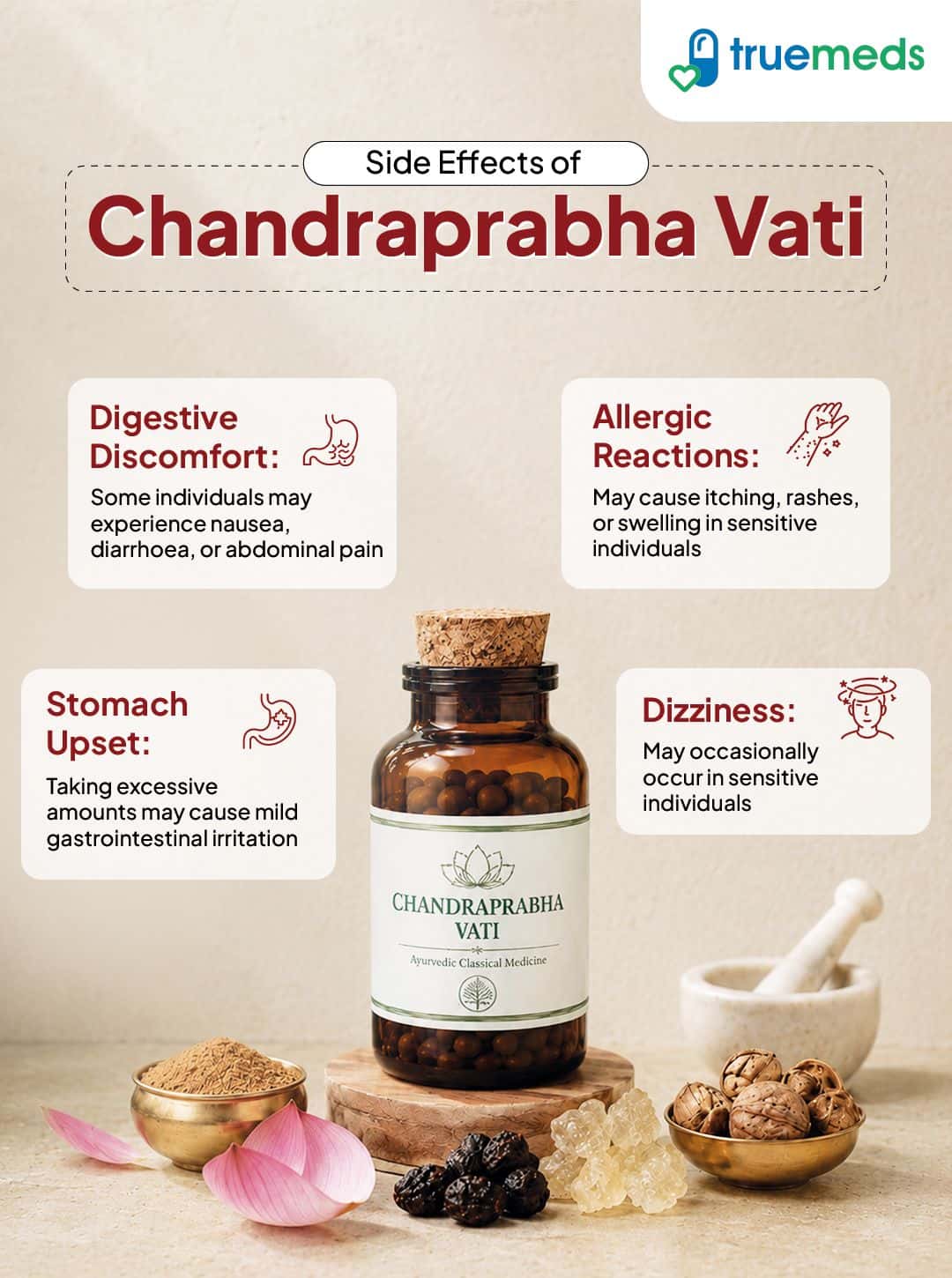
Taken after food at the prescribed dose, Chandraprabha Vati is generally tolerated, but side effects can occur. The effects below may occur during use.
 Burning, Acidity and Stomach Discomfort
The formulation is hot in potency and contains pungent herbs, two alkalis and three salts, so some people may experience burning, reflux or a sour taste, particularly if it is taken before food. Taking it after a meal may reduce these symptoms.
Loose Stools or Constipation
The formula contains ingredients that may affect bowel movements in different ways. Trivrit and Danti are traditionally used as purgatives and can loosen the bowel, while the iron in Loha Bhasma may cause constipation. Which effect you notice depends on the person and the dose.
Darkening of the Stools
Iron can turn stools very dark or black. This is a known effect of iron-containing preparations. However, black stools can also indicate bleeding from the stomach or bowel, so tell your doctor you are taking an iron-containing preparation if this is being investigated.
Nausea and Metallic Taste
Some people may experience nausea or a metallic taste in the mouth, particularly at higher doses. Taking the tablet with food and a full glass of water may help reduce these effects.
Allergic Reactions
The formula contains around 37 ingredients, so an allergic reaction is possible. Rash, itching, swelling of the face or lips, or difficulty breathing may indicate an allergic reaction and requires prompt medical attention.
Low Blood Sugar Alongside Diabetes Medicine
The formulation lowered blood glucose in animal studies (Wanjari et al., 2016). Taken with metformin, a sulfonylurea or insulin, blood sugar may fall further than expected. Shakiness, sweating and confusion can be warning signs of low blood sugar.
Effects Linked to the Salt and Alkali Content
Three rock salts and two alkalis add sodium to your daily intake. Anyone with high blood pressure, heart failure or reduced kidney function may be more sensitive to a high sodium intake and may experience fluid retention or a rise in blood pressure.
When to seek medical help: Seek urgent medical attention for swelling of the face, lips or tongue, difficulty breathing, a rash that spreads quickly, vomiting that will not settle, or signs of low blood sugar. Consult your practitioner about milder effects that persist for more than a few days.
Interaction of Chandraprabha Vati With Other Drugs
Tell your doctor and pharmacist that you are taking this formulation. The combinations below matter most, and several are related to the iron and Guggulu it contains.
Medicines Whose Absorption Iron Reduces
Iron binds several medicines in the gut and reduces how much is absorbed. This affects levothyroxine, quinolone antibiotics such as ciprofloxacin, tetracycline antibiotics, bisphosphonates for bone strength, levodopa, methyldopa, penicillamine and mycophenolate. These medicines may need to be taken at a different time from Chandraprabha Vati. Consult your doctor or pharmacist for the appropriate interval.
Diabetes Medicines and Insulin
The formulation lowered blood glucose in animal studies. Alongside metformin, a sulfonylurea or insulin, blood sugar may drop further than intended. Anyone taking both should monitor their blood glucose and have their treatment reviewed by their doctor.
Thyroid Medicine
Two separate issues arise here. Guggulu has been studied for possible effects on thyroid function, and the iron content reduces how much levothyroxine is absorbed. Consult your doctor before combining this formulation with thyroid medicine, particularly during prolonged use.
Aspirin, Blood Thinners and Antiplatelet Medicines
Guggulu may affect platelet function and blood clotting, although evidence is limited. Taken with warfarin, clopidogrel or regular aspirin, the effects may potentially increase the risk of bleeding. Report any unusual bruising, nosebleeds or bleeding gums to your doctor.
Blood Pressure and Heart Failure Medicines
The three salts and two alkalis in the formulation add sodium, which may affect blood pressure and fluid balance. Consult your doctor before using it if you take medicines for high blood pressure or heart failure.
Other Iron Supplements and Multivitamins
Taking this alongside a prescribed iron tablet or an iron-containing multivitamin can increase your total iron intake. A practitioner should look at the combined total rather than each product on its own.
Disclaimer: This is not a complete list of interactions. Always check with your doctor or pharmacist before combining this formulation with any prescription medicine.
Storage of Chandraprabha Vati
- Keep the container out of the sight and reach of children, and close the cap tightly after every dose. Accidental swallowing of iron-containing tablets can cause serious poisoning in young children.
- Store in a cool, dry place away from direct sunlight and moisture. Keep it out of the bathroom and away from sources of heat and steam, such as the kitchen hob.
- Keep the tablets in their original container with the label and batch number intact. Do not decant them into a pill box shared with other medicines.
- Camphor gives the tablets a distinctive smell. Do not use the tablets if they develop an unusual or unpleasant smell.
- Check the expiry date before each course and do not use the pack beyond it.
- Do not use tablets that have gone soft, discoloured, crumbly or stuck together, which may indicate exposure to moisture or deterioration.
- Dispose of unused or expired tablets safely according to local pharmacy or medicine-disposal guidance.
Key Takeaways
- Chandraprabha Vati is a classical Ayurvedic herbo-mineral tablet of about 37 ingredients, described in the Sharangadhara Samhita and listed in the Ayurvedic Formulary of India.
- It is hot in potency, traditionally described as balancing all three doshas with the strongest action on Kapha and Vata, and is classically indicated in Prameha and difficult urination.
- Traditional uses include supporting comfortable passing of urine, supporting appetite and digestion, easing Vata-related joint and back discomfort, and supporting recovery of strength after illness.
- The supporting research comes mainly from animal and laboratory work. No human trial has tested this formulation, so the evidence base is limited.
- It contains camphor, an iron preparation (Loha Bhasma), a copper and iron preparation (Swarna Makshika Bhasma), two alkalis and three rock salts.
- It is not suitable for children, and the container must be kept out of their reach, because accidental iron overdose can cause serious poisoning in young children.
- It should not be taken during pregnancy, or without medical advice if you have kidney disease, iron overload conditions such as haemochromatosis or thalassaemia, or an active stomach ulcer.
- Tell your doctor if you take thyroid medicine, diabetes medicine, blood thinners, aspirin or antibiotics, as the iron and Guggulu in it may interact with some of these medicines.
- Common side effects may include acidity, constipation or loose stools, and darkened stools from the iron. Stop taking it and seek medical advice for rash, facial swelling or difficulty breathing.
- It is not a substitute for treatment your doctor has prescribed, and it should be taken as a reviewed course under the guidance of a registered Ayurvedic practitioner.
FAQs
What is Chandraprabha Vati used for in Ayurveda?
Does it contain metals?
Can children take it?
Who should consult a doctor before taking it?
Does it interact with prescription medicines?
Can Chandraprabha Vati cause stomach irritation or acidity?
How long can it be taken for?
How should it be stored?
References
- Wanjari, M. M., Mishra, S., Dey, Y. N., Sharma, D., Gaidhani, S. N., & Jadhav, A. D. (2016). Antidiabetic activity of Chandraprabha vati: A classical Ayurvedic formulation. Journal of Ayurveda and Integrative Medicine, 7(3), 144–150. https://doi.org/10.1016/j.jaim.2016.08.010
- Khine, H., Weiss, D., Graber, N., Hoffman, R. S., Esteban-Cruciani, N., & Avner, J. R. (2009). A cluster of children with seizures caused by camphor poisoning. Pediatrics, 123(5), 1269–1272. https://doi.org/10.1542/peds.2008-2097
Other Ayurvedic Ingredients


Explore other categories
Latest health articles





Top Health Essentials



Top-selling ayurvedic products













Disclaimer
Top-Selling Medicines:
...View more
Top-OTC medicines:
...View more
Top-selling healthcare devices:
...View more
Company
About UsHealth ArticleHealth StoriesHealth LibraryDiseases & Health ConditionsAyurvedaUnderstanding Generic MedicinesAll MedicinesAll BrandsNeed HelpFAQSecuritySavings CalculatorAdvertise with UsSubscribe
Registered Office Address
Grievance Officer
Download Truemeds


Contact Us
Our customer representative team is available 7 days a week from 9 am - 9 pm.
v4.28.13

2026 - Truemeds | All rights reserved. Our content is for informational purposes only. See additional information.

Our Payment Partners




