- Medicines
- Lab Tests
- Personal Care
- Skin Cream
- Sunscreen
- Face Wash
- Skin and Body Soap
- Acne Care
- Body Lotions
- Moisturising Lotion
- Moisturising Cream
- Mosquito Repellent
- Moisturising Gel
- Body Wash
- Hair Oils
- Hair Shampoo
- Hair Conditioners
- Hair Supplements
- Hair Colour
- Hair Serum
- Hair Mask
- Hair Solutions
- Baby Diapers and Wipes
- Baby Lotion and Moisturising Cream
- Baby Bath Essentials
- Baby Skin Care
- Baby and Infant Food
- Baby Healthcare
- Women Multivitamins
- Ovulation Test Kit and Women Intimate Care
- Sanitary Pads
- Nutritional Drinks
- Condoms
- Lubricants
- Massage Gels
- Personal Body Massagers
- Men Performance Booster
- Sexual Health Supplements
- Massage Oils
- Ayurveda
- Tooth Paste
- Mouth Ulcer Gel
- Mouthwash
- Toothache and Gum Pain
- Tooth Brush
- Gargle Solution
- Orthopaedic Supports
- Adult Diapers
- Footwear
- Mobility and Support Accessories
- Urinary Support and Care
- Health Conditions
- Bone and Joint Care
- Digestive Care
- Eye Care
- Pain Relief
- Smoking Cessation
- Liver Care
- Stomach Care
- Cold and Cough
- Heart Care
- Kidney Care
- Piles, Fissures & Fistula
- Respiratory Care
- Mental Wellness
- Derma Care
- Pre and Probiotics
- Acidity
- Gas
- Constipation
- Loose Motion/Diarrhoea
- Digestive Fibres
- Digestive Enzymes
- Eye Lubricant Drops
- Lens Solution
- Safety Eye Wear
- Eye Cream
- Eye Vitamins and Supplements
- Eye Drops
- Eye Ointment and Gel
- Nicotine Patch
- Nicotine Gum
- Nicotine Lozenges
- Cough Syrups
- Chest Rubs and Balms
- Nasal Spray
- Lozenges
- Inhalant Capsules
- Cold and Cough Tablets
- Vitamins & Supplements
- Diabetes Care
- Healthcare Devices
- Homeopathic Medicine
- Health Guide
Arogyavardhini Vati
Arogyavardhini Vati, also called Arogyavardhini Rasa, is a classical Ayurvedic herbo-mineral tablet described in the Rasaratna Samuccaya. It combines herbs such as Kutki, Triphala, Guggulu, Neem and Chitraka with purified minerals and metals, including a mercury-sulphur base. In traditional practice it is used mainly to support liver function and digestion. Because it contains metallic ingredients, it should be taken only when prescribed by a registered Ayurvedic physician.
 50
Last updated on : 13 Aug, 2026
Read time : 12 mins

What is Arogyavardhini Vati?
Arogyavardhini Vati is a classical herbo-mineral formulation (a Rasaushadhi) prepared by combining purified minerals and metals with several herbs and grinding them with neem-leaf juice into small tablets. The name comes from the Sanskrit “Arogya” (health) and “Vardhini” (that which increases). In Ayurveda, it is used chiefly as a liver and digestive support and is described in the Rasaratna Samuccaya in the context of skin disorders (Kustha) and in the Bhaishajya Ratnavali for liver disorders (Pal et al., 2016).
In Ayurvedic terms, this medicine is said to support the body’s own digestion and clearance of Ama (metabolic residue). It is not a substitute for medical treatment of any liver, heart or skin disease, and it should not be taken to “flush out” the body without advice.
Key Facts
| Feature | Details |
| What is Arogyavardhini Vati? | Classical Ayurvedic herbo-mineral tablet (Rasaushadhi) used mainly for liver and digestive support. |
| Classical source | Rasaratna Samuccaya; also described in Bhaishajya Ratnavali |
| Full composition | Shuddha Parada (purified mercury) and Shuddha Gandhaka (purified sulphur) as kajjali; Loha Bhasma (iron), Abhraka Bhasma (mica), Tamra Bhasma (copper); Kutki, Triphala, Shuddha Guggulu, Shuddha Shilajit, Nimba (neem), Chitraka.
|
| Traditional use | Support for liver function, appetite and digestion in classical practice. |
| Form | Tablet (Vati / Gutika) |
| Typical dosage | As prescribed by a registered Ayurvedic physician, usually for a limited course. Not for unsupervised or long-term use. |
| Key safety note | Contains mercury, copper and iron compounds. Avoid in pregnancy, breastfeeding and young children unless a physician directs it. Do not exceed the prescribed dose or duration. |
Alternative Names of Arogyavardhini Vati
Arogyavardhini Vati is available under various other names region-wise or language-wise. Some of them are listed here:
- Arogyavardhini Gutika is yet another name for the tablet form of Arogyavardhini Vati.
- Arogyavardhini Rasa: In many texts, Arogyavardhini has been described as a "Rasa," which implies mineral-based Ayurvedic preparation.
- Arogyavardhini Tablet: This term is widely used in the commercial market to describe tablet form.
These names generally refer to the same classical formulation, although the composition and manufacturing process may vary between products.
Arogyavardhini Vati Ingredients
Arogyavardhini Vati brings together purified minerals and metals with digestive and liver herbs. The mercury and sulphur are processed together into kajjali, which forms the base of the tablet.
Ingredient | What it is / role in the formula |
Shuddha Parada | Purified mercury. Processed with sulphur into kajjali; the mineral base of the formulation. |
Shuddha Gandhaka | Purified sulphur. Combined with mercury as kajjali. |
Loha Bhasma | Purified iron preparation. |
Tamra Bhasma | Purified copper preparation. |
Abhraka Bhasma | Purified mica preparation. |
Kutki (Picrorhiza kurroa) | A bitter herb to support liver function and digestion. |
Triphala | Amalaki, Bibhitaki and Haritaki; supports digestion. |
Shuddha Guggulu | Purified guggul resin. |
Nimba (neem) | Bitter herb used in skin and digestive support. |
Chitraka (Plumbago zeylanica) | Digestive-stimulant herb. |
Shuddha Shilajit | Purified mineral pitch used as a rejuvenative. |
Health Benefits of Arogyavardhini Vati
Arogyavardhini Vati is a prominent Ayurvedic preparation of ancient times. This is because it is a balanced multi-mineral/herb preparation, which helps in countless health benefits. For centuries now, Arogyavardhini Vati has been undergoing Ayurveda treatment for various body issues. It doesn't just act on improving liver wellness but also assists in maintaining the working of a healthy heart.
The holistic approach of the Arogyavardhini Vati towards wellness is why it is popular. Here are the significant Arogyavardhini Vati benefits that are associated with this Ayurvedic remedy:

1. Liver Health and Detoxification
Arogyavardhini Vati is the most popular one about this healthy liver condition. This preparation's constituent, Kutki or Picrorhiza Kurroa, is a well-known hepatoprotective, which helps detoxify and ensures normal liver function.
This medicine is often given to patients suffering from jaundice, hepatitis, fatty liver, and cirrhosis. It helps flush out toxins, increases bile production, and reduces liver inflammation, thereby improving digestion and the ability of the body to process fat.
2. Improves Digestion and Relieves Constipation
Arogyavardhini Vati is an Ayurvedic formulation designed to support digestive health, particularly in managing constipation. Its Vata-balancing and Rechan (laxative) properties help promote regular bowel movements. This herbal remedy contains Amalaki, Haritaki, and Bibhitaki, key ingredients that aid in digestion, relieve constipation, and reduce flatulence. It also enhances digestive fire, known as Agni, which is essential for proper metabolism and nutrient absorption.
Additionally, Arogyavardhini Vati is effective in managing indigestion, hyperacidity, and irritable bowel syndrome (IBS) by promoting the digestion of Ama (toxins) due to its Deepan (appetizer) and Pachan (digestive) properties. This formulation is medically safe when used as directed and should be taken under the guidance of a healthcare professional, especially for those with existing health conditions.
3. Heart Health
Arogyavardhini Vati also helps maintain cardiovascular health. The Guggulu, a very potent lipid-reducing herb, regulates the cholesterol level in the body and does not allow plaque formation in the arteries. Additionally, it enhances blood flow and reduces the risk of atherosclerosis, thus maintaining normal blood pressure. As Arogyavardhini Vati stimulates lipid metabolism and lowers cholesterol, it protects the heart from coronary artery disease.
4. Skin Health and Detoxification
The detoxification abilities of Arogyavardhini Vati are said to be above the simple cleansing of the liver and digestive system; it is a holistic cure for skin diseases. The product helps control acne, eczema, psoriasis, and other skin disorders caused by toxins or impurities in blood.
The herbs in this preparation purify the blood, reduce inflammation, and show clear, healthy skin. Especially for those who suffer from chronic skin conditions and, thus, cannot be treated with conventional means, this is profoundly effective.
5. Weight Management
In Ayurveda, excess weight and obesity are linked to impaired digestion, leading to the accumulation of Ama (metabolic waste) that disrupts fat metabolism (Meda Dhatu).
Arogyavardhini Vati may help support weight management by improving digestion and metabolism through its Deepan (appetizer) and Pachan (digestive) properties. By helping reduce Ama and supporting lipid metabolism, it may assist in preventing excess fat accumulation when used with a balanced diet and an active lifestyle.
6. Maintain doshas and general wellness
Arogyavardhini Vati is mainly used to balance the doshas, which are Vata, Pitta, and Kapha, present in the human body. Ayurveda states that an imbalance of these doshas is usually at the bottom of most conditions. Hence, this remedy is mainly meant to restore balance in the human body, revitalise it, and improve the immune system.
It can quickly soothe the agitation of the excess heat of Pitta dosha within the body, which subsequently causes conditions like acidity, inflammation, and disorders within the liver.
Common Uses of Arogyavardhini Vati
In classical and modern Ayurvedic practice, Arogyavardhini Vati is used mainly for the following. The evidence base is early and small, so these are framed as traditional support rather than proven treatment.
Liver and digestive support
Its best-known use is to support liver function and appetite. Kutki, a bitter liver herb in the formula, is the ingredient most associated with this. A double-blind clinical trial published in 1980 reported improvement in acute viral hepatitis; however, the study is old, and its findings are insufficient to establish current clinical effectiveness (Antarkar et al., 1980). Anyone with a diagnosed liver condition such as hepatitis, fatty liver or cirrhosis must be under a doctor’s care and should not rely on this medicine.
Everyday digestion
Its bitter and digestive herbs (Kutki, Triphala, Chitraka) are traditionally used to improve appetite and ease sluggish digestion, bloating and occasional constipation.
Lipid and metabolic support
Limited studies have evaluated Arogyavardhini Vati as part of combined interventions for dyslipidaemia and metabolic syndrome (Gupta et al., 2012; Padhar et al., 2019). This is a supportive, physician-guided use alongside diet and standard care, not a replacement for prescribed heart or cholesterol treatment.
Skin support
In Ayurvedic practice, it is also traditionally prescribed as supportive care for certain persistent skin complaints. Evidence here is limited, and skin conditions such as psoriasis or eczema need proper dermatological care.
Maintain doshas and general wellness
In Ayurvedic practice, Arogyavardhini Vati is traditionally described as supporting the balance of Vata, Pitta and Kapha. This is a traditional Ayurvedic concept and should not be interpreted as evidence that the formulation prevents or treats all medical conditions.
Disclaimer: Arogyavardhini Vati contains mercury, copper and iron compounds and is not a substitute for medical treatment. Use it only if a registered Ayurvedic physician prescribes it, and keep any diagnosed disease under medical care.
Precautions and Safety of Arogyavardhini Vati
Because Arogyavardhini Vati contains processed mercury, copper and iron compounds, it should only be used under the guidance of a registered Ayurvedic physician. Choose standardised products from reputable manufacturers and follow the prescribed dose and duration.
Use only under close medical supervision
If you are pregnant or breastfeeding; are giving it to a child or an older adult; have liver or kidney disease; have diabetes or a heart condition and take regular medicines; or are allergic to any ingredient.
While taking it
Do not exceed the prescribed dose or the course length your physician sets. Avoid alcohol, as it may place additional strain on the liver. If treatment is continued beyond the initially prescribed course, the physician may consider clinical or laboratory monitoring based on the formulation, dose, duration and the patient’s health status.
How to Take Arogyavardhini Vati
Arogyavardhini Vati is taken as a tablet with lukewarm water, usually after food. The exact dose, the choice of anupana (the liquid it is taken with) and the length of the course depend on the person and the condition, and are decided by the prescribing Ayurvedic physician. Do not set your own dose or treat a specific disease with it on your own.
Recommended Dosage of Arogyavardhini Vati
The dose is set by a registered Ayurvedic physician for the individual. In clinical practice, the dose and frequency are determined individually by the prescribing Ayurvedic physician with lukewarm water for a limited course, commonly up to about 41 days, after which continued use is only under review. Do not exceed the dose or duration you are given.
Children and older adults
Any use in children or older adults must be decided and supervised by a physician. No self-administered dose is given here on purpose, because of the mineral and metal content.
Side Effects of Arogyavardhini Vati
When used as directed under the supervision of a qualified Ayurvedic physician, Arogyavardhini Vati is generally well tolerated. Possible side effects include:
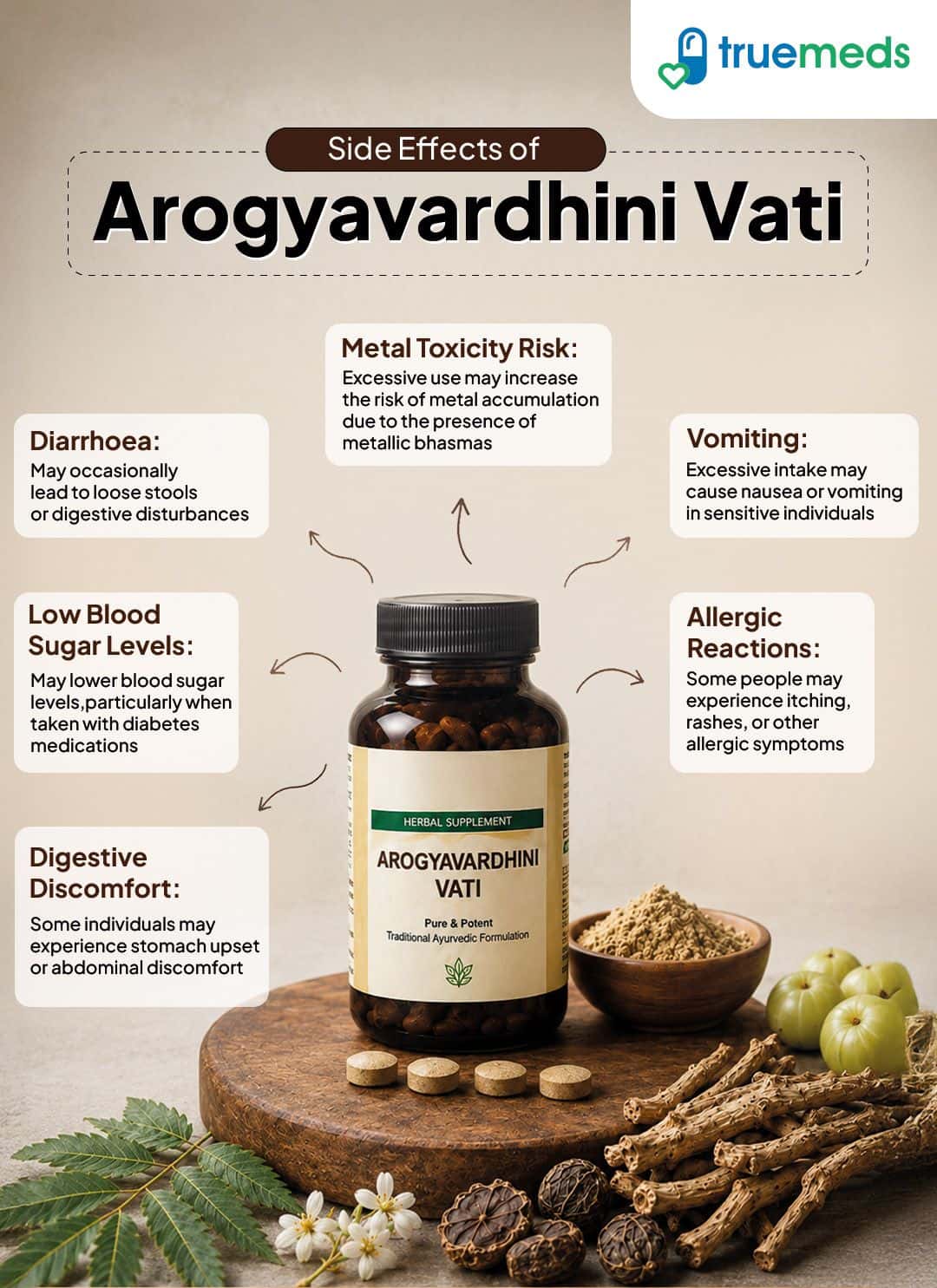
Digestive upset
Mild nausea, stomach discomfort or loose stools in some people.
Heavy-metal effects with overuse
Because the formula contains mercury, copper and iron, taking more than prescribed or for longer than advised can risk metal build-up. Studies at therapeutic-equivalent doses have been broadly reassuring, but measurable mercury has been found in tissues in animal work, so the dose and duration limits matter (Kumar et al., 2012; Jamadagni et al., 2020).
Allergy and low blood sugar
People sensitive to an ingredient may develop a rash or itching. Those taking diabetes medicines may also experience a further reduction in blood sugar levels
When to seek help: Stop and see a doctor if you notice yellowing of the eyes or skin, dark urine, persistent stomach pain, a metallic taste, tremor, unusual tiredness, or a rash. Keep the packaging so the ingredients can be checked.
Interactions With Other Medicines
Arogyavardhini Vati may interact with some medicines. Before taking Arogyavardhini Vati, inform your doctor and pharmacist about all medicines, supplements and Ayurvedic products you use:
Diabetes medicines
It may increase the effects of diabetes medicines and raise the risk of low blood sugar (hypoglycaemia). Consult your doctor before using them together.
Blood pressure medicines
It may increase the effects of blood pressure medicines, potentially causing blood pressure to fall too low. Consult your doctor before combining them.
Other prescription medicines
Formal interaction data are limited. As a general rule, separate it from other medicines and take it only with medical advice, especially if you take anticoagulants or long-term prescriptions.
Key Takeaways
- Arogyavardhini Vati is a classical herbo-mineral tablet used mainly for liver and digestive support.
- It contains mercury, copper and iron compounds, so it must be taken only on a registered Ayurvedic physician’s advice, at the set dose and for a limited course.
- It is not a substitute for medical treatment of any liver, heart, skin or metabolic disease.
- Use only standardised products from reputable manufacturers, and seek medical attention if you develop any warning signs.
FAQs
How is Arogyavardhini Vati made?
Is Arogyavardhini Vati safe?
How long can it be taken?
Is it good for the liver?
References
- Pal, S., Ramamurthy, A., & Mahajon, B. (2016). Arogyavardhini Vati: A theoretical analysis. Journal of Scientific and Innovative Research, 5(6), 225–227. https://doi.org/10.31254/jsir.2016.5605
- Antarkar, D. S., Vaidya, A. B., Doshi, J. C., Athavale, A. V., Vinchoo, K. S., Natekar, M. R., Tathed, P. S., Ramesh, V., & Kale, N. (1980). A double-blind clinical trial of Arogya-wardhani—An Ayurvedic drug—in acute viral hepatitis. Indian Journal of Medical Research, 72, 588–593. https://pubmed.ncbi.nlm.nih.gov/7014428/
- Kumar, G., Srivastava, A., Sharma, S. K., & Gupta, Y. K. (2012). Safety evaluation of an Ayurvedic medicine, Arogyavardhini Vati, on brain, liver and kidney in rats. Journal of Ethnopharmacology, 140(1), 151–160. https://doi.org/10.1016/j.jep.2012.01.004
- Jamadagni, S., Jamadagni, P., Angom, B., Mondal, D., Upadhyay, S., Gaidhani, S., & Hazra, J. (2020). Tissue distribution of mercury and copper after Aarogyavardhini Vati treatment in a rat model of CCl₄-induced chronic hepatotoxicity. Journal of Ayurveda and Integrative Medicine, 11(4), 508–514. https://doi.org/10.1016/j.jaim.2019.09.005
- Kumar, G., Srivastava, A., Sharma, S. K., & Gupta, Y. K. (2012). Safety and efficacy evaluation of Ayurvedic treatment (Arjuna powder and Arogyavardhini Vati) in dyslipidaemia patients: A pilot prospective cohort clinical study. AYU, 33(2), 197–201. https://doi.org/10.4103/0974-8520.105238
- Padhar, B. C., Dave, A. R., & Goyal, M. (2019). Clinical study of Arogyavardhini compound and lifestyle modification in the management of metabolic syndrome: A double-blind placebo-controlled randomised clinical trial. AYU, 40(3), 171–178. https://doi.org/10.4103/ayu.AYU_79_19



Explore other categories
Latest health articles



Top Health Essentials

Top-selling ayurvedic products












Disclaimer
Top-Selling Medicines:
...View more
Top-OTC medicines:
...View more
Top-selling healthcare devices:
...View more
Company
About UsHealth ArticleHealth StoriesHealth LibraryDiseases & Health ConditionsAyurvedaUnderstanding Generic MedicinesAll MedicinesAll BrandsNeed HelpFAQSecuritySavings CalculatorAdvertise with UsSubscribe
Registered Office Address
Grievance Officer
Download Truemeds


Contact Us
Our customer representative team is available 7 days a week from 9 am - 9 pm.
v4.28.27

2026 - Truemeds | All rights reserved. Our content is for informational purposes only. See additional information.
Our Payment Partners