

- Medicines
- Personal Care
- Skin Cream
- Sunscreen
- Face Wash
- Skin and Body Soap
- Acne Care
- Body Lotions
- Moisturising Lotion
- Moisturising Cream
- Mosquito Repellent
- Moisturising Gel
- Body Wash
- Hair Oils
- Hair Shampoo
- Hair Conditioners
- Hair Supplements
- Hair Colour
- Hair Serum
- Hair Mask
- Hair Solutions
- Baby Diapers and Wipes
- Baby Lotion and Moisturising Cream
- Baby Bath Essentials
- Baby Skin Care
- Baby and Infant Food
- Baby Healthcare
- Women Multivitamins
- Ovulation Test Kit and Women Intimate Care
- Sanitary Pads
- Nutritional Drinks
- Condoms
- Lubricants
- Massage Gels
- Personal Body Massagers
- Men Performance Booster
- Sexual Health Supplements
- Massage Oils
- Ayurveda
- Tooth Paste
- Mouth Ulcer Gel
- Mouthwash
- Toothache and Gum Pain
- Tooth Brush
- Gargle Solution
- Orthopaedic Supports
- Adult Diapers
- Footwear
- Mobility and Support Accessories
- Urinary Support and Care
- Health Conditions
- Bone and Joint Care
- Digestive Care
- Eye Care
- Pain Relief
- Smoking Cessation
- Liver Care
- Stomach Care
- Cold and Cough
- Heart Care
- Kidney Care
- Piles, Fissures & Fistula
- Respiratory Care
- Mental Wellness
- Derma Care
- Pre and Probiotics
- Acidity
- Gas
- Constipation
- Loose Motion/Diarrhoea
- Digestive Fibres
- Digestive Enzymes
- Eye Lubricant Drops
- Lens Solution
- Safety Eye Wear
- Eye Cream
- Eye Vitamins and Supplements
- Eye Drops
- Eye Ointment and Gel
- Nicotine Patch
- Nicotine Gum
- Nicotine Lozenges
- Cough Syrups
- Chest Rubs and Balms
- Nasal Spray
- Lozenges
- Inhalant Capsules
- Cold and Cough Tablets
- Vitamins & Supplements
- Diabetes Care
- Healthcare Devices
- Homeopathic Medicine
- Health Guide
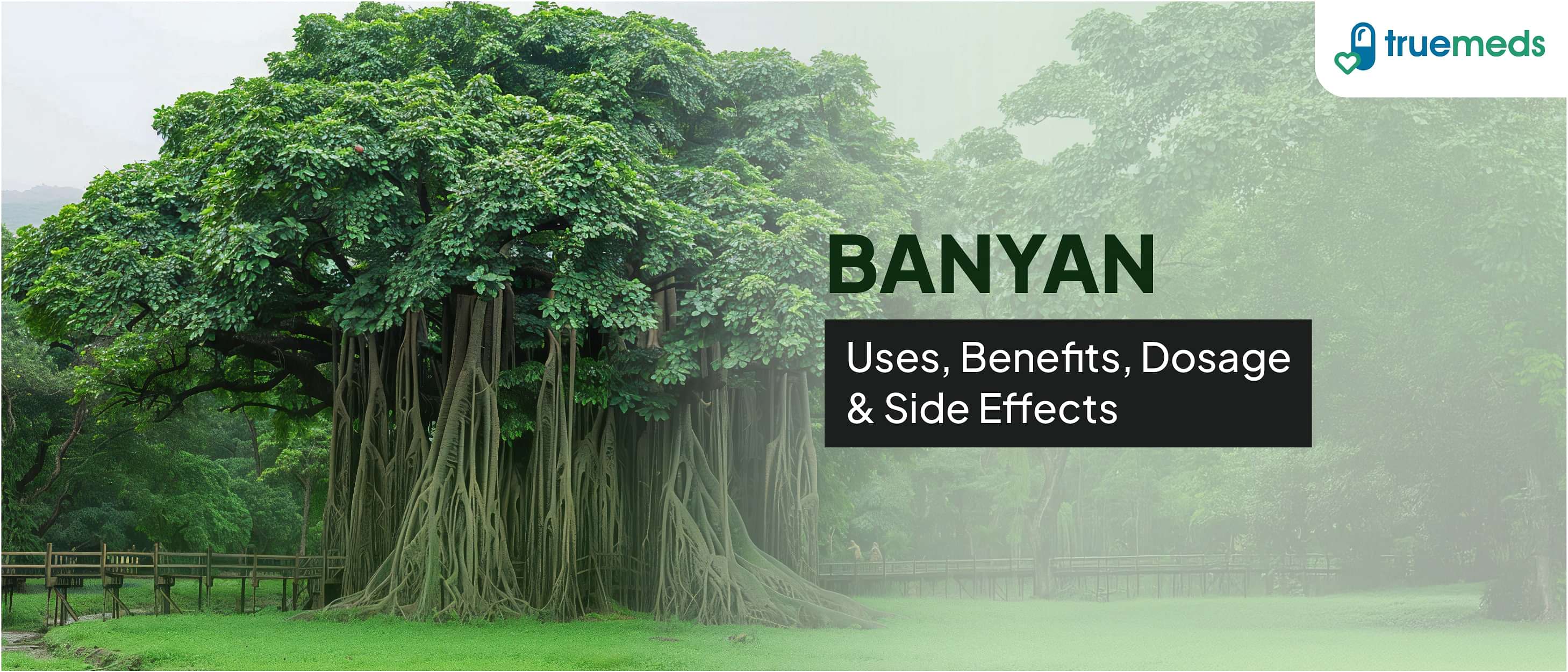
Banyan (Bargad): Uses, Benefits, Dosage & Side Effects
Last updated on : 28 Nov, 2025
Read time : 9 min
The banyan tree (Ficus benghalensis) is an evergreen tree from the Moraceae family. Known as bargad in Hindi and Urdu, bahupada or vat in Sanskrit, and banyan in English, it has a long history in India and is the national tree of the country. Different parts of the tree—such as its fruits, leaves, roots, and bark—have been studied for their nutritional content and traditional uses. In traditional Ayurvedic practice, the bark and aerial roots are often used for their astringent and cooling properties [1], [2].
Banyan Tree: Nutritional Value and Chemical Constituents
The potential uses of the banyan tree arise from its rich array of phytochemicals and nutrients. The key chemical constituents found in different parts of the tree include:
- Leaves: Rich in plant compounds like flavonoids, terpenoids, and phenols.
- Bark: Contains plant compounds like terpenoids, phenols, and flavonoids.
- Aerial Roots: Packed with sterols, amino acids, and fatty acids.
- Fruits: Contain fatty acids and their esters.
Banyan tree seeds are nutritious and contain carbohydrates and proteins. They also contain lipids, fibre, and vitamins such as vitamin C and vitamin E. Each 100 grams provides about 130 calories and contains minerals such as sodium, potassium, calcium, manganese, iron, chromium, copper, and phosphorus [3].
Properties of Banyan
The various properties of the banyan tree that have been scientifically explored include:
- Antioxidant: The presence of flavonoids and tannins gives the tree demonstrated antioxidant activity in in vitro studies [2].
- Anti-inflammatory: Research has investigated the anti-inflammatory properties of certain parts of the banyan tree, including the bark and aerial roots in lab settings [2].
- Antimicrobial: The aerial roots and other extracts demonstrate antimicrobial properties against various bacteria and fungi in laboratory tests [2].
- Astringent: The tannin content gives the tree an astringent nature, a property often utilised in traditional medicine.
Uses and Potential Benefits of the Banyan Tree
Here are some of the potential banyan tree health benefits that have been the subject of modern research:
1) Blood Sugar Management (Diabetes)
Researchers have studied parts of the banyan tree to determine if they might affect blood sugar levels, but these studies are still in their early stages and have primarily been conducted in laboratories or on animal models. For example, a study showed that an extract of banyan aerial roots had an antidiabetic effect in rats [4].
2) Wound Healing
Recent studies have revealed that extracts from the bark and leaves of the banyan tree may promote wound healing. In animal models, these extracts have been shown to potentially accelerate wound closure and promote tissue regeneration, demonstrating their traditional potential effectiveness in wound treatment [2], [5].
3) Gastrointestinal Ulcers
Some studies in animals have examined compounds in banyan tree roots, such as flavonoids and tannins, for potential effects on the stomach mucosa. The findings are preliminary, and it is not yet known if these effects apply to humans [2].
4) Anti-inflammatory Support (Arthritis)
Research has explored plant compounds in banyan bark and leaves, such as flavonoids and chlorogenic acid, for their potential anti-inflammatory effects in lab studies. However, it is crucial to note there is no direct clinical evidence that the banyan tree can treat arthritis in people [2].
5) Immune Support
Extracts from the banyan tree’s bark and leaves possess antioxidant and anti-inflammatory properties that can support immune health by combating oxidative stress and modulating immune responses in research models [2].
6) Cognitive and Neurological Effects
The banyan tree contains bioactive compounds, which have antioxidant and anti-inflammatory effects that may protect brain cells and support cognitive function. Animal studies suggest that oral administration of banyan tree roots benefits by reducing anxiety, relaxing muscles, enhancing memory, and modifying seizures [6]. Traditionally, the fruit is also believed to help alleviate stress.
7) Combating Microbes
The banyan tree exhibits potential antimicrobial properties in laboratory settings due to its bioactive compounds. Studies have demonstrated that extracts from the tree’s roots, bark, leaves, and fruit can inhibit the growth of bacteria and fungi [2].
Traditional Preparation and Usage of Banyan
The banyan tree parts are traditionally utilised in various ways:
- The root and stem bark can be made into a decoction (Kwath) [1].
- The leaves can be used directly (e.g., as poultices) or prepared as extracts [2].
- The tree’s latex (milky sap) also has medicinal properties, traditionally used for local applications [2].
Precautions and Safety Information for Banyan
While traditional use suggests banyan tree products have significant benefits, taking certain precautions can help you avoid adverse effects. The information below is not a substitute for professional medical advice.
- Consultation is Essential
Always consult your doctor or a qualified Ayurvedic practitioner before starting any herbal supplement, including banyan, especially if you have existing health conditions or are taking other medications.
- Dosage
Adhere to the dosage recommended by a healthcare professional to prevent potential gastrointestinal discomfort or other potential side effects.
- Pregnancy and Nursing
Pregnant and breastfeeding women should absolutely consult a qualified doctor before using banyan extracts or products to ensure safety, as adequate human safety data is often lacking for herbal supplements.
- Allergy Awareness
If you are allergic to figs or related plants (Moraceae family), you should avoid banyan products altogether to prevent allergic reactions.
Potential Interactions With Other Drugs
While there’s limited, specific clinical information about interactions of banyan with modern medications, it is always wise to proceed with caution due to the tree’s known pharmacological properties:
|
Potential Drug Interaction |
Rationale |
Balanced Perspective/Mitigation |
| Antidiabetic Medications | Banyan has the potential to lower blood sugar levels (hypoglycemic effect) [4]; hence, it could enhance the effects of antidiabetic medications. | Regular blood glucose monitoring is critical. Dosage adjustment of all medications may be required under medical supervision. |
| Anticoagulants (Blood Thinners) | Banyan might interact with blood-thinning medications (e.g., Warfarin) due to its potential effects on blood coagulation, increasing the risk of bleeding. | Discontinue use before any scheduled surgery. Inform your prescribing doctor immediately if you are using banyan alongside anticoagulants. |
Thoughts
Banyan trees and their varied products have been used in traditional medicine for centuries, thanks to the numerous potential health benefits they offer. However, like any other medicinal herb, users must be aware of potential side effects and precautions to ensure safe consumption. The majority of scientific evidence supporting the health benefits is currently derived from in vitro or animal studies, and further human clinical trials are needed to confirm efficacy and safety in people. Always remember to consult a doctor before starting any new health regimen. By keeping these precautions in mind, you can enjoy the benefits this mighty tree has to offer safely and effectively.
Disclaimer:
This article is for informational purposes only and does not constitute medical advice, diagnosis, or treatment. The information presented is based on traditional use and preliminary scientific research, which is often limited to animal or laboratory studies. It is not a substitute for professional medical guidance. Always consult a qualified healthcare professional, such as a certified Ayurvedic physician or your primary care doctor, before starting or changing any treatment, diet, or supplement regimen.
Frequently Asked Questions (FAQs)
What is the lifespan of the Banyan tree?
The banyan tree can live for several hundred years and occasionally over a thousand years, depending on environmental conditions and care.
What is Banyan?
Banyan is a species of fig tree, scientifically known as Ficus benghalensis, notable for its aerial roots and large canopy. It is frequently used in traditional Indian medicine, particularly in Ayurveda.
What is the scientific name of the Banyan tree?
The banyan tree is scientifically known as Ficus benghalensis. It is a member of the fig family, Moraceae.
Does the Banyan tree have medicinal uses?
The banyan tree is utilised in traditional medicine for its potential benefits in managing diabetes, promoting wound healing, and exhibiting antimicrobial properties. Extracts from its bark, leaves, and roots are utilised in traditional medicine for these purposes. Scientific research is ongoing to validate these traditional uses.
Is the fruit of the banyan tree edible?
Yes, the fruit of the banyan tree is edible. Moreover, these fruits offer several traditional health benefits, including supporting digestion and boosting immunity.
Where is the banyan tree grown in India?
The banyan tree grows across India, particularly in tropical and subtropical regions such as Tamil Nadu, Karnataka, Gujarat, Maharashtra, Madhya Pradesh, and Uttar Pradesh.
References
[1] Murugesu, S., Selamat, J., & Perumal, V. (2021). Phytochemistry, Pharmacological Properties, and Recent Applications of Ficus benghalensis and Ficus religiosa. Plants, 10(12), 2749. https://doi.org/10.3390/plants10122749
[2] Singh, P., Dhankhar, J., Kapoor, R. K., Kumar, D., Bhatia, S., Harrasi, A. A.-, & Sharma, A. (2023). Ficus benghalensis—A comprehensive review on pharmacological research, nanotechnological applications, and patents. Journal of Applied Pharmaceutical Science, 13(10), 059–082. https://doi.org/10.7324/JAPS.2023.131006
[3] Vimala, G., & Shoba, F. (2015). Determination of nutritive value and mineral elements of ficus benghalensis Linn. Seed. Asian Journal of Pharmaceutical and Clinical Research, 8, 156–159. https://journals.innovareacademics.in/index.php/ajpcr/article/view/6178
[4] Singh, R. K., Mehta, S., Jaiswal, D., Rai, P. K., & Watal, G. (2009). Antidiabetic effect of Ficus bengalensis aerial roots in experimental animals. Journal of Ethnopharmacology, 123(1), 110–114. https://doi.org/10.1016/j.jep.2009.02.008
[5] Panday, D. R., & Rauniar, G. P. (2016). Effect of root-extracts of Ficus benghalensis (Banyan) in pain in animal models. Journal of Neurosciences in Rural Practice, 07(02), 210–215. https://doi.org/10.4103/0976-3147.178660
[6] Deshmukh, P. M., Bhalerao, S. P., Narkhede, S. B., & Sali, V. K. (2015). A review on ethnopharmacological and phytochemistry of Ficus benghalensis L. International Journal of Research in Pharmacy and Chemistry, 5(2), 215–221. https://www.ijrpc.net/files/20-2219.pdf













Disclaimer
Our healthcare experts have carefully reviewed and compiled the information presented here to ensure accuracy and trustworthiness. It is important to note that this information serves as a general overview of the topic and is for informational purposes only. It is not intended to diagnose, prevent, or cure any health problem. This page does not establish a doctor-patient relationship, nor does it replace the advice or consultation of a registered medical practitioner. We recommend seeking guidance from your registered medical practitioner for any questions or concerns regarding your medical condition.
Popular Articles


Recommended Articles




Recent Articles








Company
About UsHealth ArticleHealth StoriesDiseases & Health ConditionsAyurvedaAll MedicinesAll BrandsNeed HelpFAQSecuritySubscribe
Registered Office Address
Grievance Officer
Download Truemeds


Contact Us
Our customer representative team is available 7 days a week from 9 am - 9 pm.
v4.8.0

2025 - Truemeds | All rights reserved. Our content is for informational purposes only. See additional information.

Our Payment Partners




