

- Medicines
- Personal Care
- Skin Cream
- Sunscreen
- Face Wash
- Skin and Body Soap
- Acne Care
- Body Lotions
- Moisturising Lotion
- Moisturising Cream
- Mosquito Repellent
- Moisturising Gel
- Body Wash
- Hair Oils
- Hair Shampoo
- Hair Conditioners
- Hair Supplements
- Hair Colour
- Hair Serum
- Hair Mask
- Hair Solutions
- Baby Diapers and Wipes
- Baby Lotion and Moisturising Cream
- Baby Bath Essentials
- Baby Skin Care
- Baby and Infant Food
- Baby Healthcare
- Women Multivitamins
- Ovulation Test Kit and Women Intimate Care
- Sanitary Pads
- Nutritional Drinks
- Condoms
- Lubricants
- Massage Gels
- Personal Body Massagers
- Men Performance Booster
- Sexual Health Supplements
- Massage Oils
- Ayurveda
- Tooth Paste
- Mouth Ulcer Gel
- Mouthwash
- Toothache and Gum Pain
- Tooth Brush
- Gargle Solution
- Orthopaedic Supports
- Adult Diapers
- Footwear
- Mobility and Support Accessories
- Urinary Support and Care
- Health Conditions
- Bone and Joint Care
- Digestive Care
- Eye Care
- Pain Relief
- Smoking Cessation
- Liver Care
- Stomach Care
- Cold and Cough
- Heart Care
- Kidney Care
- Piles, Fissures & Fistula
- Respiratory Care
- Mental Wellness
- Derma Care
- Pre and Probiotics
- Acidity
- Gas
- Constipation
- Loose Motion/Diarrhoea
- Digestive Fibres
- Digestive Enzymes
- Eye Lubricant Drops
- Lens Solution
- Safety Eye Wear
- Eye Cream
- Eye Vitamins and Supplements
- Eye Drops
- Eye Ointment and Gel
- Nicotine Patch
- Nicotine Gum
- Nicotine Lozenges
- Cough Syrups
- Chest Rubs and Balms
- Nasal Spray
- Lozenges
- Inhalant Capsules
- Cold and Cough Tablets
- Vitamins & Supplements
- Diabetes Care
- Healthcare Devices
- Homeopathic Medicine
- Health Guide
Khadirarishta
Khadirarishta is a classical Ayurvedic fermented liquid formulation (Arishta) prepared with Khadira (Acacia catechu) as its main herb. It is traditionally used to support skin health and digestive function, and is traditionally associated with skin conditions such as acne, eczema and psoriasis. It is also traditionally described as supporting the body's natural cleansing processes.
 50
Last updated on : 22 Sep, 2026
Read time : 12 mins

What is Khadirarishta?
Khadirarishta takes its name from its main herb, Khadira (Acacia catechu), which gives the formulation its astringent and traditionally described Rakta-shodhana (blood-purifying) properties. It is an Arishta, a self-fermented Ayurvedic liquid in which a slow, natural fermentation generates a small amount of alcohol that helps extract and preserve the herbal constituents (Balkrishna et al., 2022).
Khadirarishta is traditionally used in Ayurveda to support skin health and is traditionally associated with Rakta-shodhana (blood purification). It is traditionally used to support skin health in the context of chronic skin conditions such as eczema, psoriasis and allergic dermatitis, and to support healthy digestion (Balkrishna et al., 2022).
In Ayurvedic terms, the formulation is traditionally described as follows:
- Rasa (taste): Tikta (bitter) and Kashaya (astringent)
- Virya (potency): Sheeta (cooling)
- Vipaka (post-digestive effect): Katu (pungent)
- Dosha action: primarily described as balancing Pitta and Kapha, and traditionally associated with supporting Rakta (blood) purification
Key Facts
| Feature | Details |
| Formulation name | Khadirarishta (Khadirarishtam)
|
| Formulation type | Arishta (self-fermented Ayurvedic liquid)
|
| Also known as | Khadirarishtam and Khadira Arishta
|
| Key herbs (composition) | Khadira (Acacia catechu) as the main herb, with supportive herbs listed in the Composition section |
| Key marker compounds | Gallic acid, catechin, ellagic acid and eugenol (Balkrishna et al., 2022)
|
| Dosha action | Traditionally described as balancing Pitta and Kapha; traditionally associated with Rakta-shodhana |
| Traditional uses | Traditionally used to support skin health and digestion, including in formulations associated with chronic skin conditions such as eczema, psoriasis and acne, and with Rakta-shodhana (blood purification) |
| Common forms | Liquid (Arishta)
|
| General dosage | Adults: 15–30 ml (about 1–2 tablespoons), diluted with an equal quantity of water, twice daily after meals, or as advised by an Ayurvedic practitioner
|
| Best taken | After meals, diluted with water
|
| Key safety note | Contains self-generated alcohol and sugar. People who are pregnant or breastfeeding, have diabetes, must avoid alcohol, or take regular medicines should seek professional advice before use. |
Alternative Names of Khadirarishta
Khadirarishta is a transliterated Sanskrit name, so the variations below are spelling forms of the same formulation rather than different regional names:
- Khadirarishtam
- Khadira Arishta
- Khadirarisht
These names are transliterated rather than translated, and there is no separate English, Hindi or regional name for the formulation itself. The main herb is known as Khadira (Sanskrit), Khair (Hindi) and Acacia catechu (botanical).
Chemical Constituents of Khadirarishta
Khadirarishta contains several naturally occurring plant compounds identified in the formulation and its constituent herbs, including (Balkrishna et al., 2022):
- Gallic acid, a polyphenol with antioxidant and antimicrobial activity
- Catechin, a flavonoid with antioxidant activity, from Khadira (Acacia catechu)
- Ellagic acid, a polyphenol with antioxidant activity
- Eugenol, an aromatic compound with antimicrobial and anti-inflammatory activity
- Other constituents contributed by the individual herbs include tannins (Acacia catechu), berberine (Berberis aristata), chebulinic acid (Terminalia chebula) and piperine (Piper longum). A small amount of naturally generated ethanol is produced during fermentation, which may contribute to the extraction and preservation of plant constituents.
Ingredients of Khadirarishta
The following are the primary Khadirarishta ingredients:
| Ingredient | Botanical Name | Key Benefits |
| Khadira | Acacia Catechu | Blood purifier manages skin disorders |
| Bakuchi | Psoralea Corylifolia | A well known drug for vitiligo, rich in psoralen |
| Devadaru | Cedrus Deodara | Assist in easing skin infections |
| Haritaki | Terminalia Chebula | Improves digestion, detoxifies the body |
| Bibhitaki | Terminalia Bellirica | Antioxidant enhances immunity |
| Amalaki | Emblica Officinalis | Rich in Vitamin C, promotes skin health |
| Daruharidra | Berberis Aristata | Anti-inflammatory, supports liver function |
| Pipali | Piper Longum | Enhances digestion, anti-worm properties |
| Guda (Jaggery) | Saccharum Officinarum | Natural sweetener supports fermentation |
| Cinnamomum Zeylanicum | Cinnamon | Antimicrobial, supports skin health |
Medicinal Properties of Khadirarishta
Khadirarishta is associated with the following pharmacological and traditional properties:
- Antimicrobial, with antibacterial activity shown in laboratory testing (Balkrishna et al., 2022)
- Antioxidant, from polyphenols such as gallic acid, catechin and ellagic acid
- Anti-inflammatory, traditionally described as Shothahara
- Astringent, a property of the main herb Khadira
- Anti-parasitic (anthelmintic), traditionally described as Krimighna
- Blood-purifying (Rakta-shodhana), a traditional property
- Digestive stimulant (Deepana-Pachana), a traditional property
The antimicrobial and antioxidant activities are supported by laboratory studies, while the other properties are primarily based on traditional Ayurvedic descriptions and have limited clinical evidence in humans.
Key Health Benefits of Khadirarishta
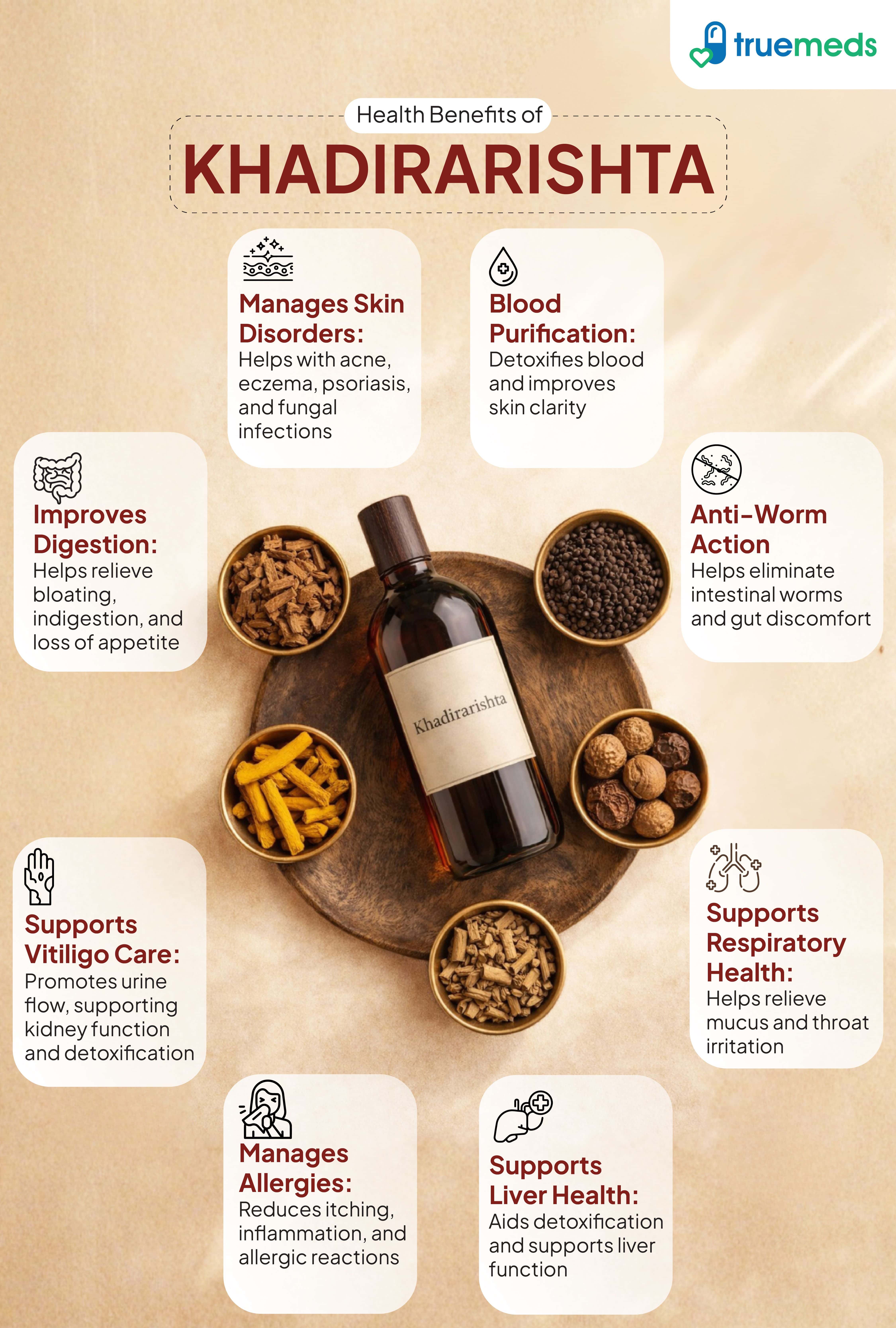
Khadirarishta is traditionally used to support skin health and digestion. It is commonly associated with skin concerns such as acne, eczema and psoriasis, as well as mild digestive discomfort. Evidence for these benefits is mainly based on traditional Ayurvedic use and preclinical research.
Supports chronic skin conditions
Khadirarishta is traditionally used to support skin health in conditions such as eczema, psoriasis and acne (Balkrishna et al., 2022). However, clinical evidence in humans is limited, and it should not be considered a proven treatment for these conditions.
Aids blood purification
In Ayurveda, the formulation is valued as a Rakta-shodhaka, meaning it is traditionally believed to support the body's natural cleansing processes. This traditional blood-purifying action is the basis for its long-standing use in skin complaints, though it should be understood as a traditional concept rather than a clinically established effect.
Promotes healthy digestion
By supporting Agni, or digestive capacity, Khadirarishta is traditionally used to ease mild indigestion, bloating and poor appetite. The fermented base and herbs such as Pippali and Haritaki are traditionally associated with digestive support, which in Ayurveda is linked to healthier skin.
Provides antimicrobial and anti-parasitic support
Several herbs in Khadirarishta have shown antimicrobial activity in laboratory studies (Balkrishna et al., 2022), which may contribute to its traditional use for skin health. Evidence supporting an anti-parasitic effect in humans is limited.
Eases allergic skin reactions
Because several of its herbs have demonstrated anti-inflammatory activity in preclinical studies, Khadirarishta is traditionally used to support mild allergic skin reactions such as itching, redness and swelling. It is intended for traditional supportive use and is not a treatment for severe or sudden allergic reactions, which need urgent medical care.
Offers traditional adjunct support in vitiligo
Khadirarishta has been traditionally used as an adjunct in some Ayurvedic approaches to vitiligo. However, there is limited clinical evidence that it improves vitiligo, and it should not replace dermatologist-prescribed treatment.
Note: These traditional benefits are supportive only. Khadirarishta is not a substitute for prescribed medical treatment. Consult an Ayurvedic practitioner or doctor before use, especially if you have a long-term condition or take other medicines.
Common Uses of Khadirarishta
Khadirarishta is traditionally used mainly to support skin health, digestion and certain Ayurvedic cleansing practices. It is also used traditionally for worm-related digestive complaints, although evidence for these uses is limited.
During chronic skin flare-ups
Traditionally taken as a supportive measure during long-standing skin complaints such as eczema, psoriasis and acne, alongside appropriate prescribed skin care and medical treatment where needed.
When digestion feels sluggish
Used in Ayurveda when appetite is poor or digestion feels slow, often when skin complaints and digestive concerns occur together.
In traditional blood-purifying regimens
Included in Rakta-shodhana routines under an Ayurvedic practitioner, as part of a broader plan rather than on its own. Rakta-shodhana is a traditional Ayurvedic concept and does not refer to a clinically established method of blood purification.
For traditional worm-related complaints
Traditionally used where intestinal worms are suspected, to support digestive comfort. Confirmed worm infestation should be assessed and treated with appropriate medical care.
Precautions While Taking Khadirarishta
- Pregnancy: Avoid during pregnancy. Khadirarishta contains self-generated alcohol and herbal ingredients whose safety during pregnancy has not been established.
- Breastfeeding: Avoid use unless advised by a healthcare professional, as the formulation contains alcohol and herbal constituents and its safety during breastfeeding has not been adequately established.
- Diabetes: Use with caution. The formulation contains sugar (jaggery) and fermented alcohol, which may affect blood glucose levels. People with diabetes should consult their doctor before use.
- Heart disease: Use with caution, as the alcohol content may be relevant when taking certain heart medicines. Consult your doctor before use.
- Kidney disease: Use with caution and under medical guidance, as there is limited evidence on its safety in people with reduced kidney function.
- Alcohol intolerance: Avoid, or use only under medical supervision, because Khadirarishta contains naturally produced alcohol.
If you are unsure whether Khadirarishta is suitable for you, consult a qualified Ayurvedic practitioner or doctor before use.
How to Use Khadirarishta
Khadirarishta is available as a liquid (Arishta). To use it:
- Measure 15 to 30 ml (about 1 to 2 tablespoons) using the cup or spoon provided.
- Mix it with an equal quantity of water.
- Take it twice daily, after meals, or as advised by your qualified Ayurvedic practitioner.
How long you take it depends on your individual needs and health condition, so follow the guidance of an Ayurvedic practitioner or doctor. If you are pregnant, breastfeeding or managing a long-term illness, consult a healthcare professional before use.
Recommended Dosage of Khadirarishta
Dosage should be individualised based on age, health status and professional advice. All doses are diluted with an equal quantity of water and taken after meals:
- Adults: 15 to 30 ml (about 1 to 2 tablespoons) twice daily.
- Elderly: Start at the lower end, around 15 ml twice daily, and adjust only on a practitioner's advice, as older adults may be more sensitive to alcohol and medicines.
- Teenagers (13 to 17 years): Only if advised by an Ayurvedic practitioner, who will set the dose for the individual. It is not recommended for routine use in this age group without guidance.
- Children (under 13 years): Not recommended without direct medical supervision, because of the alcohol and sugar content. An Ayurvedic practitioner or doctor will decide if and how much is appropriate.
Do not exceed the dose advised for you, as larger amounts can cause unwanted effects. Take Khadirarishta for prolonged periods only under professional supervision.
Side Effects of Khadirarishta
Khadirarishta is generally tolerated when used as directed, but some people may experience adverse effects:
Gastric irritation
The alcohol content may cause acidity, heartburn or stomach discomfort in some people, particularly if taken on an empty stomach.
Raised blood sugar
The sugar (jaggery) content may affect blood glucose levels, so people with diabetes should use it only on the advice of a healthcare professional.
Allergic reactions
Some people may develop a skin rash, itching or other discomfort if they are sensitive to any of the herbs.
Drowsiness or dizziness
The naturally produced alcohol may occasionally cause mild, temporary dizziness or drowsiness.
Note: Stop taking Khadirarishta and seek medical advice if you notice a severe, persistent or unusual reaction.
Interaction of Khadirarishta With Other Drugs
Khadirarishta contains self-generated alcohol and multiple herbal ingredients, so potential interactions should be considered, particularly when taking long-term medicines:
Antidiabetic medicines
The sugar and alcohol content may affect blood glucose control, so people taking antidiabetic medicines should consult their doctor before use.
Blood thinners
Khadirarishta may have effects relevant to blood clotting based on some of its herbal ingredients, but evidence of a clinically significant interaction is limited. Consult a healthcare professional before combining it with anticoagulant or antiplatelet medicines.
Sedatives and CNS depressants
The alcohol content may add to the effects of sedatives, sleep aids or other central nervous system depressants, potentially increasing drowsiness or dizziness. Avoid combining them without medical advice.
Storage of Khadirarishta
Store Khadirarishta in a cool, dry place, away from direct sunlight and moisture. Keep the bottle tightly closed after each use and out of the reach of children. Do not use it after the expiry date printed on the pack. As a naturally fermented liquid, a small amount of sediment can be normal; follow the manufacturer’s storage and handling instructions for further guidance.
Key Takeaways
- Khadirarishta is a classical Ayurvedic fermented liquid, traditionally used to support skin health and in the context of skin conditions such as eczema, psoriasis and acne.
- It is traditionally valued for Rakta-shodhana (blood purification) and digestive support, with laboratory studies showing antioxidant and antibacterial activity.
- Its main herb is Khadira (Acacia catechu), supported by herbs such as Haritaki, Amalaki and Daruharidra.
- It is a traditional supportive formulation, not a proven cure, and should be used alongside appropriate medical assessment and treatment for persistent or diagnosed health conditions.
- Because it contains alcohol and sugar, its safety during pregnancy and breastfeeding has not been established, and it should be used with caution in diabetes, heart disease and kidney disease.
FAQs
Does Khadirarishta help purify the blood?
Can I take Khadirarishta with other supplements?
Can a person with diabetes take Khadirarishta?
Is Khadirarishta suitable for skin problems?
Is Khadirarishta good for the liver?
How much alcohol does Khadirarishta contain?
How should Khadirarishta be taken?
Are Safi and Khadirarishta the same?
References
- Balkrishna, A., Gupta, A. K., Gupta, A., Singh, P., Singh, K., Tomar, M., & Rajagopal, D. (2022). Antibacterial activity and mechanism of action of an ayurvedic formulation Khadirarishta. Journal of Herbal Medicine, 32, 100509. https://doi.org/10.1016/j.hermed.2021.100509

Explore other categories
Latest health articles





Top Health Essentials


Top-selling ayurvedic products












Disclaimer
Top-Selling Medicines:
...View more
Top-OTC medicines:
...View more
Top-selling healthcare devices:
...View more
Company
About UsHealth ArticleHealth StoriesHealth LibraryDiseases & Health ConditionsAyurvedaUnderstanding Generic MedicinesAll MedicinesAll BrandsNeed HelpFAQSecuritySavings CalculatorAdvertise with UsSubscribe
Registered Office Address
Grievance Officer
Download Truemeds


Contact Us
Our customer representative team is available 7 days a week from 9 am - 9 pm.
v4.28.19

2026 - Truemeds | All rights reserved. Our content is for informational purposes only. See additional information.

Our Payment Partners




