

- Medicines
- Personal Care
- Skin Cream
- Sunscreen
- Face Wash
- Skin and Body Soap
- Acne Care
- Body Lotions
- Moisturising Lotion
- Moisturising Cream
- Mosquito Repellent
- Moisturising Gel
- Body Wash
- Hair Oils
- Hair Shampoo
- Hair Conditioners
- Hair Supplements
- Hair Colour
- Hair Serum
- Hair Mask
- Hair Solutions
- Baby Diapers and Wipes
- Baby Lotion and Moisturising Cream
- Baby Bath Essentials
- Baby Skin Care
- Baby and Infant Food
- Baby Healthcare
- Women Multivitamins
- Ovulation Test Kit and Women Intimate Care
- Sanitary Pads
- Nutritional Drinks
- Condoms
- Lubricants
- Massage Gels
- Personal Body Massagers
- Men Performance Booster
- Sexual Health Supplements
- Massage Oils
- Ayurveda
- Tooth Paste
- Mouth Ulcer Gel
- Mouthwash
- Toothache and Gum Pain
- Tooth Brush
- Gargle Solution
- Orthopaedic Supports
- Adult Diapers
- Footwear
- Mobility and Support Accessories
- Urinary Support and Care
- Health Conditions
- Bone and Joint Care
- Digestive Care
- Eye Care
- Pain Relief
- Smoking Cessation
- Liver Care
- Stomach Care
- Cold and Cough
- Heart Care
- Kidney Care
- Piles, Fissures & Fistula
- Respiratory Care
- Mental Wellness
- Derma Care
- Pre and Probiotics
- Acidity
- Gas
- Constipation
- Loose Motion/Diarrhoea
- Digestive Fibres
- Digestive Enzymes
- Eye Lubricant Drops
- Lens Solution
- Safety Eye Wear
- Eye Cream
- Eye Vitamins and Supplements
- Eye Drops
- Eye Ointment and Gel
- Nicotine Patch
- Nicotine Gum
- Nicotine Lozenges
- Cough Syrups
- Chest Rubs and Balms
- Nasal Spray
- Lozenges
- Inhalant Capsules
- Cold and Cough Tablets
- Vitamins & Supplements
- Diabetes Care
- Healthcare Devices
- Homeopathic Medicine
- Health Guide
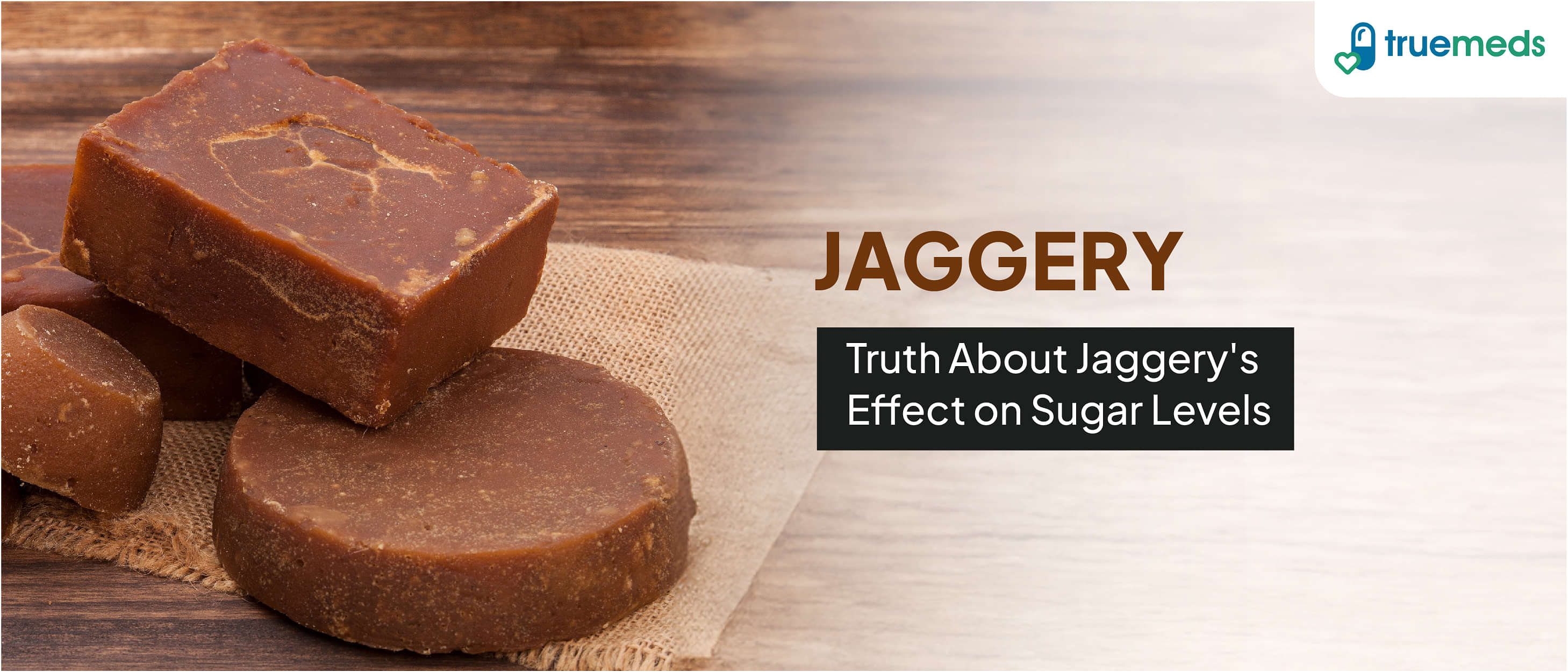
Is Jaggery Safe for Diabetes? Risks, Benefits & Glycemic Index Explained
Last updated on : 01 Dec, 2025
Read time : 9 min
Jaggery, a traditional, unrefined sweetener made from sugarcane or palm sap, is frequently perceived as a ‘natural’ or healthier alternative to refined white sugar. For individuals managing diabetes, however, this common perception requires careful scrutiny. Is jaggery good for people with diabetes? While jaggery retains minor trace minerals, it is primarily a source of concentrated sugar (sucrose) and possesses a high glycemic index (GI), which significantly impacts blood glucose control [1].
In this article, based on current clinical evidence and my experience, we will break down the effects of jaggery on blood sugar, compare its impact to that of refined sugar, discuss the safe amount to consume, and suggest better alternatives for individuals with diabetes.
Understanding the Glycemic Index of Jaggery: Why It Matters
The Glycemic Index (GI) is a ranking system that measures how quickly a food containing carbohydrates raises blood glucose levels. Foods with a GI of 70 or more are considered high GI and cause a rapid, significant rise in blood sugar.
Jaggery has a high glycemic index, reported to be around 84.4 [2]. This high GI means that jaggery, much like refined sugar, causes a rapid and pronounced surge in blood glucose levels shortly after consumption.
Its high carbohydrate and sugar content are the primary reasons for this effect. For an individual with diabetes, this rapid spike can exacerbate insulin resistance and complicate effective blood sugar management. To control postprandial (after-meal) glucose, people with diabetes must strictly limit their intake of high-GI foods like jaggery.
Should People with Diabetes Eat Jaggery, Even in Moderation?
Individuals with diabetes should minimize or completely avoid jaggery consumption, as its sugar content poses a direct risk to blood glucose control. While jaggery is often touted as a healthier alternative to refined sugar, the distinction often lies only in its minimal retention of trace minerals.
During the refining process, jaggery retains small amounts of micronutrients such as iron, magnesium, and potassium, which are stripped from white sugar [3]. However, it is crucial to understand that these trace mineral amounts are negligible compared to the total sugar content. For example, to gain a meaningful amount of iron, one would have to consume an unsafe quantity of jaggery, leading to significant hyperglycemia.
Therefore, while jaggery is ‘less processed,’ this distinction does not make it a safer or ‘healthier’ sugar substitute for individuals with pre-diabetes or diabetes. The primary concern remains its high sugar concentration and high GI.
Trace Nutritional Benefits of Jaggery (When Used Extremely Sparingly)
It is important to emphasize that for effective diabetes management, the risks associated with jaggery’s high sugar content far outweigh these minor, often non-clinical benefits. However, when used in minute quantities (such as a pinch for flavor), jaggery does offer the following trace nutritional components:
- Source of Trace Minerals: Jaggery contains small amounts of minerals like iron, potassium, and magnesium due to its unrefined nature [3]. These micronutrients, when consumed via safer, low-sugar sources (like green leafy vegetables and nuts), support metabolism and overall health.
- Aids in Digestion: Jaggery is sometimes traditionally consumed after meals and may act as a digestive aid due to its potential to activate digestive enzymes [4]. For a person with diabetes, any perceived digestive benefit must be weighed against the significant risk of blood sugar elevation.
- Contains Antioxidants: Jaggery is reported to contain trace amounts of antioxidants [5]. While antioxidants help combat cellular damage, a diabetic patient should obtain these from high-fiber, low-sugar sources like berries, not jaggery.
Tips for Safe Consumption of Jaggery in Diabetes
If you choose to include jaggery in your diet despite the clinical warnings, these precautions are essential to mitigate the risk of severe blood sugar fluctuations:
- Practice Extreme Moderation: Limit your jaggery intake to no more than 1-2 teaspoons per day—and ideally, less. This small quantity may provide flavor without a massive spike, but constant monitoring is essential.
- Select Quality Jaggery: Opt for minimally processed, organic jaggery (often darker in color) as it may retain slightly more minerals. Be aware that the GI difference between various jaggery types (e.g., cane vs. palm) is minimal [2].
- Regularly Monitor Blood Glucose Levels: Check your blood sugar 1-2 hours after consumption to understand its specific impact on your body. Documenting this is critical.
- Pair with Low-GI Foods: Always consume jaggery as part of a meal containing ample protein, fat, and high-fiber, low-GI carbohydrates (e.g., nuts, seeds, or whole grains). This will slow the rate of gastric emptying and sugar absorption.
- Seek Specialist Advice: Before making any dietary changes involving sugar substitutes, consult your endocrinologist or a Certified Diabetes Educator (CDE) to ensure alignment with your current treatment plan.
Spiced Jaggery Millet Porridge (Diabetes-Conscious Recipe)
Note: This recipe is provided as an example of extremely moderate usage, but should still be used with caution.
Ingredients
- 1/2 cup millet (like foxtail or barnyard)
- 1 teaspoon jaggery (grated)
- 1/2 tsp cinnamon powder
- 1 tsp flaxseeds
- 1 tsp soaked chia seeds
- Crushed nuts (almonds/walnuts)
Method
- Cook the millet in 2 cups of water until it is soft.
- Stir in jaggery while the millet is still warm
- Add cinnamon, flaxseeds, chia seeds, and nuts.
Healthier Alternatives to Jaggery for People with Diabetes
For successful long-term diabetes management, adopting sweeteners with minimal to no impact on blood sugar is the safest path.
|
Alternative Sweetener |
Classification | Impact on Blood Sugar |
Note |
| Stevia & Monk Fruit | Natural, High-Intensity | Minimal to None | Excellent choice; use in small quantities as they are much sweeter than sugar. |
| Erythritol, Xylitol | Sugar Alcohols | Low/Minimal | Can be used, but may cause digestive distress in large amounts. |
| Natural Herbs | Flavor Enhancers | None | Ginger, cinnamon, cardamom, and basil add flavor without sugar content. |
| Low-GI Fruits | Natural Sugars (Fructose) | Moderate (when whole) | Berries, apples, and citrus fruits offer sweetness with fiber; consumption should still be counted in daily carbohydrate limits. |
Sweeteners such as honey and maple syrup should be approached with the same caution as jaggery, as they also have high sugar content and can cause significant blood sugar spikes.
Takeaway:
Jaggery, despite being less refined than white sugar, is not a recommended substitute for people with diabetes.
The fundamental takeaway is that the high glycemic index (around 84.4) and high sucrose content pose a significant, unavoidable risk of hyperglycemia, making effective diabetes control much more difficult.
While jaggery offers trace minerals, these minor benefits do not justify the associated blood sugar risk. My clinical recommendation is to minimize or completely substitute jaggery with zero-calorie, non-nutritive sweeteners like Stevia or Monk Fruit. As always, dietary decisions must be made in consultation with your healthcare provider and CDE.
Frequently Asked Questions (FAQs)
Can diabetics eat jaggery?
Diabetics can technically consume jaggery, but it is strongly discouraged. Due to its high carbohydrate and high glycemic index, jaggery can significantly raise blood sugar levels, complicating diabetes management.
Is jaggery better than sugar for diabetics?
No, jaggery is not significantly better than refined sugar for diabetics. Both have a similar, high glycemic impact, and the trace mineral content in jaggery is too small to offer a meaningful health benefit that outweighs the sugar risk.
Does jaggery increase sugar levels in the blood?
Yes, jaggery has a high glycemic index (GI approx 84.4) and a high carbohydrate load. Consuming jaggery will cause a significant spike in blood glucose levels.
What is the glycemic index of jaggery?
The glycemic index (GI) of jaggery is reported to be approximately 84.4 [2], classifying it as a high-GI food.
Are there any benefits of jaggery for diabetics?
Jaggery contains minute amounts of minerals and antioxidants. However, these minimal benefits do not clinically outweigh its detrimental effect on blood sugar control for diabetic patients.
Can jaggery be a substitute for sugar in a diabetic diet?
No, jaggery is not recommended as a safe substitute for sugar in a diabetic diet due to its high GI and potential to cause hyperglycemia. Zero-calorie sweeteners are safer alternatives.
How much jaggery can a diabetic safely consume?
The safest amount is zero. If consumed, it should be limited to 1-2 teaspoons per day at an absolute maximum and only with strict blood sugar monitoring and medical approval.
What are the alternatives to jaggery for diabetics?
Diabetics should consider natural, zero-calorie alternatives like Stevia and Monk Fruit or sugar alcohols like Erythritol, as these have minimal to no impact on blood glucose levels.
References
[1] Pathirana, H. P. D. T. H., Wijesekara, I., Yalegama, L. L. W. C., Garusinghe, C., Jayasinghe, M. A., & Waidyarathne, K. P. (2022). Comparison of blood glucose responses by cane sugar (Saccharum officinarum) versus coconut jaggery (Cocos nucifera) in type 2 diabetes patients. Journal of Future Foods, 2(3), 261–265. https://doi.org/10.1016/j.jfutfo.2022.06.007
[2] Pathirana, H. P. D. T. H., et al. (2022). The GI of cane sugar was 84.4, while that of coconut jaggery was 82.2. [Data extracted from: Comparison of blood glucose responses by cane sugar (Saccharum officinarum) versus coconut jaggery (Cocos nucifera) in type 2 diabetes patients]. Journal of Future Foods, 2(3), 261–265. https://doi.org/10.1016/j.jfutfo.2022.06.007
[3] Jaffé, W. R. (2012). Health Effects of Non-Centrifugal Sugar (NCS): A Review. Sugar Tech, 14(2), 87–94. https://doi.org/10.1007/s12355-012-0145-1
[4] Kumar, A., & Singh, S. (2020). The benefit of Indian jaggery over sugar on human health. Dietary Sugar, Salt and Fat in Human Health, 347–359. https://doi.org/10.1016/b978-0-12-816918-6.00016-0
[5] Sharifi‐Rad, J., Painuli, S., Sener, B., Kılıç, M., Kumar, N. V. A., Semwal, P., Docea, A. O., Suleria, H. A. R., & Calina, D. (2023). Revisiting the nutraceutical profile, chemical composition, and health benefits of jaggery: Updates from the recent decade. EFood, 4(2). https://doi.org/10.1002/efd2.75














Disclaimer
Our healthcare experts have carefully reviewed and compiled the information presented here to ensure accuracy and trustworthiness. It is important to note that this information serves as a general overview of the topic and is for informational purposes only. It is not intended to diagnose, prevent, or cure any health problem. This page does not establish a doctor-patient relationship, nor does it replace the advice or consultation of a registered medical practitioner. We recommend seeking guidance from your registered medical practitioner for any questions or concerns regarding your medical condition.
Popular Articles


Recommended Articles



Recent Articles










Company
About UsHealth ArticleHealth StoriesHealth LibraryDiseases & Health ConditionsAyurvedaUnderstanding Generic MedicinesAll MedicinesAll BrandsNeed HelpFAQSecuritySubscribe
Registered Office Address
Grievance Officer
Download Truemeds


Contact Us
Our customer representative team is available 7 days a week from 9 am - 9 pm.
v4.10.3

2025 - Truemeds | All rights reserved. Our content is for informational purposes only. See additional information.

Our Payment Partners




