

- Medicines
- Personal Care
- Skin Cream
- Sunscreen
- Face Wash
- Skin and Body Soap
- Acne Care
- Body Lotions
- Moisturising Lotion
- Moisturising Cream
- Mosquito Repellent
- Moisturising Gel
- Body Wash
- Hair Oils
- Hair Shampoo
- Hair Conditioners
- Hair Supplements
- Hair Colour
- Hair Serum
- Hair Mask
- Hair Solutions
- Baby Diapers and Wipes
- Baby Lotion and Moisturising Cream
- Baby Bath Essentials
- Baby Skin Care
- Baby and Infant Food
- Baby Healthcare
- Women Multivitamins
- Ovulation Test Kit and Women Intimate Care
- Sanitary Pads
- Nutritional Drinks
- Condoms
- Lubricants
- Massage Gels
- Personal Body Massagers
- Men Performance Booster
- Sexual Health Supplements
- Massage Oils
- Ayurveda
- Tooth Paste
- Mouth Ulcer Gel
- Mouthwash
- Toothache and Gum Pain
- Tooth Brush
- Gargle Solution
- Orthopaedic Supports
- Adult Diapers
- Footwear
- Mobility and Support Accessories
- Urinary Support and Care
- Health Conditions
- Bone and Joint Care
- Digestive Care
- Eye Care
- Pain Relief
- Smoking Cessation
- Liver Care
- Stomach Care
- Cold and Cough
- Heart Care
- Kidney Care
- Piles, Fissures & Fistula
- Respiratory Care
- Mental Wellness
- Derma Care
- Pre and Probiotics
- Acidity
- Gas
- Constipation
- Loose Motion/Diarrhoea
- Digestive Fibres
- Digestive Enzymes
- Eye Lubricant Drops
- Lens Solution
- Safety Eye Wear
- Eye Cream
- Eye Vitamins and Supplements
- Eye Drops
- Eye Ointment and Gel
- Nicotine Patch
- Nicotine Gum
- Nicotine Lozenges
- Cough Syrups
- Chest Rubs and Balms
- Nasal Spray
- Lozenges
- Inhalant Capsules
- Cold and Cough Tablets
- Vitamins & Supplements
- Diabetes Care
- Healthcare Devices
- Homeopathic Medicine
- Health Guide
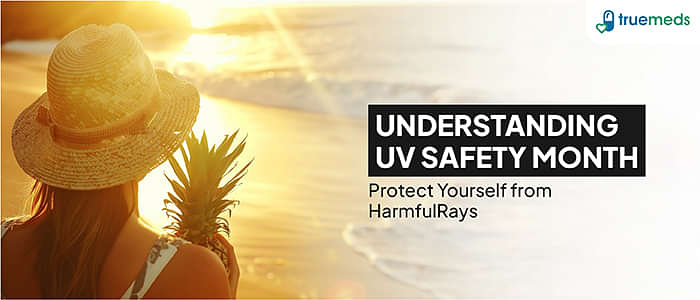
UV Safety Month: Simple Ways to Protect Yourself from Harmful Sun Rays
Last updated on :24 Feb, 2026
Read time :8 min
UV Safety Month, observed every July, is a critical reminder of the importance of protecting our skin and eyes from harmful ultraviolet (UV) radiation. Unprotected exposure to these rays can cause immediate effects such as sunburn and is associated with long-term risks, including premature skin ageing and a higher risk of skin cancer [1]. Skin cancer is the most common cancer in the United States, and it is estimated that one in five Americans will develop it by age 70 [2]. As summer increases outdoor activities, understanding and implementing effective sun safety measures is essential for protecting your health.
Understanding UV Radiation and Its Health Risks
UV radiation is energy emitted by the sun and artificial sources, such as tanning beds. It is classified by wavelength into UVA, UVB, and UVC rays:
- UVC Rays: UVC rays are largely absorbed by the Earth’s atmosphere and generally do not reach the ground under natural conditions.
- UVA Rays: These penetrate deeply into the skin (the dermis). Exposure to UVA is linked to premature skin ageing (such as wrinkles and age spots) and may contribute to an increased risk of skin cancer [3].
- UVB Rays: These primarily affect the outermost layer of the skin (the epidermis). UVB rays are the main cause of sunburn and also play a critical role in the development of skin cancer [3].
Associated Health Risks
Long-term, unprotected exposure to UV radiation is linked to several serious health outcomes:
- Skin Cancer: This includes the three main types: basal cell carcinoma, squamous cell carcinoma, and the most serious, melanoma [4].
- Premature Ageing: Causes photoaging, which manifests as wrinkles, fine lines, and uneven pigmentation (age spots) [3].
- Eye Damage: UV can lead to eye problems, including cataracts, macular degeneration, and photokeratitis (a painful condition akin to a corneal sunburn) [5].
- Immune Suppression: Excessive UV exposure has been shown to affect local immune responses in the skin, which may influence the body’s ability to respond to damage potentially increasing susceptibility to infections and reducing the body’s defense against skin cancer [1].
Your Essential Sun Protection Action Plan
The summer months bring peak UV exposure, typically between 10 a.m. and 4 p.m. [6]. Following precautionary measures can help reduce the potential risks associated with UV radiation.
1. Apply Sunscreen Strategically
Use a broad-spectrum sunscreen (protects against both UVA and UVB rays) with an SPF of 30 or higher [4].
- When to Apply: Apply liberally to all exposed skin 15 minutes before going outside [4].
- Reapplication Rule: Reapply at least every two hours. If swimming or heavily sweating, reapply every 40 to 80 minutes (check the product label for its water-resistance rating) or immediately after towel-drying [4].
2. Wear Sun-Protective Clothing
Protective clothing is an excellent physical barrier against UV radiation.
- Cover Up: Wear long-sleeved shirts, long pants, and skirts made of tightly woven, darker fabrics [7].
- Understand UPF: Look for clothing with an Ultraviolet Protection Factor (UPF) rating. This rating is specific to fabrics and indicates how effectively the material helps block UV rays [7].
3. Seek Shade During Peak Hours
Whenever possible, seek shade, especially when the UV radiation is strongest. [6]. Use natural shade from trees or create your own with umbrellas and canopies to reduce direct sun exposure.
4. Put on a Wide-Brimmed Hat
A hat provides vital protection for areas often missed by sunscreen.
- Optimal Style: Choose a wide-brimmed hat that goes all the way around to effectively shade the face, neck, and ears, which are highly vulnerable areas.
- Enhanced Protection: For better coverage, choose a tightly woven fabric or one with an official UPF rating [7].
5. Use 100% UV-Protective Sunglasses
Help reduce UV-related eye damage, which may contribute to conditions such as cataracts [5].
- Look for the Label: Ensure your sunglasses are labeled as offering 100% UV protection against both UVA and UVB rays. Wrap-around styles offer better coverage to the skin around your eyes.
6. Avoid Tanning Beds Entirely
Tanning beds and sunlamps emit intense artificial UV radiation, often at levels 10 to 15 times higher than the midday sun [2]. This significantly increases the risk of skin cancer and accelerates skin ageing. For cosmetic purposes, self-tanning lotions and sprays may offer a lower-risk alternative for a darker appearance.
Factors Influencing UV Exposure
The total amount of UV radiation you receive is affected by several variables:
- Time of Day: UV radiation is at its strongest between 10 a.m. and 4 p.m., as the sun is highest in the sky [6].
- Season: UV exposure is generally greater during late spring and summer months when the sun’s angle is more direct and daylight hours are longer [6].
- Altitude: UV radiation increases by approximately 2% for every 1,000-foot increase in elevation due to the thinner atmosphere providing less filtering [6].
- Reflection: Surfaces like snow (which can reflect up to 80% of UV rays), sand (about 15%), and water (about 10%) can significantly increase your UV exposure [6].
- Geographic Location: UV radiation is more intense near the equator [6].
- UV Index (UVI): This is an international measure of the level of UV radiation and the potential for skin damage. A UVI of 3 or higher generally indicates a moderate to high risk, suggesting that protective measures may be needed [6].
Conclusion
Proactive sun safety is an important part of maintaining long-term skin and eye health. Awareness of the risks associated with UV radiation and taking consistent protective measures can help reduce potential damage. A holistic sun safety approach includes applying sunscreen correctly, wearing protective clothing, using hats and sunglasses, seeking shade, and avoiding tanning beds. By following these precautions, you can safely enjoy outdoor activities while minimising the risks from UV exposure.
Frequently Asked Questions (FAQs)
In which months are UV rays strongest?
UV rays are typically strongest during the spring and summer months (April to August), especially between 10 a.m. and 4 p.m. [6].
What UV Index range is safe?
A UV Index of 0–2 is considered Low and generally safe for the average person, with minimal risk from unprotected sun exposure. However, even at this range, caution is advised for extended periods outdoors, especially for those who burn easily [6].
How much sun exposure is acceptable for health benefits?
Brief, unprotected sun exposure (approximately 10–15 minutes depending on skin type, location, and time of day) can help the body synthesize Vitamin D; however, longer exposure without protection can cause skin damage. The consensus among dermatological and public health organizations is that sun protection is needed when the UV Index is 3 or higher, as the risk of damage rapidly outweighs the benefit [6].
Which UV rays are harmful to the skin?
Both UVA and UVB rays are harmful. UVA rays penetrate deeply, causing premature aging and contributing to cancer. UVB rays primarily cause sunburn and are a major factor in skin cancer development [3].
At what time is sunlight most harmful?
Sunlight is generally considered most harmful, or the UV radiation is most concentrated, between 10 a.m. and 4 p.m. [6]. This is when you should prioritize seeking shade and using all forms of sun protection.
How to protect from ultraviolet rays?
To protect yourself from ultraviolet (UV) rays, use a multi-pronged approach: 1) Apply a broad-spectrum sunscreen with an SPF of at least 30, reapplying every two hours (or more frequently if swimming/sweating) [4]; 2) Wear protective clothing, including a wide-brimmed hat and UV-blocking sunglasses [7]; 3) Seek shade during peak hours (10 a.m.–4 p.m.) [6]; and 4) Avoid artificial UV sources like tanning beds [2].
References
[1] **D’Orazio, J., Jarrett, S., Amaro-Ortiz, A., & Scott, T. (2013). UV radiation and the skin.**International Journal of Molecular Sciences, 14(6), 12222–12248. https://doi.org/10.3390/ijms140612222
[2] American Academy of Dermatology. (n.d.). Skin cancer facts and statistics. Retrieved October 28, 2025, from https://www.aad.org/media/stats-skin-cancer
[3] Sultana, S., Naz, S., Akhtar, N., Ijaz, M., Huma, S., Khan, M. S., Dilshad, R., Tanveer, S., Shahzadi, T., & Qureshi, M. S. (2024). From rays to protection: How sun exposure affects our skin and the importance of sunscreen. In Recent Updates in Disease and Health Research Vol. 9 (pp. 75–85). B P International. Retrieved from https://www.researchgate.net/publication/381885291_From_Rays_to_Protection_How_Sun_Exposure_Affects_Our_Skin_and_the_Importance_of_Sunscreen
[4] American Academy of Dermatology Association. (n.d.). Sunscreen FAQs. Retrieved October 28, 2025, from https://www.aad.org/media/stats-sunscreen
[5] **Chinnasamy, S., Ramachandran, M., & Sivaji, C. (2022). A study on ultraviolet radiation and its effects.**REST Journal on Advances in Mechanical Engineering, 1(2), 1–9. Retrieved from https://www.academia.edu/download/93580412/1._10.46632_jame_1_2_1.pdf
[6] U.S. Environmental Protection Agency. (n.d.). UV index scale. Retrieved October 28, 2025, from https://www.epa.gov/sunsafety/uv-index-scale-0
[7] **Lu, J. T., Ilyas, E., & ILYAS, E. N. (2022). An overview of ultraviolet-protective clothing.**Cureus, 14(7). Retrieved from https://www.cureus.com/articles/105594-an-overview-of-ultraviolet-protective-clothing.pdf












Disclaimer
Our healthcare experts have carefully reviewed and compiled the information presented here to ensure accuracy and trustworthiness. It is important to note that this information serves as a general overview of the topic and is for informational purposes only. It is not intended to diagnose, prevent, or cure any health problem. This page does not establish a doctor-patient relationship, nor does it replace the advice or consultation of a registered medical practitioner. We recommend seeking guidance from your registered medical practitioner for any questions or concerns regarding your medical condition.
Recent Articles





Company
About UsHealth ArticleHealth StoriesHealth LibraryDiseases & Health ConditionsAyurvedaUnderstanding Generic MedicinesAll MedicinesAll BrandsNeed HelpFAQSecuritySavings CalculatorSubscribe
Registered Office Address
Grievance Officer
Download Truemeds


Contact Us
Our customer representative team is available 7 days a week from 9 am - 9 pm.
v4.23.0

2026 - Truemeds | All rights reserved. Our content is for informational purposes only. See additional information.
Our Payment Partners