

- Medicines
- Personal Care
- Skin Cream
- Sunscreen
- Face Wash
- Skin and Body Soap
- Acne Care
- Body Lotions
- Moisturising Lotion
- Moisturising Cream
- Mosquito Repellent
- Moisturising Gel
- Body Wash
- Hair Oils
- Hair Shampoo
- Hair Conditioners
- Hair Supplements
- Hair Colour
- Hair Serum
- Hair Mask
- Hair Solutions
- Baby Diapers and Wipes
- Baby Lotion and Moisturising Cream
- Baby Bath Essentials
- Baby Skin Care
- Baby and Infant Food
- Baby Healthcare
- Women Multivitamins
- Ovulation Test Kit and Women Intimate Care
- Sanitary Pads
- Nutritional Drinks
- Condoms
- Lubricants
- Massage Gels
- Personal Body Massagers
- Men Performance Booster
- Sexual Health Supplements
- Massage Oils
- Ayurveda
- Tooth Paste
- Mouth Ulcer Gel
- Mouthwash
- Toothache and Gum Pain
- Tooth Brush
- Gargle Solution
- Orthopaedic Supports
- Adult Diapers
- Footwear
- Mobility and Support Accessories
- Urinary Support and Care
- Health Conditions
- Bone and Joint Care
- Digestive Care
- Eye Care
- Pain Relief
- Smoking Cessation
- Liver Care
- Stomach Care
- Cold and Cough
- Heart Care
- Kidney Care
- Piles, Fissures & Fistula
- Respiratory Care
- Mental Wellness
- Derma Care
- Pre and Probiotics
- Acidity
- Gas
- Constipation
- Loose Motion/Diarrhoea
- Digestive Fibres
- Digestive Enzymes
- Eye Lubricant Drops
- Lens Solution
- Safety Eye Wear
- Eye Cream
- Eye Vitamins and Supplements
- Eye Drops
- Eye Ointment and Gel
- Nicotine Patch
- Nicotine Gum
- Nicotine Lozenges
- Cough Syrups
- Chest Rubs and Balms
- Nasal Spray
- Lozenges
- Inhalant Capsules
- Cold and Cough Tablets
- Vitamins & Supplements
- Diabetes Care
- Healthcare Devices
- Homeopathic Medicine
- Health Guide
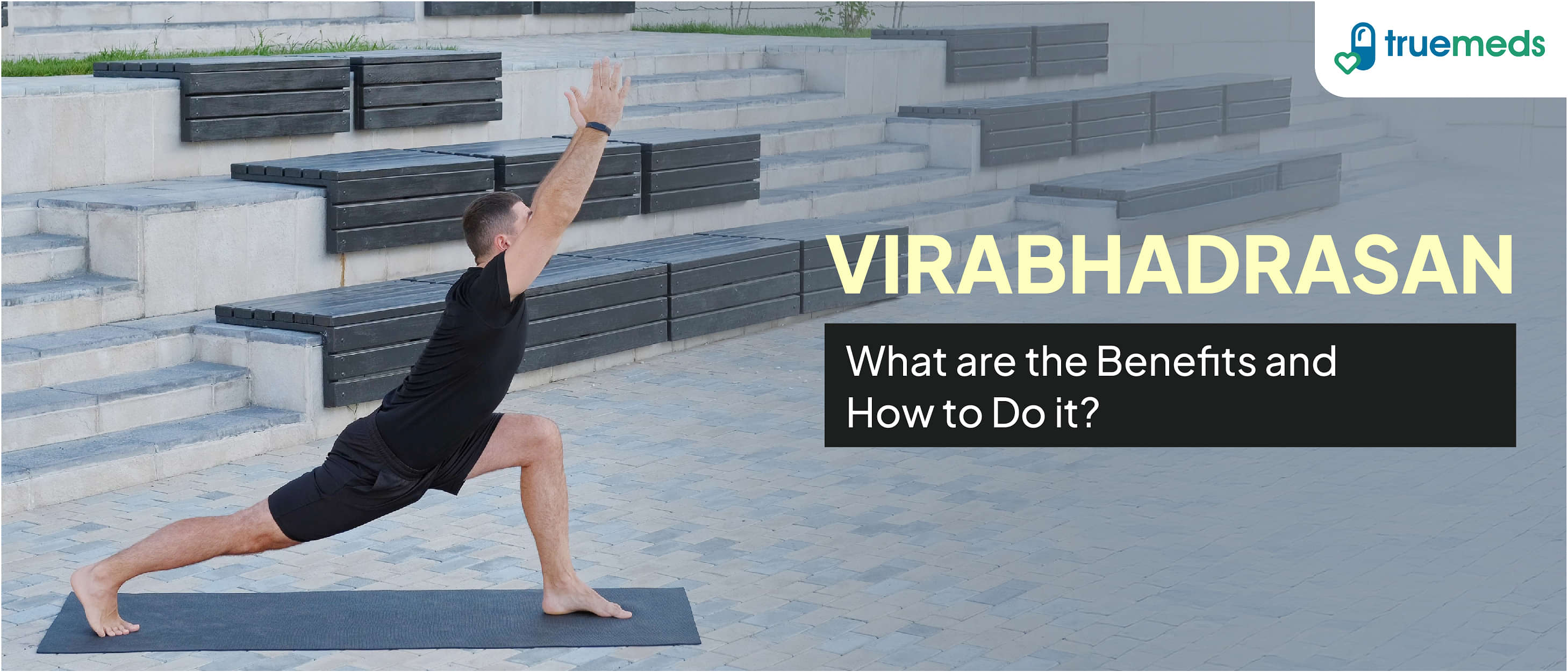
Health Benefits of Virabhadrasana: Steps, Variations & Benefits
Last updated on : 01 Dec, 2025
Read time : 8 min
Yoga offers holistic benefits to both body and mind, and Virabhadrasana—the Warrior pose—is renowned for enhancing strength, balance, and mental focus. Below, we explore its different variations, a guide to practice, and its evidence-based benefits.
What is Virabhadrasana?
Virabhadrasana, commonly known as the Warrior Pose, is a foundational standing posture (asana) in yoga practice that pays tribute to the legendary warrior Virabhadra. The name ‘Virabhadrasana’ has its roots in Sanskrit: ‘Vira’ means ‘brave’ or ‘hero’, ‘Bhadra’ translates to ‘friend’, and ‘Asana’ refers to ‘pose’ or ‘seat’. This pose honours the spirit of the warrior, helping practitioners cultivate strength, stamina, and stability. It’s named after the mythological figure Virabhadra, an incarnation of the god Shiva’s rage in Hindu tradition [1].
Benefits of Virabhadrasana (Warrior Pose)
Virabhadrasana, or Warrior Pose, is a yoga posture that primarily enhances musculoskeletal strength and neuromuscular coordination. Regular practice supports overall physical and mental well-being when performed correctly.
Key Benefits
- Strengthens Muscles and Joints: Engages major muscle groups in the lower body, including the quadriceps, hamstrings, and glutes, and provides resistance training to the arms and shoulders [2]. This helps improve muscle tone and joint stability around the hips and knees.
- Enhances Balance and Coordination: Specifically, Virabhadrasana III (Warrior III) is highly effective at developing dynamic balance and proprioception (body awareness), as it requires single-leg stability and core engagement [3].
- Improves Postural Alignment: The chest opening and spinal extension involved in Virabhadrasana I and II can help counteract upper-body slouching, reducing tension in the neck and shoulders [2].
- Stress Reduction and Focus: As a standing, grounding posture that requires focused attention on alignment and breath, practicing the Warrior poses can help reduce psychological stress and improve present-moment concentration [4].
- Supports Blood Circulation: The active engagement of large muscle groups and the elevated arm position in Warrior I can contribute to an increase in blood flow and oxygen delivery to the tissues [5].
- Increases Flexibility: The deep hip opening in Virabhadrasana II gently stretches the groin and inner thigh muscles.
Note on Medical Claims: Claims regarding direct “Aid in Digestion and Metabolism” or “Supports Weight Management” are common, but often overstated without specific, longitudinal data for this single pose. While general physical activity aids these processes, Virabhadrasana’s primary proven benefits are musculoskeletal strength and balance.
Step-by-Step Guide to the Warrior Poses
Here are the steps to perform the three main types of Virabhadrasana (Warrior Poses) in yoga:
Virabhadrasana I (Warrior Pose I)
- Stand with your feet hip-distance apart.
- Step your right foot forward approximately 3 to 4 feet. Rotate your left foot inward at a 45-degree angle. Ensure the heels are in line or slightly apart for stability.
- Bend your right knee, keeping it directly aligned above your ankle, forming a 90-degree angle if possible. Your left leg remains straight.
- Inhale as you raise your arms overhead, keeping them straight with your palms facing each other. Draw your shoulders down away from your ears.
- Lengthen your spine and gaze forward (or slightly up, if comfortable for the neck).
- Hold for 3 to 5 breaths, taking deep breaths.
- Straighten your right knee, step back to the starting pose, and repeat on the left side.
Virabhadrasana II (Warrior Pose II)
- Start with your feet hip-distance apart.
- Step your right foot forward 3 to 4 feet. Rotate your left foot outward at a 90-degree angle, ensuring your front heel aligns with the arch of your back foot.
- Bend your right knee over your ankle, keeping your left leg straight.
- Raise your arms out to the sides at shoulder height, palms facing down. Keep your arms parallel to the floor.
- Turn your head to look over your right fingertips.
- Hold for 3 to 5 breaths, breathing deeply and maintaining alignment.
- Straighten your right knee, return to the starting pose, and repeat on the left side.
Virabhadrasana III (Warrior Pose III)
- Stand in Tadasana (Mountain Pose) with feet hip-distance apart.
- Shift weight onto your right foot and lift your left leg straight back, keeping the foot flexed.
- Lean your torso forward while extending your left leg back, simultaneously creating a straight line from the crown of your head to the heel of the extended foot.
- Keep arms extended forward or alongside your body for balance. A common modification is to place hands in prayer position (Anjali Mudra) at the chest.
- Maintain a straight line from head to extended foot, engaging your core and keeping your hips level.
- Hold for 3 to 5 breaths, focusing on balance.
- Lower your left leg back to the ground, return to the starting pose, and repeat on the opposite side.
Incorporate Virabhadrasana into your daily yoga practice to enjoy its many benefits!
Precautions and Contraindications for Practising Virabhadrasana
While Virabhadrasana is generally safe, it’s essential to practice it mindfully to avoid injury. Follow these precautions:
- Joint Injuries: Avoid this pose if you have a recent or chronic hip, knee, or ankle injury. If you have arthritis or joint pain, practice with modifications (e.g., a shallower knee bend) under the guidance of a professional.
- Cardiovascular Concerns: Individuals with uncontrolled high blood pressure or heart conditions should avoid holding the poses for extended periods or suddenly raising their arms overhead (especially in Warrior I). Consult your doctor before practice.
- Eye Conditions: Individuals with glaucoma or other eye conditions should avoid any unnecessary straining of the neck or eyes, specifically by not maintaining an upward gaze in Warrior I.
- Pregnancy: Pregnant individuals, especially in the second and third trimesters, should widen their stance for stability and practice only modified versions of this pose, focusing on balance and avoiding overexertion. Always seek guidance from a prenatal yoga specialist.
- General Safety Tips: Always warm up beforehand, maintain proper alignment, and ease into the pose gradually without forcing your body into it. Never practice through sharp or shooting pain.
Conclusion
Virabhadrasana offers multiple proven benefits, primarily related to physical strength, improved balance, and enhanced posture [2], [3]. It is also a valuable tool for stress relief and mental focus [4]. However, claims of direct effects on disease treatment or significant weight loss are often overclaimed and lack specific evidence [5]. Use it as part of a broader, well-rounded yoga or fitness routine, and always listen to your body.
Frequently Asked Questions(FAQs)
What are the benefits of Virabhadrasana?
Virabhadrasana, also known as Warrior Pose, primarily boosts musculoskeletal strength and tones the arms, legs, and lower back. It also promotes overall body balance, stability, and mental focus [3].
What are the benefits of Virabhadrasana I?
Warrior I pose, also known as Virabhadrasana I, offers several benefits, including strengthening the shoulders, arms, legs, ankles, and back, while also stretching the chest and hips. It also improves focus and stability.
What are the benefits of Virabhadrasana II?
Virabhadrasana II (Warrior II) offers numerous benefits, including strengthening the lower body (quadriceps and glutes), opening the hips, enhancing flexibility, improving balance and stability, and building mental focus and concentration [2].
What are the benefits of Virabhadrasana III?
Virabhadrasana III (Warrior III) is considered an advanced pose that significantly improves dynamic balance, tones your abdomen, and strengthens the legs and ankles. It also enhances your focus and concentration due to the stability required [3].
What are the disadvantages of Virabhadrasana I?
If not done correctly, Virabhadrasana I can cause strain or injury to your neck, knees, or back. The main disadvantage is the risk of misalignment, particularly letting the front knee move past the ankle or twisting the back knee. Always practice yoga under the guidance of a trained instructor, especially when starting.
References
[1] Lyons, J. (2015). With danger, opportunity: Virabhadrasana, Warrior Pose. River Teeth: A Journal of Nonfiction Narrative, 16(2), 9–18. https://doi.org/10.1353/rvt.2015.0001
[2] Sahu, P., Singh, B. K., & Nirala, N. (2021). Effect of various standing poses of yoga on the musculoskeletal system using EMG. In P. K. Singh, B. K. Singh, & N. Nirala (Eds.), Computer-Aided Design and Diagnosis Methods for Biomedical Applications (pp. 89–112). CRC Press. Retrieved from https://www.taylorfrancis.com/chapters/edit/10.1201/9781003121152-4/effect-various-standing-poses-yoga-musculoskeletal-system-using-emg-pramod-sahu-bijay-kumar-singh-neelam-nirala
[3] Gothe, N. P., McAuley, E., & Winding, T. (2019). Yoga and dynamic balance in older adults: A systematic review and meta-analysis. Complementary Therapies in Medicine, 44, 25-32. https://doi.org/10.1016/j.ctim.2019.03.003
[4] Pascoe, M. C., Thompson, D. R., & Ski, C. F. (2017). Yoga, mindfulness-based stress reduction and stress-related psychological symptoms: A meta-analysis and mechanism review. Psychoneuroendocrinology, 86, 152-166. https://doi.org/10.1016/j.psyneuen.2017.08.008
[5] Telles, S., Gaurav, V., Sharma, S. K., & Gupta, R. K. (2020). Yoga practice for cardiovascular health: A systematic review. Journal of Complementary and Integrative Medicine, 17(1). https://doi.org/10.1515/jcim-2019-0158













Disclaimer
Our healthcare experts have carefully reviewed and compiled the information presented here to ensure accuracy and trustworthiness. It is important to note that this information serves as a general overview of the topic and is for informational purposes only. It is not intended to diagnose, prevent, or cure any health problem. This page does not establish a doctor-patient relationship, nor does it replace the advice or consultation of a registered medical practitioner. We recommend seeking guidance from your registered medical practitioner for any questions or concerns regarding your medical condition.
Popular Articles


Recommended Articles




Recent Articles










Company
About UsHealth ArticleHealth StoriesHealth LibraryDiseases & Health ConditionsAyurvedaUnderstanding Generic MedicinesAll MedicinesAll BrandsNeed HelpFAQSecuritySubscribe
Registered Office Address
Grievance Officer
Download Truemeds


Contact Us
Our customer representative team is available 7 days a week from 9 am - 9 pm.
v4.10.3

2025 - Truemeds | All rights reserved. Our content is for informational purposes only. See additional information.

Our Payment Partners