Key Takeaways
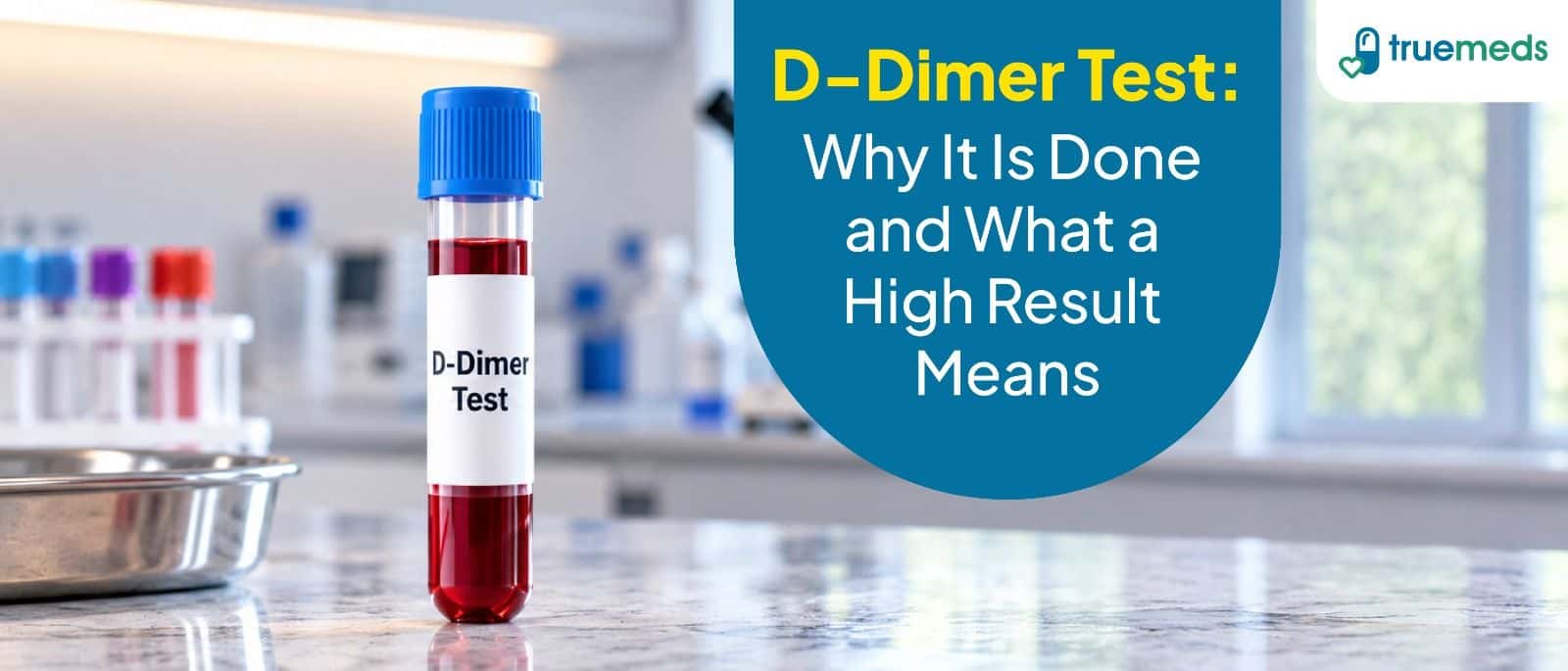
- A D-dimer test measures fibrin breakdown products in blood to help rule out blood clots
- A low or normal result is genuinely reassuring against clots
- A high result does not confirm a blood clot; many other conditions can elevate D-dimer
- The test has high sensitivity but low specificity, making it better for ruling out than confirming clots
- Further imaging tests are needed after a high result
- "Reducing" D-dimer is not a treatment goal; treating the underlying cause is what matters
If you have received a D-dimer test result and are unsure what it means, you are not alone. A low D-dimer level is genuinely reassuring and suggests you probably do not have a blood clotting disorder[1]. However, a high result does not confirm a clot, since many other conditions can also raise D-dimer levels[2].
This misunderstanding often causes unnecessary worry. This article explains what the D-dimer test measures, why doctors order it, and what high results actually mean. It is intended for general education only and does not interpret your individual result. Always consult your healthcare provider for personalised guidance.
What is a D-dimer test, and why is it done?
D-dimer is a protein fragment (called a fibrin degradation product) that forms when blood clots break down. When your body creates a clot and then dissolves it, D-dimer is released into your bloodstream[3].
Doctors order D-dimer tests to check for blood clotting problems. The test is commonly used to help rule out conditions such as[1]:
- Deep vein thrombosis (DVT): Blood clots in deep veins, usually in the legs
- Pulmonary embolism (PE): Blood clots that travel to the lungs
- Disseminated intravascular coagulation (DIC): A serious condition involving abnormal clotting throughout the body
- Stroke: When blood flow to the brain is blocked
The test is often used in emergency settings when a patient presents with symptoms like leg pain, swelling, or sudden shortness of breath[1].
Understanding sensitivity and specificity: Why a negative result matters more than a positive one
The D-dimer test has high sensitivity but low specificity. In practical terms, this means[4]:
- High sensitivity (approximately 87-98%): The test is very good at detecting when a clot is present. A negative result strongly suggests no clot exists.
- Low specificity (approximately 40-45%): Many non-clot conditions can raise D-dimer levels, leading to frequent false positives.
Studies show D-dimer has an excellent negative predictive value of approximately 97%, meaning when the result is normal, you can be highly confident no clot is present. However, the positive predictive value is limited to around 12.5%, meaning most high results are not caused by blood clots[4]. The D-dimer test cannot be used as a standalone parameter to confirm venous thromboembolism (VTE)[5].
Age-adjusted D-dimer cutoffs can help improve the test's usefulness in older adults[6]. This approach accounts for the natural increase in D-dimer that occurs with ageing.
What can cause a high D-dimer besides a blood clot?
The following table outlines common causes of elevated D-dimer beyond blood clots[2],[6],[7]:
Condition | How it may affect D-dimer |
|---|---|
Infection | Inflammation and immune response can trigger clotting activity |
Pregnancy | Normal physiological changes may increase clotting factors |
Cancer (neoplasia) | Tumours can activate the clotting system |
Recent surgery | Tissue trauma may activate clotting and healing processes |
Circulatory stress can trigger clot formation and breakdown | |
Impaired clotting factor production may affect fibrinolysis | |
Cigarette smoking | Chronic inflammation can elevate baseline D-dimer |
Advanced age | D-dimer naturally increases with age |
This wide range of causes explains why a positive D-dimer result requires further investigation rather than immediate alarm.
What is considered a normal D-dimer range?
Standard laboratory cutoffs generally consider D-dimer levels below 500 ng/mL (or 0.5 mg/L) as normal[8]. Values above this threshold typically prompt further investigation.
However, interpreting D-dimer is not straightforward because:
- Different laboratories may use different assays with varying cutoff values
- Sample type (whole blood vs. plasma) can affect results
- Age significantly impacts expected values
For patients aged 50 years or older, many clinicians now use an age-adjusted cutoff: patient's age multiplied by 10 (in µg/L). For example, a 70-year-old would have a threshold of 700 µg/L rather than the standard 500 µg/L. This approach significantly increases the number of older patients who can safely avoid unnecessary imaging, from 5.5% using conventional cutoffs to 16.6% using age-adjusted thresholds[9].
Normal ranges may vary between laboratories. Always interpret your results with guidance from your healthcare provider.
Read about - What Are the Most Common Blood Tests, and Why Are They Done?
What level of D-dimer is dangerous? Correcting a common misunderstanding
Many people search for information about "dangerous" D-dimer levels, but this framing reflects a misunderstanding of what the test measures.
D-dimer levels do not directly indicate danger. A high level signals that clotting and clot breakdown are occurring somewhere in your body, but it does not tell you where or why [2].
Research on extremely elevated levels provides some context. In patients with plasma D-dimer levels exceeding 5,000 ng/mL, venous thromboembolism was the most common diagnosis, followed by cancer and pneumonia. Mortality rates were notably higher when levels exceeded 15,000 ng/mL[10].
However, these extreme values represent hospitalised patients with serious underlying conditions. The "danger" comes from the underlying disease, not the D-dimer number itself.
The key point: D-dimer is a marker, not a diagnosis. A very high level warrants urgent investigation, but the number alone cannot tell you what is wrong. Seek immediate medical attention if you have symptoms like sudden chest pain, difficulty breathing, or leg swelling.
How to "reduce" D-dimer levels: why this is not the right goal
Searching for "how to reduce D-dimer levels" is understandable but reflects a misunderstanding of what the test indicates.
D-dimer is not a target for treatment; it is a signal pointing to an underlying condition.
An elevated D-dimer, even without confirmed VTE, should prompt doctors to investigate what is causing the clotting activity[6]. Treating the underlying cause (infection, inflammation, malignancy, or actual clot) will naturally address the elevated D-dimer.
Importantly, elevated D-dimer alone is not an indication for starting blood-thinning medications[6]. Treatment decisions depend on identifying the specific cause, not simply responding to the number.
Any treatment decisions should be made by your healthcare provider after appropriate diagnostic evaluation.
Conclusion
The D-dimer test is a valuable screening tool that excels at ruling out blood clots rather than confirming them. A low result is generally reassuring, whereas a high result indicates the need for further investigation. Many conditions beyond blood clots, including infection, pregnancy, cancer, and normal ageing, can elevate D-dimer levels.
Understanding this distinction helps reduce unnecessary anxiety about test results. If your D-dimer is elevated, work with your healthcare provider to identify the underlying cause rather than focusing on the number itself.
FAQs
Can a D-dimer test alone diagnose a blood clot?
No. A positive D-dimer result only suggests that clotting activity is occurring somewhere in your body. Imaging tests such as Doppler ultrasound for DVT or CT angiography for pulmonary embolism are needed to confirm or rule out an actual clot.
Why do older adults often have higher D-dimer results?
D-dimer naturally increases with age due to chronic inflammation and age-related changes in the clotting system. This is why doctors may use age-adjusted cutoffs (age × 10 in µg/L) for patients 50 years and older, improving test accuracy.
Can a D-dimer test give a false negative?
Yes, though uncommon. False negatives may occur if blood is drawn very early during clot formation, after the clot has organised, or after anticoagulant treatment has begun. Clinical assessment remains essential alongside test results.
Does pregnancy affect D-dimer levels?
Yes. D-dimer levels increase throughout pregnancy as part of normal physiological changes. This makes standard cutoffs unreliable for pregnant women, and doctors must interpret results carefully in the context of each trimester.
What happens after a high D-dimer result?
Your doctor will typically order imaging tests to look for clots. For suspected DVT, Doppler ultrasound of the legs is common. For suspected pulmonary embolism, CT angiography of the chest may be performed.
Can stress or diet affect D-dimer levels?
While chronic inflammation from poor lifestyle habits may slightly affect baseline D-dimer, acute stress or dietary factors are not established causes of clinically significant elevation. If your D-dimer is high, underlying medical conditions are far more likely responsible.
Medical Disclaimer
This article is for informational purposes only and does not constitute medical advice. The information provided should not be used for diagnosing or treating health conditions. Always consult a qualified healthcare provider for diagnosis, treatment, and personalised medical advice. Do not disregard professional medical advice or delay seeking it because of information found in this article. If you have a medical emergency, contact your doctor or emergency services immediately.
References
MedlinePlus. (2024). D-Dimer Test. MedlinePlus. https://medlineplus.gov/lab-tests/d-dimer-test/
MedlinePlus. (2026). D-dimer test. MedlinePlus Medical Encyclopedia. https://www.nlm.nih.gov/medlineplus/ency/article/007620.htm
PMC. (2023). How we manage a high D-dimer. National Center for Biotechnology Information. https://pmc.ncbi.nlm.nih.gov/articles/PMC10985443/
PMC. (2026). Assessing D-dimer test specificity for pulmonary embolism diagnosis in emergency departments. National Center for Biotechnology Information. https://pmc.ncbi.nlm.nih.gov/articles/PMC13380212/