

Rising healthcare costs have become a significant concern for millions of Indians, with out-of-pocket health expenses constituting nearly 45% of total health expenses in recent years[1]. As medication prices continue to climb, generic medicines have emerged as a practical and affordable alternative to branded medicines. India has taken substantial steps to improve access to generic medicines through initiatives like the Pradhan Mantri Bhartiya Janaushadhi Pariyojana (PMBJP), which now operates over 19,000 Jan Aushadhi centres across the country[2].
Understanding how generic medicines work, their regulatory oversight, and their benefits can help you make informed decisions about your treatment options without compromising quality or safety.
Why Are Generic Medicines Important?
Generic medicines play a crucial role in making healthcare accessible and affordable, particularly for patients requiring long-term treatment. These medications help bridge the gap between rising medicine costs and patient affordability while maintaining equivalent therapeutic outcomes to their branded equivalents[3].
Generic medicines contain the same active pharmaceutical ingredients as their branded counterparts and must comply with identical safety, efficacy, and quality standards set by regulatory authorities[3]. The key difference lies in pricing. Generic manufacturers do not incur the high research, development, and marketing costs associated with new medicine discovery. This allows them to offer medicines at significantly lower prices without compromising therapeutic effectiveness[4].
In India, generic medicines account for nearly 70% of the pharmaceutical market by volume, reflecting their widespread acceptance[5]. Government initiatives such as the Jan Aushadhi programme further support affordability by offering generic medicines at 50–90% lower prices than their branded alternatives[2]. To maintain this affordability with added convenience, many patients now choose to purchase generic medicine online through verified platforms, ensuring a steady supply for consistent treatment.
For patients with chronic conditions like diabetes or hypertension, affordable generics enable consistent, long-term treatment and reduce the risk of skipped doses due to cost constraints[6].
Beyond individual benefits, generic medicines promote market competition. Once patents expire, the entry of multiple generic manufacturers drives prices down across the market. This increased competition helps reduce overall healthcare costs while maintaining quality and safety through regulatory oversight[3].
Advantages of Generic Medicines
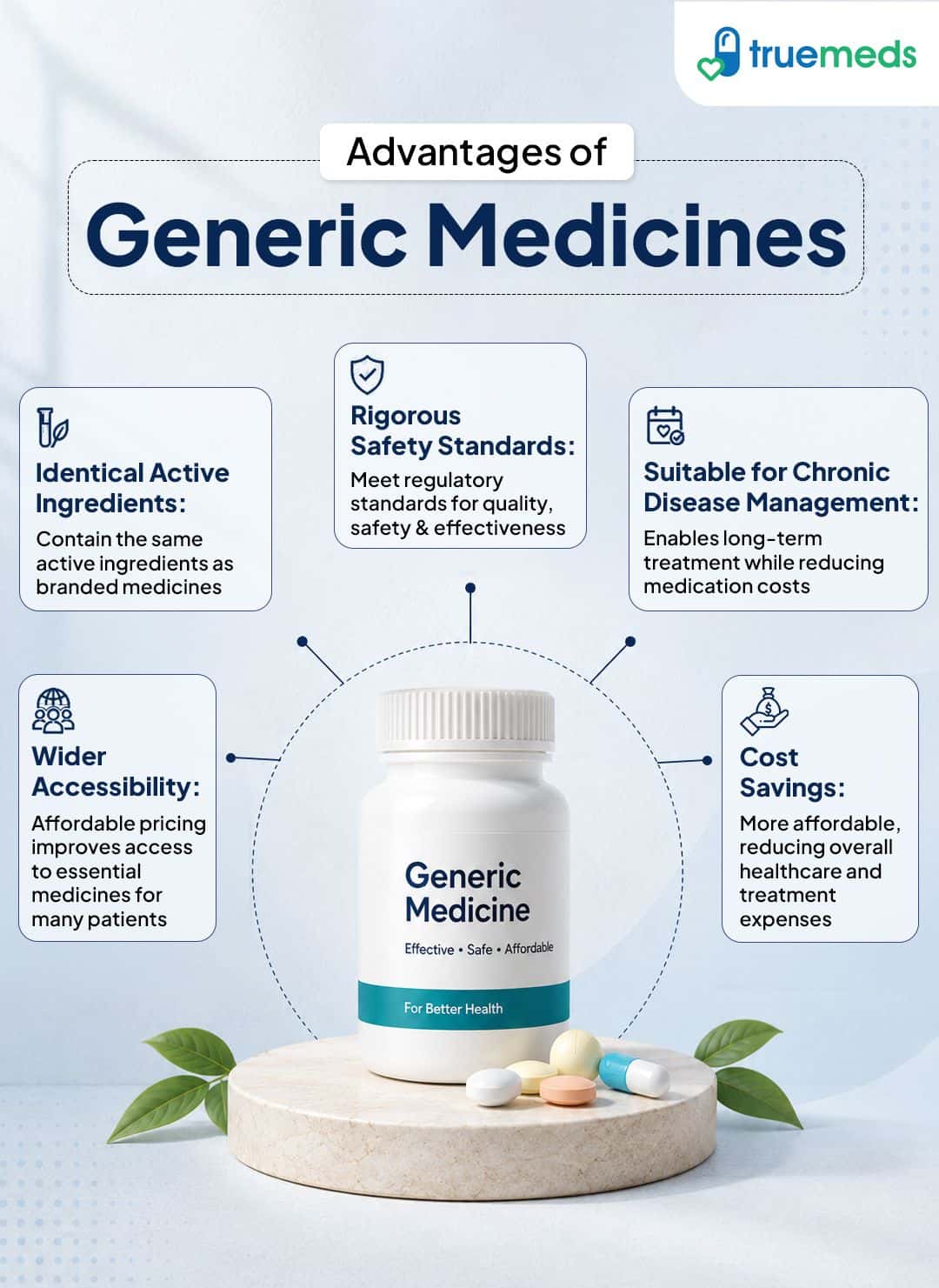
Generic medicines can provide the same therapeutic benefits as their branded counterparts while offering key advantages such as lower costs, the same active ingredients, established quality and safety standards, wider access to essential treatments, and greater affordability for people requiring long-term medicines.
1. Cost Savings
The most significant advantage of generic medicines is their substantial cost reduction compared with branded medicines. Generic medicines typically cost 30-80% less than their branded equivalents, making essential treatments accessible to a broader population[6].
In the United States alone, generic medicines save the healthcare system over $467 billion in 2024[4]; a figure that underscores their economic impact, particularly in high-spending healthcare systems. In India, through the Jan Aushadhi initiative, patients can access generic medicines at 50-90% lower prices[2]. These cost savings do not compromise treatment quality, as generics must meet the same regulatory standards as their branded counterparts.
2. Identical Active Ingredients
Generic medicines contain the same active pharmaceutical ingredients in identical concentrations as their branded versions[3]. Regulatory authorities require that generics demonstrate bioequivalence, meaning the generic medicines deliver the same amount of active ingredient into the bloodstream at the same rate as the branded medicines[7]. This bioequivalence testing ensures that switching from a branded to a generic medication will produce the same therapeutic effect[7].
3. Rigorous Safety Standards
Generic medicines undergo a comprehensive regulatory review before approval. In India, the Central Drugs Standard Control Organisation (CDSCO) ensures that all generic medicines meet Schedule M quality standards and Good Manufacturing Practice (GMP) certification requirements[8].
Internationally, regulatory bodies like the FDA require extensive documentation proving that generics match branded medicines in quality, safety, and effectiveness[3]. Both branded and generic medicines remain subject to continuous post-market surveillance to monitor adverse effects and maintain safety standards[8].
4. Wider Accessibility
The availability of generic medicines through government programmes and retail pharmacies has significantly improved access to essential treatments. Jan Aushadhi centres have expanded rapidly across urban and rural areas, bringing affordable medicines closer to patients who previously struggled with high medicine costs[2].
This improved accessibility ensures that geographic location or economic status does not become a barrier to receiving necessary medical treatment[2].
5. Suitable for Chronic Disease Management
Patients with chronic conditions such as diabetes, hypertension, and cardiovascular disease require lifelong medication therapy. The affordability of generic medicines makes sustained treatment financially feasible for millions of patients[6].
Studies have shown that medication adherence improves when patients face lower out-of-pocket costs, leading to better health outcomes. Generic availability for common chronic disease medications ensures that patients can maintain consistent treatment without financial strain[9].
Are There Any Limitations to Generic Medicines?
Generic medicines are considered safe and equally effective for the vast majority of patients and conditions, but a few situations call for extra care. Regulatory bioequivalence testing is intended to demonstrate comparable drug exposure between the generic and branded versions, within accepted regulatory limits. For most medicines, this difference has no practical effect. For medicines with a narrow therapeutic index, such as certain thyroid, heart rhythm, seizure, and immunosuppressant medicines, even small differences can matter, so doctors may monitor patients more closely after a brand-to-generic switch.
Generic medicines can also differ from the branded version in inactive ingredients, such as fillers, binders, or colourings. These differences generally do not affect how the medicine works, but in rare cases, they can trigger a reaction in patients with specific allergies or sensitivities. Finally, a generic version only becomes available once a medicine's patent protection ends, so very new medicines may not have a generic option yet.
These situations are the exception rather than the rule. For most people and most conditions, generic medicines offer the same therapeutic benefit as branded medicines at a substantially lower cost. If you have concerns about switching to a generic version of a specific medicine, speak with your doctor or pharmacist first.
Conclusion
Generic medicines represent a safe, effective, and economically viable option for patients across India and globally. They provide the same therapeutic benefits as branded medicines while offering substantial cost savings that can make the difference between consistent treatment and medication non-adherence[3]. Regulatory frameworks maintained by organisations such as CDSCO and FDA ensure that approved generic medicines meet rigorous quality and safety standards.
When choosing between generic and branded medicines, consult your doctor or pharmacist to understand which option best suits your specific medical needs and circumstances. For many patients and commonly treated conditions, generic medicines offer an excellent balance of affordability, quality, and accessibility. The continued expansion of programmes like Jan Aushadhi demonstrates the government's commitment to making essential medicines available to all citizens regardless of economic status.
FAQs
What are the benefits of generic medicines?
Generic medicines cost 30-80% less than branded versions while containing identical active ingredients. They meet the same safety, quality, and effectiveness standards as branded medicines set by regulatory authorities like FDA and CDSCO, making them affordable alternatives for long-term treatment without compromising therapeutic outcomes.
Which medicine is better, generic or branded?
Both are considered equally effective when approved by regulators. Generic medicines have the same active ingredients, dosage, and therapeutic effect as their branded versions. The main difference is price; generics cost less because manufacturers avoid research and marketing expenses. Your choice may depend on availability and affordability.
Is buying generic medicine good?
Yes, buying generic medicine is a smart choice for most patients. They provide the same treatment quality at significantly lower cost. In India, government initiatives like Jan Aushadhi promote generics with 50-90% savings. Always verify that the medicine is approved by CDSCO for safety assurance.
Do generic medicines have side effects?
Generic medicines have the same side effect profile as branded medicines because they contain identical active ingredients. Any medication can cause side effects depending on individual response. Both generic and branded versions undergo the same safety monitoring by regulatory authorities to ensure patient protection.
When not to use generics?
Most generics are suitable for all patients. However, consult your doctor before switching if you take medications with narrow therapeutic windows (like certain heart or seizure medicines), have experienced adverse reactions, or require specific inactive ingredient formulations due to allergies or sensitivities.
Are generic medicines safe to use?
Yes, approved generic medicines are safe. In India, CDSCO ensures generics meet Schedule M quality standards and GMP certification. Internationally, the FDA requires bioequivalence testing proving generics work identically to branded medicines. Both undergo continuous safety monitoring throughout their market life.
Are generic medicines suitable for long-term treatment?
Yes, generic medicines are ideal for long-term treatment of chronic conditions like diabetes, hypertension, and heart disease. Their lower cost makes sustained treatment affordable without compromising effectiveness. Millions of patients worldwide successfully rely on generics for lifelong therapy with excellent outcomes.
Are generic medicines available for all diseases?
Generic medicines are available for most common conditions once the branded medicine's patent expires. In India, generics cover diabetes, hypertension, infections, pain relief, and many chronic diseases. However, newly developed medicines remain patent-protected until generics can legally enter the market after exclusivity periods end.
Medical Disclaimer
This article is for informational purposes only and does not constitute medical advice. The information provided should not be used for diagnosing or treating health conditions. Always consult a qualified healthcare provider for diagnosis, treatment, and personalised medical advice. Do not disregard professional medical advice or delay seeking it because of information found in this article. If you have a medical emergency, contact your doctor or emergency services immediately.
References
World Bank open data. (n.d.). World Bank Open Data. https://data.worldbank.org/indicator/SH.XPD.OOPC.CH.ZS?locations=IN
Department of Pharmaceuticals, Ministry of Chemicals and Fertilizers, Government of India. (2026, July 24). Availability of Medicines at JAKs. Press Information Bureau. https://www.pib.gov.in/PressReleasePage.aspx?PRID=2288771
U.S. Food and Drug Administration. (2023). Generic Drug Facts. U.S. Food and Drug Administration. https://www.fda.gov/drugs/generic-drugs/generic-drug-facts
Association for Accessible Medicines. (2025). 2025 U.S. Generic & Biosimilar Medicines Savings Report. Association for Accessible Medicines. https://accessiblemeds.org/resources/reports/2025-savings-report/