Key Takeaways
- Generic medicines contain the same active ingredient, strength, and dosage form as branded medicines.
- Generics must meet regulatory standards for quality, safety, and efficacy, with bioequivalence testing required for applicable medicines.
- Generic medicines are usually more affordable because manufacturers do not incur the same research, development, and marketing costs.
- Inactive ingredients may differ between generic and branded medicines, but these differences generally do not affect the medicine’s therapeutic effect.
- Generic and branded medicines generally have similar effectiveness and safety when they contain the same active ingredient and are approved as therapeutically equivalent.
- Speak to your doctor or pharmacist before switching, especially when taking medicines that require close monitoring, such as warfarin or certain anti-epileptic medicines.
- Never stop or switch a prescribed medicine without medical advice, even when a generic alternative is available.
It is entirely natural for patients to question the safety, purity, and efficacy of a medication when observing a 30% to 80% cost reduction compared to its branded counterpart. In healthcare, we instinctively associate a lower price with lower quality[1]. However, in clinical pharmacology, this substantial price disparity is a reflection of regulatory economics, not a compromise in therapeutic value.
These concerns persist even though generic medicines account for nearly 80% of all prescriptions dispensed worldwide[2]. For many consumers, lower cost is still closely associated with lower quality, especially when it comes to healthcare decisions that directly affect well-being.
To address these concerns, it’s important to look beyond price alone and understand the science, testing processes, and regulatory frameworks that govern how generic medicines are developed and approved.
Are Generic Medicines as Effective as Branded Medicines?
Generic medicines are just as effective as branded medicines when approved by regulatory authorities. They contain the same active ingredient, in the same strength and dosage form, as the branded version[1]. This means they work in the same way in your body to treat the condition.
Before approval, generic medicines must also prove bioequivalence, demonstrating that their pharmacokinetic parameters (AUC and Cmax) fall within 80–125% of the branded product's values, confirming equivalent drug absorption[3].
In India, the Central Drugs Standard Control Organisation (CDSCO) requires generic medicines to meet the same quality, safety, and efficacy standards as branded medicines through bioequivalence testing[4]. The World Health Organisation's prequalification programme further confirms that approved generic medicines have the same clinical effect as innovator products when used under identical conditions[5].
Multiple systematic reviews and meta-analyses have demonstrated no clinically significant difference in therapeutic outcomes between generic and branded medicines for most cardiovascular disorders, though individual monitoring may be advised for narrow therapeutic index cardiovascular medicines[6].
What are the Differences Between Generic vs Branded Medicines?
Although generic and branded medicines deliver identical therapeutic efficacy and clinical outcomes, they differ fundamentally in their regulatory lifecycles, production economics, and physical aesthetics. These key structural variations explain the substantial cost disparities and outward differences without compromising patient safety, drug purity, or medical performance. A parameters-based breakdown reveals how these two drug classes compare:
Price and Development Costs
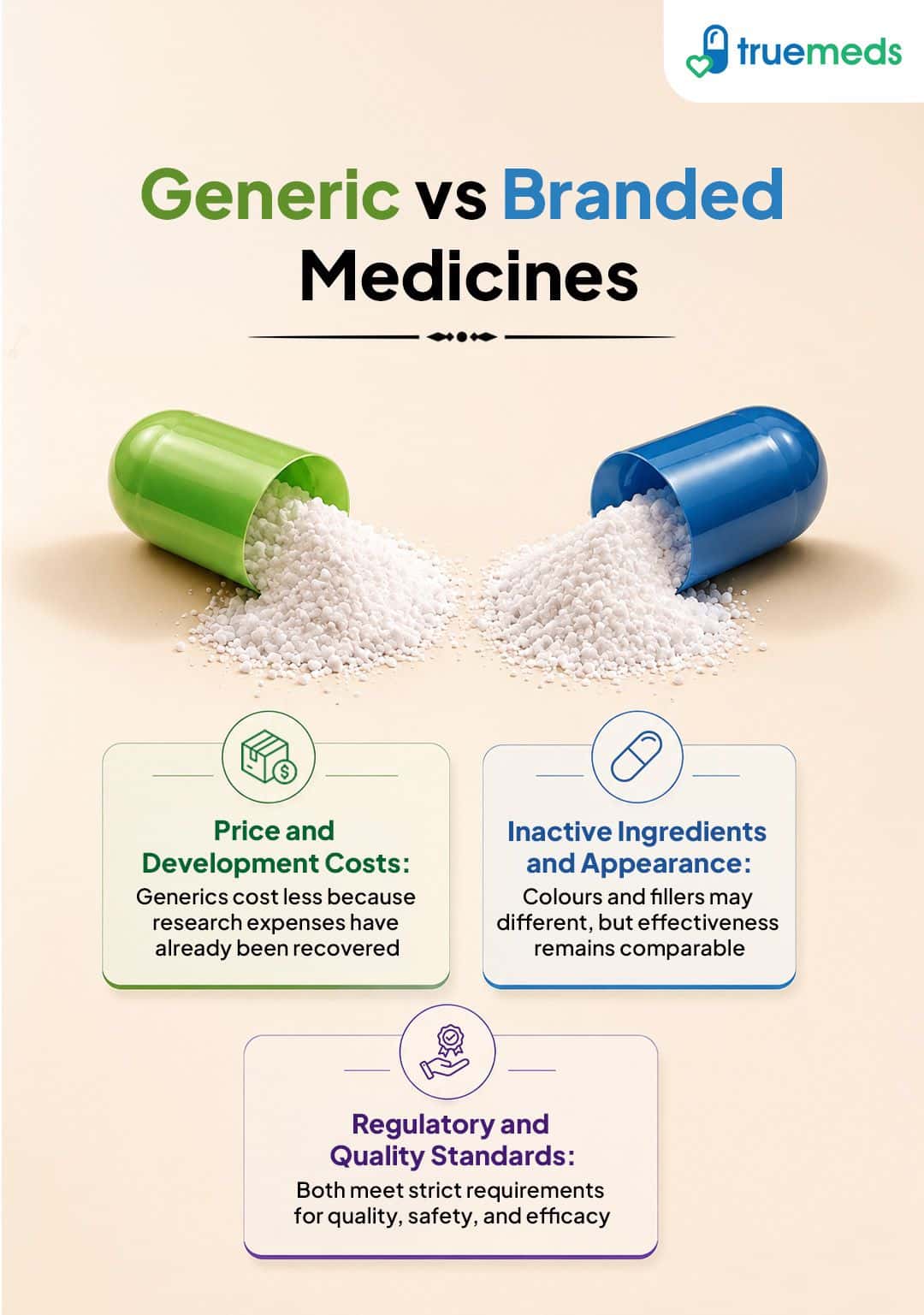
Generic medicines can cost 30-80% less than their branded versions because manufacturers do not bear research, development, and marketing costs[1]. Developing a new medicine costs approximately $2.6 billion, including years of research and clinical trials[7]. Generic manufacturers produce the same medicine after patent expiration, passing these massive cost savings directly to consumers.
Regulatory and Quality Standards
Here's how generic and branded medicines compare across key parameters:
Aspect | Branded Medicines | Generic Medicines |
|---|---|---|
Active Ingredient | Original formulation | Identical active ingredient, same strength |
Effectiveness | Clinically tested | Must prove bioequivalence (80–125% range) |
Quality Standards | USP/IP standards | Same USP/IP standards |
Inactive Ingredients | Original fillers, binders, colours | May differ, but it cannot affect the medicine's action |
Patent Protection | 20 years of exclusivity from the date of filing the patent[8] | Available after patent expiry |
Appearance | Original design | Different colour, shape, packaging[9] |
Price | Premium pricing | 30-80% lower cost |
While inactive ingredients do not affect the drug's therapeutic action, individuals with specific allergies or intolerances should check formulations with a pharmacist.
Inactive Ingredients and Appearance
Generic medicines may contain different inactive ingredients such as fillers, binders, and colouring agents. These differences affect the tablet's appearance, colour, and shape, but they cannot influence how the active ingredient works in your body. Regulatory authorities strictly ensure that any variations in inactive ingredients remain therapeutically irrelevant.
Branded medicines maintain their original packaging, colour, and shape for brand recognition. Generic medicines appear different because they cannot legally copy the branded appearance, but this cosmetic difference does not impact therapeutic effectiveness.
When Should You Consult a Doctor Before Switching?
While generic medicines are generally safe and effective, certain situations require medical guidance before switching from branded to generic versions.
1. Narrow Therapeutic Index Medications
Patients taking narrow therapeutic index medicines should consult healthcare providers before switching. These medications, including warfarin, levothyroxine, anti-epileptics, and immunosuppressants, have a small difference between effective and potentially harmful doses[10]. Even minor variations in bioavailability within the approved 80-125% range may affect clinical outcomes for these sensitive medications.
Consult your doctor before switching medications with narrow therapeutic windows.
2. Allergies and Sensitivities
Individuals with documented allergies or sensitivities to specific inactive ingredients should review generic formulations with pharmacists. If you react to dyes, lactose, gluten, or other excipients, different generic versions may contain different inactive ingredients. Your pharmacist can help identify formulations that avoid your specific allergens.
3. Chronic Disease Management
Patients with chronic conditions requiring stable disease control, such as diabetes, hypertension, or heart disease, should inform their doctor when switching to monitor for any necessary dose adjustments[11]. While the medicine works the same way, your doctor may want to verify that your condition remains well-controlled after the switch. This precaution ensures therapeutic continuity rather than indicating generic inferiority.
4. Special Populations
Medical supervision is recommended when switching between generic versions or from branded to generic for critical medications[12]. Pregnant or breastfeeding women should consult healthcare providers before any medication changes, including switches between generic and branded versions, to ensure maternal and foetal safety[13].
Professional medical guidance is essential for medication changes during pregnancy and breastfeeding.
FAQs
Which medicine is better, generic or branded?
Neither is inherently better. Both contain the same active ingredient and meet identical safety and efficacy standards. Generic medicines offer the same therapeutic benefit at 30-80% lower cost. Your choice depends on individual needs, budget, and your doctor's recommendation.
Do generic medicines have the same ingredients as branded ones?
Yes, generic medicines contain the same active pharmaceutical ingredient in identical strength and dosage form. Inactive ingredients like fillers and colours may differ, but these variations don't affect how the medicine works in your body.
Is it safe to switch from branded to generic medicines?
Yes, switching is generally safe as generic medicines meet the same regulatory standards. However, consult your doctor first if you take narrow therapeutic index medicines, have allergies, or manage chronic conditions requiring stable control.
Is it better to buy branded or generic medicines?
Generic medicines offer the same therapeutic effect at 30-80% lower cost, making them excellent value for most patients. Only specific medical situations require branded versions. Your doctor can advise if your condition needs special consideration.
Are generic medicines less effective for chronic diseases?
Research shows no clinically significant difference in effectiveness between generic and branded medicines for chronic conditions like diabetes, hypertension, and heart disease. Both must meet identical bioequivalence standards proving they work the same way.
Why are generic medicines so much cheaper than branded ones?
Generic manufacturers don't bear the cost of research, development, clinical trials, and marketing. They produce the same medicine after patent expiration, passing substantial cost savings directly to consumers.
Do doctors recommend generic medicines in India?
Yes, Indian medical authorities and ICMR support generic medicines meeting CDSCO standards. Doctors increasingly prescribe generics to improve medication affordability and access while maintaining treatment quality for patients across economic backgrounds.
Can generic medicines have different side effects than branded ones?
Because generic and branded medicines contain the same active ingredient, they have identical side effect profiles. Rarely, someone may react to a different inactive ingredient, which your doctor or pharmacist can help manage.
Are generic medicines available for all medications?
No. Generic medicines become available only after the patent and exclusivity period of the branded medicine expires. Some newer or specialised medicines may not yet have generic versions, while others may have multiple approved generic alternatives.
How can I be sure I'm getting a genuine generic medicine?
Purchase medicines from licensed pharmacies or trusted online platforms. Check that the medicine is approved by the relevant regulatory authority, verify the manufacturer's details, expiry date, batch number, and ensure the packaging is intact before use.
Can I buy generic medicines online?
Yes, you can buy generic medicines online from licensed and reputable pharmacies that comply with applicable regulations. Always ensure the pharmacy requires a valid prescription for prescription medicines and dispenses products from authorised manufacturers.
What should I check on a generic medicine label?
Check the active ingredient, strength, dosage form, manufacturer's name, batch number, manufacturing and expiry dates, storage instructions, and regulatory approval details. If you have allergies or intolerances, review the inactive ingredients and consult your pharmacist if needed.
Medical Disclaimer
This article is for informational purposes only and does not constitute medical advice. The information provided should not be used for diagnosing or treating health conditions. Always consult a qualified healthcare provider for diagnosis, treatment, and personalised medical advice. Do not disregard professional medical advice or delay seeking it because of information found in this article. If you have a medical emergency, contact your doctor or emergency services immediately.
References
Joshi, S., Shetty, Y., & Karande, S. (2019b). Generic drugs – The Indian scenario. Journal of Postgraduate Medicine, 65(2), 67–69. https://doi.org/10.4103/jpgm.jpgm_420_18
Mathew, P. (2015c). Generic drugs: Review and experiences from South India. Journal of Family Medicine and Primary Care, 4(3), 319. https://doi.org/10.4103/2249-4863.161305
European Medicines Agency. (2010). Guideline on the investigation of bioequivalence (Rev. 1). https://www.ema.europa.eu/en/investigation-bioequivalence-scientific-guideline
Manak, S., & Inder, D. (2025). Generic drugs in India: Regulations, challenges, and reforms: An overview. Journal of Integrative Medicine and Research, 3(3), 140-147. https://doi.org/10.4103/jimr.jimr_31_25