

- Medicines
- Personal Care
- Skin Cream
- Sunscreen
- Face Wash
- Skin and Body Soap
- Acne Care
- Body Lotions
- Moisturising Lotion
- Moisturising Cream
- Mosquito Repellent
- Moisturising Gel
- Body Wash
- Hair Oils
- Hair Shampoo
- Hair Conditioners
- Hair Supplements
- Hair Colour
- Hair Serum
- Hair Mask
- Hair Solutions
- Baby Diapers and Wipes
- Baby Lotion and Moisturising Cream
- Baby Bath Essentials
- Baby Skin Care
- Baby and Infant Food
- Baby Healthcare
- Women Multivitamins
- Ovulation Test Kit and Women Intimate Care
- Sanitary Pads
- Nutritional Drinks
- Condoms
- Lubricants
- Massage Gels
- Personal Body Massagers
- Men Performance Booster
- Sexual Health Supplements
- Massage Oils
- Ayurveda
- Tooth Paste
- Mouth Ulcer Gel
- Mouthwash
- Toothache and Gum Pain
- Tooth Brush
- Gargle Solution
- Orthopaedic Supports
- Adult Diapers
- Footwear
- Mobility and Support Accessories
- Urinary Support and Care
- Health Conditions
- Bone and Joint Care
- Digestive Care
- Eye Care
- Pain Relief
- Smoking Cessation
- Liver Care
- Stomach Care
- Cold and Cough
- Heart Care
- Kidney Care
- Piles, Fissures & Fistula
- Respiratory Care
- Mental Wellness
- Derma Care
- Pre and Probiotics
- Acidity
- Gas
- Constipation
- Loose Motion/Diarrhoea
- Digestive Fibres
- Digestive Enzymes
- Eye Lubricant Drops
- Lens Solution
- Safety Eye Wear
- Eye Cream
- Eye Vitamins and Supplements
- Eye Drops
- Eye Ointment and Gel
- Nicotine Patch
- Nicotine Gum
- Nicotine Lozenges
- Cough Syrups
- Chest Rubs and Balms
- Nasal Spray
- Lozenges
- Inhalant Capsules
- Cold and Cough Tablets
- Vitamins & Supplements
- Diabetes Care
- Healthcare Devices
- Homeopathic Medicine
- Health Guide
Passion Fruit: Health Benefits, Nutrition and Side Effects
Last updated on : 07 Nov, 2025
Read time : 8 min
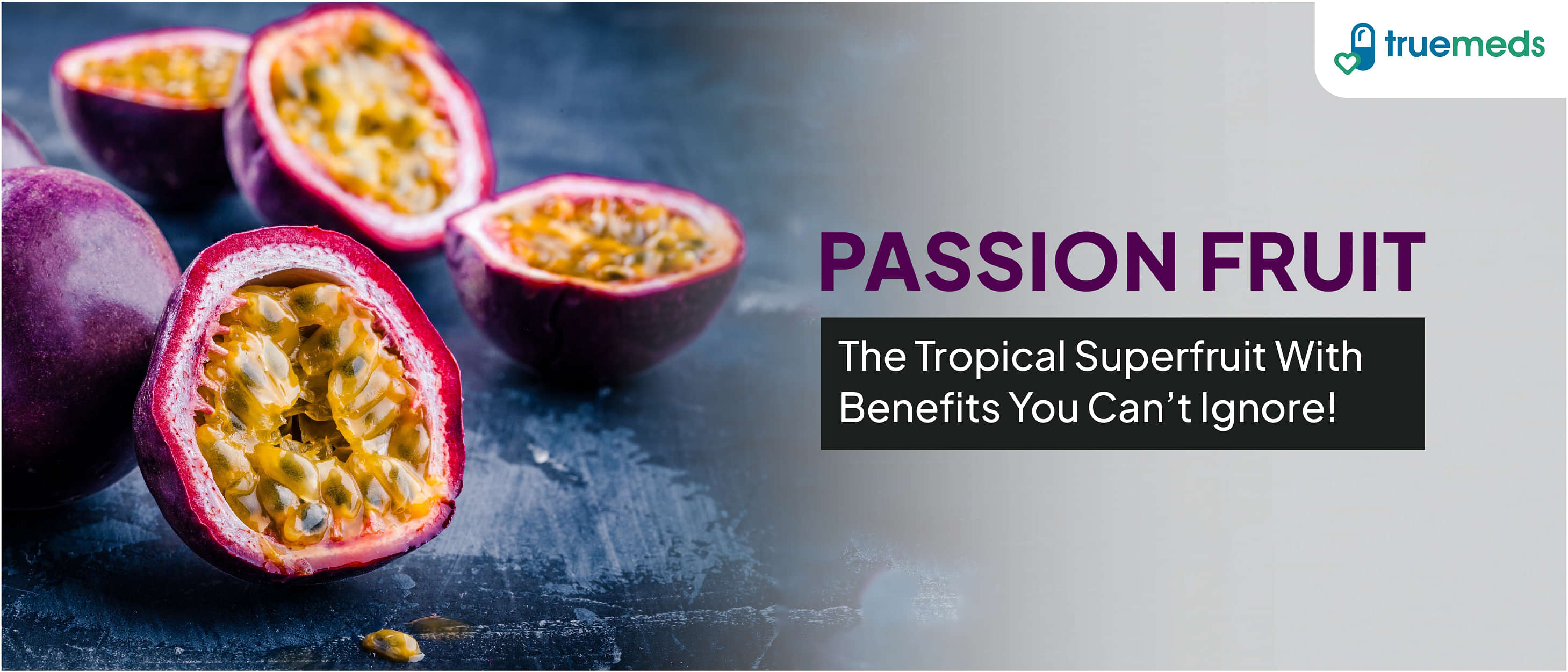
Passion fruit, scientifically known as Passiflora edulis, is a fascinating tropical fruit that not only tantalises the taste buds but also offers many nutritional benefits. It is a small, round or oval fruit with a tough outer rind that can range in colour from yellow to dark purple. The surface of the rind is often dimpled, giving it a unique and distinctive appearance. When cut open, the fruit reveals a juicy, seed-filled interior.
This guide explores the nutritional value, potential health benefits backed by research, and necessary precautions for consuming passion fruit.
What is the Nutritional Value of Passion Fruit?
Passion fruit, with its tempting aroma and flavour, is a delightful tropical treat and a nutritional powerhouse. The nutritional values of the edible pulp and seeds of 100 g of passion fruit are as follows [1]:
|
Nutrients |
Nutritional Value per 100 g |
| Energy | 97 kcal |
| Carbohydrate | 23.38 g |
| Protein | 2.20 g |
| Total fat | 0.7 g |
| Cholesterol | 0.0 g |
| Dietary fibre | 10.4 g |
| Folates | 14 µg |
| Niacin | 1.5 mg |
| Pyridoxine | 0.1 mg |
| Riboflavin | 0.130 mg |
| Thiamine | 0.0 mg |
| Vitamin A (as RAE) | 38 µg RAE |
| Vitamin C | 30 mg |
| Potassium | 348 mg |
| Calcium | 12 mg |
| Iron | 1.60 mg |
| Magnesium | 29 mg |
| Phosphorus | 68 mg |
| Carotene | 743 µg |
| Crypto-xanthene | 41 µg |
Passion fruit is an excellent source of dietary fibre, providing 10.4 grams per 100g, which is approximately 37% of the recommended daily intake for an average adult [1]. The fruit’s vibrant colour is indicative of its rich antioxidant content, particularly carotenoids and polyphenols (like piceatannol) [2], which help neutralise free radicals in the body, potentially reducing oxidative stress and cellular damage.
Potential Health Benefits of Passion Fruit
Passion fruit, with its unique nutritional makeup, has been studied for its potential benefits, which primarily stem from its high fiber and antioxidant content.
1. Digestive Health and Weight Management
Passion fruit’s high dietary fiber content (10.4g per 100g) is key to its digestive benefits. This fiber promotes regular bowel movements and may help prevent constipation [3]. The fiber also contributes to satiety, which can curb hunger and potentially support healthy weight management as part of a calorie-conscious diet [3].
2. Immune Support and Antioxidant Activity
Passion fruit is a good source of Vitamin C (30 mg per 100g), an essential antioxidant that supports immune function [1]. Additionally, the presence of polyphenols and carotenoids (like beta-carotene) provides potent antioxidant properties, which are being studied for their role in supporting the body’s natural defenses and potentially protecting against chronic diseases [4].
3. Cardiovascular and Blood Sugar Support
The high potassium content (348 mg per 100g) may help in regulating blood pressure by balancing sodium levels and promoting relaxation of blood vessel walls [1]. Furthermore, passion fruit has a low glycemic index (GI), meaning it has a minimal impact on blood sugar levels [5]. A study has indicated that piceatannol, a polyphenol found in passion fruit seeds, may support healthy metabolic function and insulin sensitivity [6].
4. Sleep and Relaxation Properties
Passion fruit contains certain alkaloids, including harman, which have been traditionally associated with mild calming effects [7]. These compounds, often more concentrated in the passion flower than the fruit, may help promote relaxation and support restful sleep [7]. The fruit also contains magnesium, a mineral that supports normal nerve and muscle function and may aid in managing occasional stress [1].
5. Skin Health and Anti-Inflammatory Effects
The Vitamin C in passion fruit is crucial for collagen synthesis, a protein that maintains skin elasticity and firmness [1]. The anti-inflammatory properties, particularly from its flavonoid content, are being investigated for their potential to help alleviate minor body discomfort and inflammation, such as post-exercise soreness [2].
Side Effects and Precautions
While passion fruit is generally safe for consumption, certain individuals need to exercise caution.
Allergic Reactions (Latex-Fruit Syndrome)
Individuals with a known allergy to latex should exercise caution. Passion fruit contains proteins that may cross-react with latex allergens, a condition known as latex-fruit syndrome. Symptoms can range from mild oral allergy (itching or tingling in the mouth) to more severe reactions such as hives, abdominal pain, or, rarely, anaphylaxis [8].
Potential Drug Interactions
Passion fruit, particularly extracts derived from the passion flower (Passiflora incarnata), may interact with certain medications. Compounds in Passiflora have been shown to possess mild sedative or anxiolytic properties [7]. Therefore, individuals taking the following medications should consult a doctor before consuming passion fruit or its supplements regularly:
- Sedatives or Anxiolytics
- Antidepressants (especially MAOIs)
- Anticoagulants (Blood Thinners) due to potential effects on clotting [9].
Other Considerations
- Gastrointestinal Sensitivity: The acidity of passion fruit may be harsh for individuals with sensitive stomachs or those prone to acid reflux or Gastroesophageal Reflux Disease (GERD).
- FODMAP Sensitivity: Passion fruit contains some fermentable carbohydrates. If you have Irritable Bowel Syndrome (IBS) or known FODMAP sensitivity, consume it in moderation and monitor your symptoms.
- Kidney or Potassium-Related Disorders: Due to its high potassium content, individuals with kidney issues or hyperkalemia (high potassium levels) should consult their physician to determine a safe amount of consumption.
Frequently Asked Questions (FAQs)
What is Passion Fruit called in India?
In India, passion fruit is commonly known as “Krishna Phal” or “Krishna Fruit.”
Can we eat Passion Fruit?
Yes, passion fruit is edible. The juicy pulp and seeds are consumed, either fresh or added to foods and beverages. The tough outer rind is not typically eaten.
Is passion fruit good for your liver?
Passion fruit contains antioxidants that may help combat oxidative stress in the liver [4]. However, all claims of specific organ protection are preliminary and should not replace medical treatment. Consultation with a healthcare professional is advised for liver concerns.
Who should not eat passion fruit?
Individuals with a known latex allergy should avoid passion fruit. Also, those on sedatives, antidepressants, or blood pressure/clotting medications should consult their doctor before regular consumption due to potential interactions.
References
[1] U.S. Department of Agriculture. (2019). Passiflora edulis (Passion fruit) pulp and seeds (FoodData Central ID: 172152). https://fdc.nal.usda.gov/fdc-app.html#/food-details/172152/nutrients
[2] Zhang, J., Tao, S., Hou, G., Zhao, F., Meng, Q., & Tan, S. (2023). Phytochemistry, nutritional composition, health benefits and future prospects of Passiflora: A review. Food Chemistry, 428, 136825. https://doi.org/10.1016/j.foodchem.2023.136825
[3] He, X., Luan, F., Yang, Y., Wang, Z., Zhao, Z., Fang, J., Wang, M., Zuo, M., & Li, Y. (2020). Passiflora edulis: An insight into current research on phytochemistry and pharmacology. Frontiers in Pharmacology, 11, 617. https://doi.org/10.3389/fphar.2020.00617
[4] Pereira, Z. C., Cruz, J. M. D. A., Corrêa, R. F., Sanches, E. A., Campelo, P. H., & Bezerra, J. D. A. (2023). Passion fruit (Passiflora spp.) pulp: A review on bioactive properties, health benefits and technological potential. Food Research International, 166, 112626. https://doi.org/10.1016/j.foodres.2023.112626
[5] Rao, B. S., Sharma, M., & Rao, B. S. (2018). Glycemic Index and Glycemic Load of Selected Indian Fruits. International Journal of Diabetes and Clinical Research, 5(2). https://doi.org/10.23937/2377-3634/1410065
[6] Sato, M., K. Yamaguchi, K. Ohtsuki, H. Kido, & M. Kido (2013). Passion fruit seed extract rich in piceatannol attenuates hypertrophy and improves function in mice with heart failure. Journal of Agricultural and Food Chemistry, 61(45), 10738-10744. https://doi.org/10.1021/jf403664s
[7] Sahane, R. S., Sanap, D. M., Ubale, R. W., Kalpande, P. G., & Kakde, M. R. (2023). A review on passion fruit and its pharmacological benefits. International Journal of Novel Research and Development, 8(3), c676–c684. https://doi.org/10.12944/CRNFSJ.11.1.32
[8] Mandal, A., Mondal, S., & Chatterjee, P. (2022). Latex-fruit syndrome: a brief review. Journal of the American Academy of Dermatology, 87(3), e107-e108. https://doi.org/10.1016/j.jaad.2021.08.067
[9] Cao, Q., Teng, J., Wei, B., Huang, L., & Xia, N. (2021). Phenolic compounds, bioactivity, and bioaccessibility of ethanol extracts from passion fruit peel based on simulated gastrointestinal digestion. Food Chemistry, 356, 129682. https://doi.org/10.1016/j.foodchem.2021.129682













Disclaimer
Our healthcare experts have carefully reviewed and compiled the information presented here to ensure accuracy and trustworthiness. It is important to note that this information serves as a general overview of the topic and is for informational purposes only. It is not intended to diagnose, prevent, or cure any health problem. This page does not establish a doctor-patient relationship, nor does it replace the advice or consultation of a registered medical practitioner. We recommend seeking guidance from your registered medical practitioner for any questions or concerns regarding your medical condition.
Popular Articles



Recommended Articles



Recent Articles










Company
About UsHealth ArticleHealth StoriesHealth LibraryDiseases & Health ConditionsAyurvedaUnderstanding Generic MedicinesAll MedicinesAll BrandsNeed HelpFAQSecuritySubscribe
Registered Office Address
Grievance Officer
Download Truemeds


Contact Us
Our customer representative team is available 7 days a week from 9 am - 9 pm.
v4.11.0

2026 - Truemeds | All rights reserved. Our content is for informational purposes only. See additional information.

Our Payment Partners




