

- Medicines
- Personal Care
- Skin Cream
- Sunscreen
- Face Wash
- Skin and Body Soap
- Acne Care
- Body Lotions
- Moisturising Lotion
- Moisturising Cream
- Mosquito Repellent
- Moisturising Gel
- Body Wash
- Hair Oils
- Hair Shampoo
- Hair Conditioners
- Hair Supplements
- Hair Colour
- Hair Serum
- Hair Mask
- Hair Solutions
- Baby Diapers and Wipes
- Baby Lotion and Moisturising Cream
- Baby Bath Essentials
- Baby Skin Care
- Baby and Infant Food
- Baby Healthcare
- Women Multivitamins
- Ovulation Test Kit and Women Intimate Care
- Sanitary Pads
- Nutritional Drinks
- Condoms
- Lubricants
- Massage Gels
- Personal Body Massagers
- Men Performance Booster
- Sexual Health Supplements
- Massage Oils
- Ayurveda
- Tooth Paste
- Mouth Ulcer Gel
- Mouthwash
- Toothache and Gum Pain
- Tooth Brush
- Gargle Solution
- Orthopaedic Supports
- Adult Diapers
- Footwear
- Mobility and Support Accessories
- Urinary Support and Care
- Health Conditions
- Bone and Joint Care
- Digestive Care
- Eye Care
- Pain Relief
- Smoking Cessation
- Liver Care
- Stomach Care
- Cold and Cough
- Heart Care
- Kidney Care
- Piles, Fissures & Fistula
- Respiratory Care
- Mental Wellness
- Derma Care
- Pre and Probiotics
- Acidity
- Gas
- Constipation
- Loose Motion/Diarrhoea
- Digestive Fibres
- Digestive Enzymes
- Eye Lubricant Drops
- Lens Solution
- Safety Eye Wear
- Eye Cream
- Eye Vitamins and Supplements
- Eye Drops
- Eye Ointment and Gel
- Nicotine Patch
- Nicotine Gum
- Nicotine Lozenges
- Cough Syrups
- Chest Rubs and Balms
- Nasal Spray
- Lozenges
- Inhalant Capsules
- Cold and Cough Tablets
- Vitamins & Supplements
- Diabetes Care
- Healthcare Devices
- Homeopathic Medicine
- Health Guide
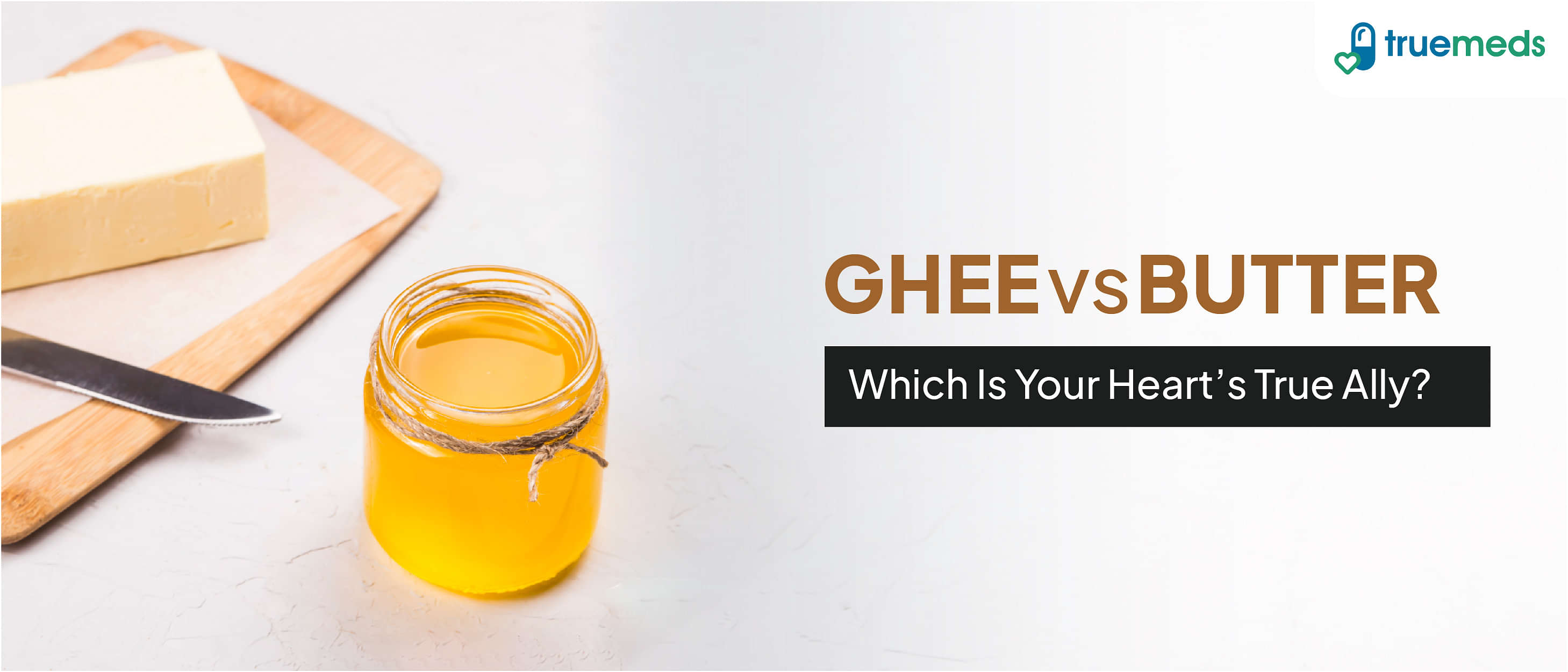
Ghee vs Butter: Which One Is Better for Your Health?
Last updated on : 12 Nov, 2025
Read time : 12 min
Ghee and butter are two popular dairy products that have been used in cooking for centuries. While both are derived from cow’s milk, the processing methods and resulting properties set them apart. In this article, we will explore the differences between ghee and butter to help you make an informed decision about which one might be better for your health, focusing on evidence-based nutritional and culinary characteristics.
Nutritional Differences Between Ghee and Butter
The table below compares the general nutritional content of ghee and butter per tablespoon (approximately 14 grams):
|
Nutrient |
Ghee |
Butter |
| Calories | 123 | 100 |
| Fat | 14 g | 11 g |
| Saturated Fat | ~8.7 g | ~7.3 g |
| Monounsaturated Fat | ~4.0 g | ~3.0 g |
| Polyunsaturated Fat | ~0.5 g | ~0.4 g |
| Protein | Trace amounts (negligible) | Trace amounts (negligible) |
| Carbs | Trace amounts (negligible) | Trace amounts (negligible) |
| Vitamin A | 13% of the Daily Value (DV) | 11% of the DV |
| Vitamin E | 3% of the DV | 2% of the DV |
| Vitamin K | 1% of the DV | 1% of the DV |
| Lactose and Casein | Extremely low levels (mostly removed) | Small amounts (present) |
Note: Values are approximate and can vary based on the source (e.g., grass-fed vs. conventional).
Health Benefits of Ghee
Ghee, a staple in Indian cuisine, is renowned for its rich flavour and has been traditionally associated with numerous health benefits. Let us explore the potential advantages based on its composition.
1. Source of Butyrate for Digestive Support
One of the key advantages of incorporating ghee into your diet is its potential to promote optimal digestive health. Ghee is a rich source of butyric acid (or butyrate), a short-chain fatty acid that plays a crucial role in maintaining the health of your digestive tract by serving as the primary fuel source for colonocytes (cells lining the colon) [1], [2]. In individuals with a healthy gut, this fatty acid is naturally produced by microbial fermentation of dietary fibre; however, adding ghee may provide a direct source. Butyrate has demonstrated anti-inflammatory properties in the gut, which may support gut barrier function [1].
2. Contains Healthy Fats, Including MCTs and CLA
Ghee is a powerhouse of healthy fats, including a balance of saturated, monounsaturated, and polyunsaturated fats, as well as a small percentage of medium-chain triglycerides (MCTs) and Conjugated Linoleic Acid (CLA). MCTs are easily digestible, converting more quickly into energy for your body to use compared to long-chain fatty acids [3]. CLA is a naturally occurring trans-fat in dairy that has been researched for its potential anti-carcinogenic and anti-inflammatory effects [4].
3. High Smoke Point for Cooking
Ghee’s smoke point is approximately 485°F (250°C), making it significantly higher than butter’s. This is because the milk solids (which burn easily) have been removed. This higher smoke point is a key advantage for high-heat cooking like deep-frying and sautéing, as it reduces the risk of the fat degrading and forming potentially harmful free radicals [5].
4. Generally Suitable for Lactose-Intolerant Individuals
Ghee is clarified butter that has been heated to remove most of the milk solids and water, resulting in a product that is virtually free of lactose and casein. This makes ghee generally more tolerable for individuals with mild lactose intolerance or casein sensitivity compared to traditional butter [6]. However, individuals with severe dairy allergies should still exercise caution as trace amounts of casein may remain.
Health Benefits of Butter
While ghee is often touted as the healthier alternative, butter also offers several nutritional benefits when consumed in moderation.
1. Good Source of Fat-Soluble Vitamins
Butter is a good source of fat-soluble vitamins, including vitamins A, D, E, and K. These vitamins are essential for several biological functions: Vitamin A is crucial for vision and immune function; Vitamin D supports calcium absorption and bone health; and Vitamin K is vital for blood clotting and bone metabolism. A single tablespoon can provide roughly 11% of the Daily Value (DV) for Vitamin A [7].
2. Contains Conjugated Linoleic Acid (CLA)
Similar to ghee, butter also contains CLA, a naturally occurring fatty acid. Research suggests that CLA may play a role in reducing body fat mass and supporting immune function, primarily based on studies of CLA supplements [4]. However, the amount of CLA found in a typical serving of butter is generally low and less significant than that found in other dietary sources, such as grass-fed beef and dairy products.
3. Contributes to Rich Flavour in Cooking
Butter’s milk solids give it a sweet, creamy, and rich flavour that is highly desirable in baking and various low-temperature dishes. Its characteristic taste profile is often irreplaceable in certain culinary applications.
Ghee vs Butter for Weight Management
When considering weight management, it is essential to note that both ghee and butter are nearly 100% fat and are calorie-dense. One tablespoon of ghee contains approximately 123 calories, and butter contains about 100 calories.
While ghee contains higher amounts of medium-chain and short-chain fatty acids compared to butter, which may support fat burning by altering metabolism [3], the overall impact on weight loss is primarily driven by total calorie consumption and energy expenditure. No single fat will cause weight loss; thus, both should be consumed in moderation as part of a calorie-controlled, balanced diet [8].
Ghee vs Butter: Which is Better for Cooking?
Ghee and butter have different cooking properties that make one more suitable than the other:
- Ghee: With a high smoke point of approximately 485°F (250°C), ghee is the superior choice for high-heat methods such as frying, deep-frying, and sautéing, as it maintains its structural integrity and prevents the fat from oxidising and burning [5].
- Butter: With a lower smoke point of around 350°F (175°C), butter is ideal for low-temperature cooking, pan-searing, and baking, where its rich, creamy flavour is sought after.
Ghee vs Butter for Heart Health
The impact of ghee and butter on heart health is often debated, primarily due to their high saturated fat content (over 50% of total fat) [9].
- General Consensus: Due to their similar saturated fat profiles, excessive consumption of either can raise LDL (“bad”) cholesterol, which is a risk factor for cardiovascular disease [9].
- Ghee’s Potential Edge: Ghee’s unique composition includes butyrate and CLA, which have been linked to potential anti-inflammatory effects that could be theoretically beneficial [4], [10]. Additionally, a small-scale study from 2010 suggested that ghee consumption in rats led to a decrease in serum total cholesterol, LDL, and triglycerides, but these findings need to be replicated in large-scale human trials to draw definitive conclusions [10]. Therefore, it is best to view both as a source of saturated fat and limit intake according to medical guidelines.
Ghee vs Butter: Which is Healthier?
When it comes to choosing between ghee and butter, the differences are subtle and context-dependent, with neither being significantly “healthier” than the other.
- Ghee’s Advantages: Ghee is a better choice for individuals with lactose intolerance and for high-temperature cooking due to its significantly higher smoke point.
- The Critical Factor: Moderation: Both are high in total fat and saturated fat. The key determinant of health impact is moderation and total dietary fat intake, not the choice between these two specific fats.
Potential Side Effects and Concerns
While both ghee and butter can be part of a healthy diet when consumed in moderation, there are some potential side effects and concerns to consider, primarily due to their high saturated fat and calorie density:
- Weight Gain and Obesity: Excessive consumption of either ghee or butter can lead to weight gain and obesity due to their high-calorie and fat content [8].
- Cardiovascular Risk: High intake of saturated fats from any source can increase LDL (bad) cholesterol levels, which is a key risk factor for heart disease and stroke [9].
- Oxidised Cholesterol: Improperly prepared or overused ghee that is heated to extremely high temperatures for prolonged periods may contain oxidised cholesterol, which is associated with an increased risk of heart disease [10].
- Dairy Sensitivities: While ghee is largely lactose-free, individuals with severe dairy allergies should still exercise caution, as trace amounts of casein may still be present [6].
Conclusion
In the debate between ghee and butter, the optimal choice depends on your individual health needs and intended use. Neither is significantly healthier than the other in terms of core nutritional content.
Ghee offers practical advantages, such as a higher smoke point and lower lactose content, making it a better choice for certain high-heat cooking methods and for individuals with lactose sensitivities. Butter is preferred for its creamy flavour in baking and lower-temperature cooking.
The most crucial takeaway is moderation. Both should be consumed in limited amounts to ensure total saturated fat intake remains balanced and within recommended health guidelines (e.g., generally limiting saturated fat to less than 10% of total daily calories, as advised by major health organisations) [9].
Frequently Asked Questions (FAQs)
Is ghee healthier than butter?
Ghee and butter have similar nutritional profiles and are both high in saturated fat. Ghee is functionally superior for high-heat cooking due to its higher smoke point, and it is more suitable for those with lactose intolerance as it contains minimal lactose.
How do I choose between ghee and butter?
Choose ghee for high-heat cooking (frying, sautéing) and if you are lactose intolerant. Opt for butter for low-heat cooking, spreading, and baking because of its sweeter, creamier flavour.
Can I substitute ghee for butter?
Yes, ghee can often replace butter in recipes, particularly for frying or roasting, due to its higher smoke point. However, the flavour is nuttier and less creamy, so results may vary in baking or spreads. You may need to adjust liquid content in baking recipes slightly due to ghee’s lack of water content.
Why is butter cheaper than ghee?
Butter is generally cheaper than ghee because ghee requires an additional, dedicated processing step, clarification, to remove milk solids and water, which increases its production cost and labour.
Who should avoid ghee?
Individuals with a severe casein allergy should avoid ghee, even though it contains very low levels of casein. Those with hypercholesterolemia (high blood cholesterol) should limit the consumption of both ghee and butter due to their high saturated fat content, following their physician’s advice.
What happens if you eat ghee daily?
Daily consumption of ghee in moderation is generally safe and can be a source of fat-soluble vitamins and healthy fats. However, excessive daily intake can lead to an increased intake of saturated fats and calories, potentially increasing LDL cholesterol levels, contributing to weight gain, and elevating the risk of heart disease and stroke [9].
Who invented ghee in India?
Ghee has a long and central history in South Asian cooking, Ayurveda, and traditional practices, particularly in Indian cuisine, where it’s used both as a cooking fat and for ceremonial and medicinal purposes. Its origins are prehistoric, linked to the early domestication of cattle and dairy processing in the Indian subcontinent.
Disclaimer
This article is for informational purposes only and is not intended to be a substitute for professional medical advice, diagnosis, or treatment. Always seek the advice of a qualified healthcare professional with any questions you may have regarding a medical condition or dietary changes.
References
[1] Hamer, H. M., Jonkers, S. M., Venema, K., Vanhoutvin, S. A. L. W., Troost, F. J., & Brummer, R. J. M. (2008). Review article: The intestinal effects of butyrate in health and disease. Alimentary Pharmacology & Therapeutics, 27(2), 104-119. https://doi.org/10.1111/j.1365-2036.2007.03563.x
[2] Sharma, H., Zhang, X., & Dwivedi, C. (2010). The effect of ghee (clarified butter) on serum lipid levels and microsomal lipid peroxidation. Ayu, 31(2), 134–140. https://doi.org/10.4103/0974-8520.72363
[3] St-Onge, M. P., & Jones, P. J. H. (2002). Physiological effects of medium-chain triglycerides: Potential agents in the prevention of obesity. The Journal of Nutrition, 132(3), 329-332. https://doi.org/10.1093/jn/132.3.329
[4] Wang, Y., Lu, R., Wang, X., & He, G. (2020). Potential role of conjugated linoleic acid in human health. RSC Advances, 10(70), 43015-43026. https://doi.org/10.1039/D0RA08375C
[5] Mohammadi-Nasrabadi, F., Rashidimehr, A., Khoshtinat, K., Alhouei, B., Massomian, A., Rashidian, M., & Esfarjani, F. (2024). A comparative analysis of butter, ghee, and margarine and its implications for healthier fat and oil group choices: SWOT analysis. Food Science & Nutrition, 12(12), 10123–10135. https://doi.org/10.1002/fsn3.4557
[6] Venkatesh, K., & Balaram, M. (2021). A study on the processing and quality characteristics of Indian traditional ghee (clarified butter): A review. Journal of Food Science and Technology, 58(3), 851-860. https://doi.org/10.1007/s13197-020-04533-5
[7] U.S. Department of Agriculture. (2024). FoodData Central: Butter, salted. Retrieved October 27, 2025, from https://fdc.nal.usda.gov/fdc-app.html#/food-details/170940/nutrients
[8] Willett, W. C., & Koplan, J. P. (2018). Prevention of obesity and weight gain: Challenges and opportunities. The Lancet Diabetes & Endocrinology, 6(12), 949-960. https://doi.org/10.1016/S2213-8587(18)30282-7
[9] American Heart Association. (2021). Saturated fat. Retrieved October 27, 2025, from https://www.heart.org/en/healthy-living/healthy-eating/eat-smart/fats/saturated-fats
[10] Sankar, S., Jaganathan, P., & Mohanty, S. (2019). Ghee and its potential anti-inflammatory and cardiovascular benefits. International Journal of Ayurveda and Pharma Research, 7(10), 1-6. https://www.ijapr.in/index.php/ijapr/article/view/1435














Disclaimer
Our healthcare experts have carefully reviewed and compiled the information presented here to ensure accuracy and trustworthiness. It is important to note that this information serves as a general overview of the topic and is for informational purposes only. It is not intended to diagnose, prevent, or cure any health problem. This page does not establish a doctor-patient relationship, nor does it replace the advice or consultation of a registered medical practitioner. We recommend seeking guidance from your registered medical practitioner for any questions or concerns regarding your medical condition.
Popular Articles

Recommended Articles


Recent Articles






Company
About UsHealth ArticleHealth StoriesHealth LibraryDiseases & Health ConditionsAyurvedaUnderstanding Generic MedicinesAll MedicinesAll BrandsNeed HelpFAQSecuritySubscribe
Registered Office Address
Grievance Officer
Download Truemeds


Contact Us
Our customer representative team is available 7 days a week from 9 am - 9 pm.
v4.10.1

2025 - Truemeds | All rights reserved. Our content is for informational purposes only. See additional information.

Our Payment Partners




