

- Medicines
- Personal Care
- Skin Cream
- Sunscreen
- Face Wash
- Skin and Body Soap
- Acne Care
- Body Lotions
- Moisturising Lotion
- Moisturising Cream
- Mosquito Repellent
- Moisturising Gel
- Body Wash
- Hair Oils
- Hair Shampoo
- Hair Conditioners
- Hair Supplements
- Hair Colour
- Hair Serum
- Hair Mask
- Hair Solutions
- Baby Diapers and Wipes
- Baby Lotion and Moisturising Cream
- Baby Bath Essentials
- Baby Skin Care
- Baby and Infant Food
- Baby Healthcare
- Women Multivitamins
- Ovulation Test Kit and Women Intimate Care
- Sanitary Pads
- Nutritional Drinks
- Condoms
- Lubricants
- Massage Gels
- Personal Body Massagers
- Men Performance Booster
- Sexual Health Supplements
- Massage Oils
- Ayurveda
- Tooth Paste
- Mouth Ulcer Gel
- Mouthwash
- Toothache and Gum Pain
- Tooth Brush
- Gargle Solution
- Orthopaedic Supports
- Adult Diapers
- Footwear
- Mobility and Support Accessories
- Urinary Support and Care
- Health Conditions
- Bone and Joint Care
- Digestive Care
- Eye Care
- Pain Relief
- Smoking Cessation
- Liver Care
- Stomach Care
- Cold and Cough
- Heart Care
- Kidney Care
- Piles, Fissures & Fistula
- Respiratory Care
- Mental Wellness
- Derma Care
- Pre and Probiotics
- Acidity
- Gas
- Constipation
- Loose Motion/Diarrhoea
- Digestive Fibres
- Digestive Enzymes
- Eye Lubricant Drops
- Lens Solution
- Safety Eye Wear
- Eye Cream
- Eye Vitamins and Supplements
- Eye Drops
- Eye Ointment and Gel
- Nicotine Patch
- Nicotine Gum
- Nicotine Lozenges
- Cough Syrups
- Chest Rubs and Balms
- Nasal Spray
- Lozenges
- Inhalant Capsules
- Cold and Cough Tablets
- Vitamins & Supplements
- Diabetes Care
- Healthcare Devices
- Homeopathic Medicine
- Health Guide
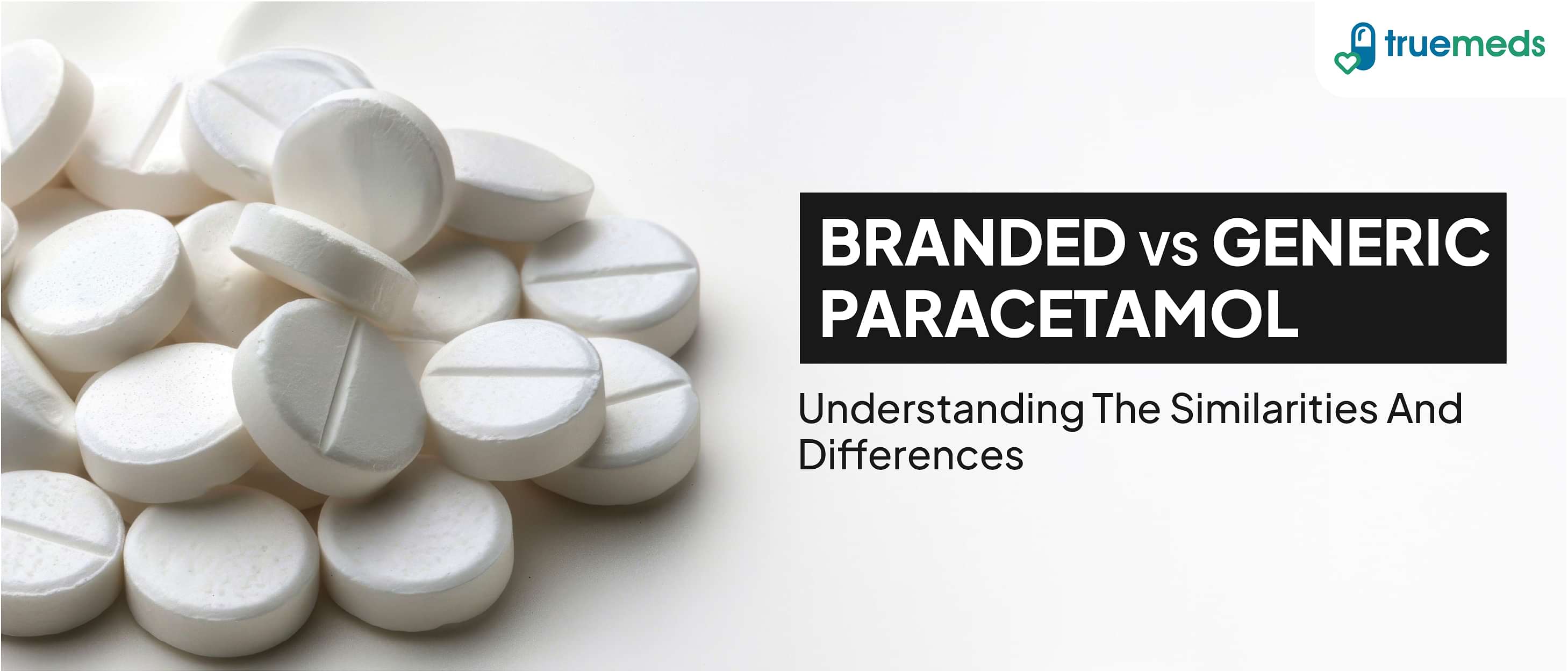
Generic vs. Branded Paracetamol (Acetaminophen)
Last updated on : 01 Dec, 2025
Read time : 7 min
Paracetamol, also known by its generic name Acetaminophen, is a globally recognised over-the-counter (OTC) medication primarily used for managing minor to moderate pain and reducing fever. It is widely available in both generic forms and branded names. While both versions contain the same active ingredient, there are some important distinctions, primarily in cost and inactive components. Understanding the therapeutic equivalence between generic and branded formulations is key to making informed healthcare decisions.
Composition: Active and Inactive Ingredients
Both generic and branded Paracetamol products are pharmacologically equivalent, though their precise formulations differ.
1. Active Ingredient: The Core Equivalence
The active pharmaceutical ingredient (API) in all therapeutic versions of this medication is Paracetamol (Acetaminophen). This ingredient is solely responsible for the drug’s intended effects: reducing pain (analgesia) and lowering fever (antipyresis) [1].
Pharmacological Mechanism: Paracetamol works primarily by inhibiting prostaglandin synthesis in the central nervous system (CNS). It acts centrally to block pain signals and modulate the hypothalamic heat-regulating centre to bring down fever (reducing body temperature) [1]. Since the API is chemically identical, the therapeutic effect of generic and branded versions is considered the same.
2. Inactive Ingredients (Excipients)
Inactive ingredients, or excipients, such as fillers, stabilisers, binding agents, and dyes, play a crucial role in the manufacturing process, shelf stability, and how quickly the tablet dissolves (disintegration). While these ingredients do not alter the drug’s core therapeutic efficacy, they can vary significantly between generic and branded versions. These differences can be relevant for individuals with specific allergies or sensitivities (e.g., to certain dyes or gluten).
The following table provides a comparison of examples of inactive ingredients found in different formulations:
|
Formulation Type |
Example Ingredients |
Function/Impact |
| Branded Tablets | Maize starch, microcrystalline cellulose, povidone, crospovidone, magnesium stearate | Provide bulk, binding, and controlled disintegration speed for optimal absorption. |
| Branded Suspensions | Sorbitol, glycerin, citric acid, sodium methylparaben, flavouring agents | Crucial for stability, palatability, and dosing accuracy in liquid forms. |
| Generic Effervescent Tablets | Anhydrous citric acid, sodium hydrogen carbonate, sodium carbonate anhydrous, saccharin sodium | Responsible for the rapid dissolving action and flavour. |
| Generic Capsules | Gelatine, titanium dioxide, various dyes | Primarily cosmetic, along with standard fillers and binding agents. |
Are Generic and Branded Paracetamol Equally Effective?
Yes, the effectiveness of generic and branded paracetamol is clinically considered identical. Here are the key reasons why this therapeutic equivalence is maintained:
- Identical Active Ingredient: As the active chemical (Paracetamol) is the same, the body processes it to produce the same pain-relieving and fever-reducing effects.
- Identical Mechanism of Action: Both versions target the same chemical pathways in the CNS.
- Regulatory Standards: Both generic and branded products must adhere to stringent regulatory standards set by bodies like the CDSCO in India or the FDA in the US. Generic manufacturers must demonstrate bioequivalence, meaning the generic drug is absorbed into the bloodstream at the same rate and extent as the branded product [2]. This requirement ensures that the amount of active drug reaching the site of action is the same [3].
- Clinical Consensus: Recommendations from major health bodies and pharmacists consistently confirm that generic Acetaminophen is as effective as branded versions in providing symptomatic relief.
Cost Comparison: Why is Generic Paracetamol Cheaper?
Generic paracetamol is substantially more affordable than its branded counterparts due to a clear financial structure:
- No Research and Development (R&D) Costs: Generic manufacturers do not bear the multi-million dollar costs of researching, developing, and testing the original molecule. They can begin production once the original drug’s patent expires [2].
- Minimal Marketing and Branding: Branded products incur immense expenses for nationwide advertising, promotion, and brand-specific packaging. Generic versions have significantly lower overheads in this area.
- Market Competition: The generic market is highly competitive, with multiple companies manufacturing the same drug. This market force naturally drives prices down, leading to lower costs for the consumer.
- Government Promotion: Initiatives like the Jan Aushadhi Scheme in India actively promote generics to improve affordability and access to essential medicines.
Crucial Safety Warnings and Side Effects
Both generic and branded paracetamol are generally safe only when taken strictly as directed. However, the risks associated with misuse are serious and can be life-threatening.
The Primary Risk: Acute Liver Toxicity (Hepatotoxicity)
The most critical risk associated with Paracetamol is dose-dependent hepatotoxicity (liver damage) [1].
- Maximum Daily Dose: The recommended maximum daily dose for healthy adults should not exceed 4,000 milligrams (4g) per 24 hours [4]. Exceeding this dose, even slightly or over several days, can lead to irreversible liver failure, potentially requiring a transplant or resulting in death [1].
- Alcohol Interaction: Individuals who regularly consume more than three alcoholic drinks per day are at a significantly higher risk of liver toxicity, and should consult a doctor before using Paracetamol [4].
- Hidden Dosing: A major risk is taking multiple products that all contain Paracetamol (e.g., a cold medicine and a headache tablet), accidentally leading to an overdose. Always check the active ingredients of all combination medications before use.
Common and Rare Side Effects
Common Side Effects (usually mild): Rashes, itching, or minor allergic reactions.
- Rare/Serious Side Effects: In rare cases, severe skin reactions (like Stevens-Johnson syndrome) can occur. Immediate medical attention is required if a rash or blister develops [1].
- Long-Term/Chronic Misuse: Chronic, excessive use may rarely be linked to anaemia, an increased risk of kidney damage (nephropathy), and chronic tiredness, particularly when doses frequently approach the maximum limit.
Which One Should You Choose? Generic or Branded?
The choice between generic and branded paracetamol is ultimately a personal and financial one, as therapeutic efficacy is assuredly the same.
Choose Generic if:
- Cost is paramount: Generics offer the same effect at a lower price point.
- You prefer a specific excipient: You may need to avoid a specific dye or filler found in a branded product due to a known allergy.
- Effectiveness is your only concern: The active ingredient ensures equal therapeutic results.
Choose Branded if:
- Specific Formulations are Required: Branded versions often pioneer unique delivery systems, such as particular extended-release tablets, liquid formulations for paediatrics, or suppositories that may not be immediately available in generic form.
- Familiarity and Trust: Some consumers derive comfort from decades of brand recognition and packaging consistency.
Conclusion
In summary, both generic and branded paracetamol are therapeutically equivalent and equally effective in managing pain and reducing fever. The principal differences lie in cost, branding, and minor variations in inactive ingredients. The most crucial factor, regardless of brand, is adhering strictly to the recommended dosage to ensure safety and prevent potentially fatal liver damage. Consult your doctor or pharmacist to determine the appropriate product and dosage based on your needs and existing medical conditions.
References
[1] Gerriets, V., & Nappe, T. M. (2024). Acetaminophen. StatPearls Publishing. https://www.ncbi.nlm.nih.gov/books/NBK482369/
[2] Thakkar, K. B., & Billa, G. (2013). The concept of: Generic drugs and patented drugs vs. brand name drugs and non-proprietary (generic) name drugs. Frontiers in Pharmacology, 4. https://doi.org/10.3389/fphar.2013.00113
[3] U.S. Food and Drug Administration. (2018, June 1). Generic Drugs: Questions & Answers. https://www.fda.gov/drugs/frequently-asked-questions-generic-drugs/generic-drugs-questions-answers
[4] TGA. (2021). OTC medicine monograph: Paracetamol for oral use. Therapeutic Goods Administration. https://www.tga.gov.au/sites/default/files/otc-medicine-monograph-paracetamol-oral-use.pdf














Disclaimer
Our healthcare experts have carefully reviewed and compiled the information presented here to ensure accuracy and trustworthiness. It is important to note that this information serves as a general overview of the topic and is for informational purposes only. It is not intended to diagnose, prevent, or cure any health problem. This page does not establish a doctor-patient relationship, nor does it replace the advice or consultation of a registered medical practitioner. We recommend seeking guidance from your registered medical practitioner for any questions or concerns regarding your medical condition.
Popular Articles

Recommended Articles



Recent Articles









Company
About UsHealth ArticleHealth StoriesHealth LibraryDiseases & Health ConditionsAyurvedaAll MedicinesAll BrandsNeed HelpFAQSecuritySubscribe
Registered Office Address
Grievance Officer
Download Truemeds


Contact Us
Our customer representative team is available 7 days a week from 9 am - 9 pm.
v4.9.0

2025 - Truemeds | All rights reserved. Our content is for informational purposes only. See additional information.

Our Payment Partners




