

- Medicines
- Personal Care
- Skin Cream
- Sunscreen
- Face Wash
- Skin and Body Soap
- Acne Care
- Body Lotions
- Moisturising Lotion
- Moisturising Cream
- Mosquito Repellent
- Moisturising Gel
- Body Wash
- Hair Oils
- Hair Shampoo
- Hair Conditioners
- Hair Supplements
- Hair Colour
- Hair Serum
- Hair Mask
- Hair Solutions
- Baby Diapers and Wipes
- Baby Lotion and Moisturising Cream
- Baby Bath Essentials
- Baby Skin Care
- Baby and Infant Food
- Baby Healthcare
- Women Multivitamins
- Ovulation Test Kit and Women Intimate Care
- Sanitary Pads
- Nutritional Drinks
- Condoms
- Lubricants
- Massage Gels
- Personal Body Massagers
- Men Performance Booster
- Sexual Health Supplements
- Massage Oils
- Ayurveda
- Tooth Paste
- Mouth Ulcer Gel
- Mouthwash
- Toothache and Gum Pain
- Tooth Brush
- Gargle Solution
- Orthopaedic Supports
- Adult Diapers
- Footwear
- Mobility and Support Accessories
- Urinary Support and Care
- Health Conditions
- Bone and Joint Care
- Digestive Care
- Eye Care
- Pain Relief
- Smoking Cessation
- Liver Care
- Stomach Care
- Cold and Cough
- Heart Care
- Kidney Care
- Piles, Fissures & Fistula
- Respiratory Care
- Mental Wellness
- Derma Care
- Pre and Probiotics
- Acidity
- Gas
- Constipation
- Loose Motion/Diarrhoea
- Digestive Fibres
- Digestive Enzymes
- Eye Lubricant Drops
- Lens Solution
- Safety Eye Wear
- Eye Cream
- Eye Vitamins and Supplements
- Eye Drops
- Eye Ointment and Gel
- Nicotine Patch
- Nicotine Gum
- Nicotine Lozenges
- Cough Syrups
- Chest Rubs and Balms
- Nasal Spray
- Lozenges
- Inhalant Capsules
- Cold and Cough Tablets
- Vitamins & Supplements
- Diabetes Care
- Healthcare Devices
- Homeopathic Medicine
- Health Guide
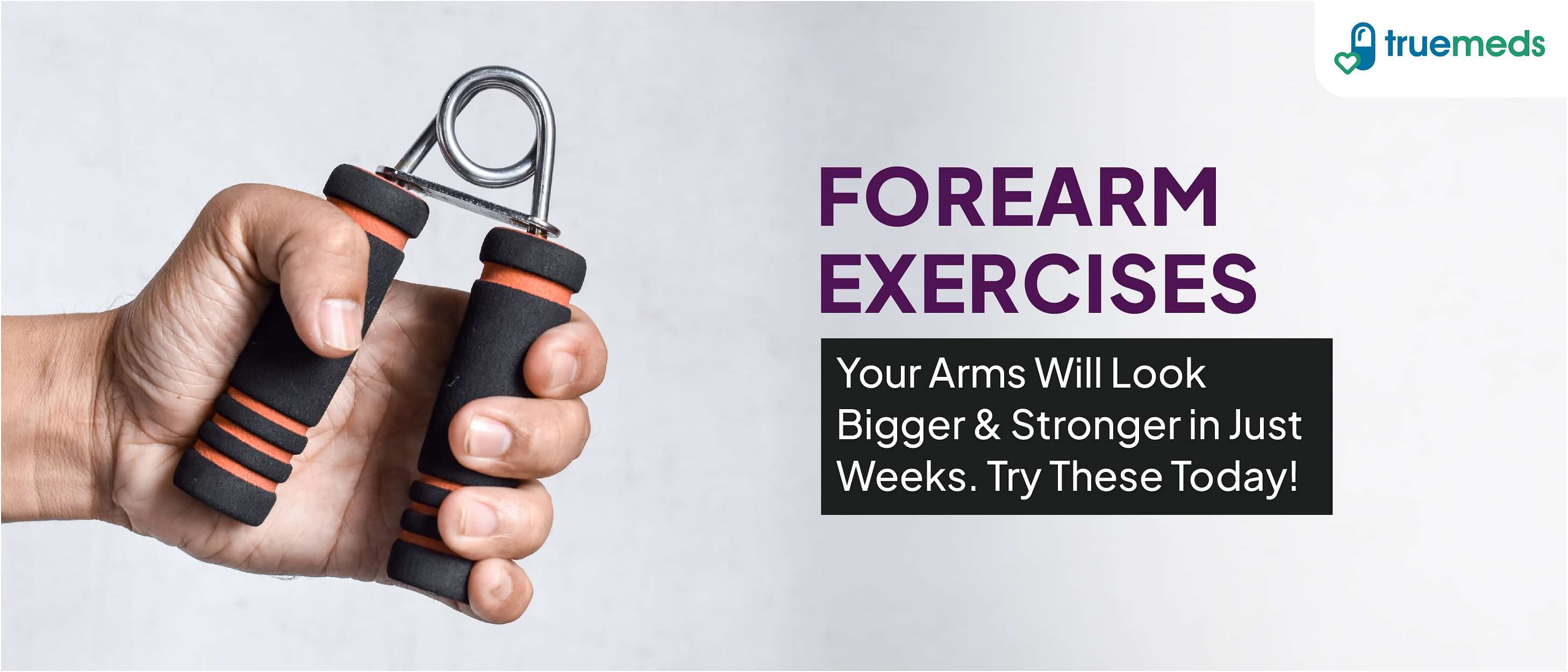
13 Best Forearm Exercises and Workouts to Build Strength at Home
Last updated on : 01 Dec, 2025
Read time : 10 min
Forearm exercises are fundamental for developing a resilient grip, stable wrists, and balanced arm strength. Incorporating these movements into your routine can significantly enhance performance in sports and daily activities, while potentially contributing to injury risk reduction [1].
This article provides a curated list of 13 highly effective forearm exercises you can perform right in your home.
13 Best Forearm Exercises and Workouts to Build Strength
1. Palms-Up Wrist Curl
The Palms-up Wrist Curl is a classic isolation movement that effectively targets the forearm flexors (muscles responsible for closing the hand and flexing the wrist).
Steps and Benefits:
- Sit on the edge of a bench with your forearms resting on your thighs or a bench, palms facing up.
- Grip a light barbell or dumbbell with an underhand grip.
- Slowly curl your wrists upwards, flexing the forearm muscles, then lower the weight back down in a controlled manner.
- Benefits: Primarily targets forearm flexors, improving the strength necessary for grip performance [2].
2. Palms-Down Wrist Curl
The Palms-down Wrist Curl is vital for developing the wrist extensors on the top of the forearm, which are crucial for balancing the strength gained from flexor training and maintaining wrist stability.
Steps and Benefits:
Kneel in front of a bench and rest your forearms on it with palms facing down.
- Grip a light barbell or dumbbell with an overhand grip.
- Curl your wrists upwards, lifting the weight, then slowly lower it back down.
- Benefits: Strengthens the wrist extensors and can help reduce the risk of common wrist overuse injuries [3].
3. Grip Crush
The Grip Crush, often performed with a dedicated grip strength trainer, directly trains the maximal crushing power of your hand and forearm flexors.
Steps and Benefits:
- Hold a grip strength trainer or a tightly rolled towel.
- Squeeze the device or towel as hard as possible for several seconds.
- Release and repeat.
- Benefits: Enhances maximal grip strength and endurance, which translates to improved performance in lifting and pulling exercises.
4. Farmer’s Walk
The Farmer’s Walk is a compound, full-body exercise that places a massive demand on your forearm and grip endurance (the ability to sustain a grip over time) [4].
Steps and Benefits:
- Hold a heavy pair of dumbbells or kettlebells in each hand.
- Walk for a set distance or time, keeping your core engaged and arms straight.
- Benefits: Dramatically improves sustained grip strength, forearm endurance, and shoulder stability [6].
5. Behind-the-Back Cable Wrist Curl
Behind-the-Back Cable Wrist Curl
This exercise offers a unique loading angle, potentially maximising the stretch on the forearm flexors at the bottom of the movement.
Steps and Benefits:
- Stand facing away from a cable machine with the cable at the lowest setting.
- Hold the cable handle behind your back with palms up (underhand grip).
- Curl your wrists upwards, then lower the handle back down slowly.
- Benefits: Targets the forearm flexors with continuous cable tension, adding variety to your strength routine.
6. Towel Cable Row
The Towel Cable Row is a dynamic exercise that leverages the towel to create a thick, unstable grip, mimicking the functional strength needed in grappling or climbing.
Steps and Benefits:
- Wrap a towel around the cable handle of a cable machine.
- Hold the ends of the towel with both hands.
- Perform rows while maintaining a crushing grip on the towel.
- Benefits: Engages the forearm muscles isometrically while training the back, significantly improving functional grip strength.
7. Pull-Ups
Pull-ups are one of the best compound exercises for the upper body, with the forearms being heavily recruited to maintain your grip throughout the entire movement.
Steps and Benefits:
- Hang from a pull-up bar with hands shoulder-width apart.
- Pull yourself up until your chin clears the bar.
- Lower yourself back down in a controlled manner.
- Benefits: Strengthens the overall upper body and specifically the forearm flexors and grip stabilisers [4].
8. Dead Hangs
Dead Hangs are a simple, high-intensity endurance exercise. They provide an excellent stretch for the shoulders while testing and improving the isometric endurance of your grip and forearms.
Steps and Benefits:
- Hang from a pull-up bar with hands shoulder-width apart.
- Hold for as long as possible.
- Benefits: Rapidly improves sustained grip strength and forearm endurance, and helps with shoulder decompression.
9. Forearm Band Pull (Resistance Band Rotation)
Forearm Band Pull (Resistance Band Rotation)
This exercise uses a resistance band to specifically train the rotational strength of the forearm (pronation and supination), which is often neglected.
Steps and Benefits:
- Hold a resistance band with both hands, positioned in front of you.
- Twist your wrists in opposite directions (like wringing a towel), focusing on contracting your forearm rotators.
- Release slowly.
- Benefits: Targets the forearm flexors, extensors, and rotators, enhancing wrist joint stability.
10. Forearm Squeeze (Hand Gripper)
The Forearm Squeeze, using a hand gripper, is a classic isolation tool for directly strengthening the intrinsic hand muscles and forearm flexors.
Steps and Benefits:
- Hold a forearm grip trainer in one hand.
- Squeeze the device for several seconds or perform high-repetition sets.
- Release and repeat with the other hand.
- Benefits: Directly increases crushing grip strength and contributes to forearm muscle development (hypertrophy) [5].
11. Fingertip Push-Ups
Fingertip Push-ups are an advanced bodyweight exercise that demands high levels of strength and stability from the intrinsic hand and finger flexor muscles, challenging the forearms significantly.
Steps and Benefits:
- Start in a high push-up position, but support your weight only on your fingertips instead of your palms.
- Perform push-ups, focusing on maintaining finger and forearm tension.
- Benefits: Significantly targets forearm flexors and hand strength, serving as a progression for traditional push-ups.
12. Crab Walk
The Crab Walk is a dynamic, multi-joint bodyweight movement. It requires significant wrist extensor and core strength to maintain the elevated “crab” position, functionally engaging the forearms.
Steps and Benefits:
- Sit on the ground with your hands behind you and feet in front of you.
- Lift your hips off the ground, forming an inverted tabletop position.
- Walk forward or backward, maintaining wrist extension and overall body tension.
- Benefits: Strengthens forearm extensors and shoulders, improves coordination, and engages the posterior chain.
13. Plank with Shoulder Taps
The Plank with Shoulder Taps is a core exercise that secondarily challenges the forearms and wrist stabilisers by requiring them to support the body’s weight on one arm during the tap.
Steps and Benefits:
- Start in a high plank position with your hands directly under your shoulders.
- Tap your right hand to your left shoulder, then return it to the ground.
- Repeat with your left hand, tapping your right shoulder.
- Benefits: Improves wrist and forearm stability under shifting loads, while primarily strengthening the core and shoulders.
Precautions of Forearm Exercises
When performing forearm exercises, it is essential to take certain precautions to minimise the risk of injury and ensure optimal results. As a certified physical therapist, here are crucial points to keep in mind:
- Warm-Up: Always start with a proper warm-up, such as light wrist circles and stretches, to increase blood flow and tissue elasticity before applying load.
- Proper Technique: Maintain a neutral or slightly extended wrist position during loaded movements like curls and walks, and avoid excessive or painful overextending to prevent tendon strain [3].
- Weight Selection: Use appropriate, manageable weights that allow you to complete 8-15 repetitions with good form. Avoid weights that cause a breakdown in wrist stability.
- Controlled Movements: Perform all exercises slowly and deliberately. Avoid jerky motions to ensure maximum muscle engagement and joint safety.
- Full Range of Motion: While maintaining wrist stability, strive to use the full available range of motion for wrist curls and extensions to fully engage the muscles.
- Rest & Recovery: Allow the muscles time to recover. For heavier training, training the forearms 2-3 times per week is generally advised for optimal growth and recovery [7].
- Pain Monitoring: Stop immediately if you feel sharp or increasing pain. Do not push through joint or tendon discomfort; this is a sign to reduce intensity or rest.
Conclusion
Building robust and resilient forearms at home is entirely achievable with a consistent and thoughtfully varied routine. Incorporate targeted isolation exercises like palms-up and palms-down wrist curls for specific muscle development, and pair them with high-endurance, functional movements like the Farmer’s Walk and Dead Hangs to improve your sustained grip. These exercises collectively target the main forearm muscle groups, which are key to improving grip strength and overall arm and wrist stability [1], [4]. Focus on impeccable form, progressively increasing the challenge, and allowing for adequate recovery to maximise results and avoid injury.
Frequently Asked Questions (FAQs)
How can I build my forearms?
Consistent training of wrist flexors (curls), extensors (reverse curls), and integrating functional grip exercises like farmer’s carries is the most effective approach [1].
What is the best exercise for forearms?
There is no single “best” exercise. However, the Palms-Up and Palms-Down Wrist Curls are highly effective for isolating and developing the primary forearm muscle groups.
Are forearms difficult to grow?
The forearm muscles, like the brachioradialis, are known to be challenging to develop (often considered a difficult muscle to grow). However, progressive overload (gradually increasing resistance) and consistent training will lead to growth [7].
How can I increase forearm size?
Increase forearm size (hypertrophy) by using wrist curls, hammer curls, and grip training with resistance that is challenging enough to induce muscle fatigue (typically 8-15 repetitions to failure) [5].
Can skinny forearms get bigger?
Yes, with targeted, high-effort strength training and a proper nutritional intake that supports muscle growth.
How can I get veiny forearms?
Vein visibility is primarily affected by low body fat percentage and genetics. Building forearm muscle through consistent training can also make them appear more prominent.
Do hand grippers increase forearm size?
Yes, hand grippers primarily improve crushing grip strength and, when used with appropriate resistance, can contribute to the hypertrophy (size) of the forearm flexor muscles [5].
Can I train my forearms daily?
No, it’s advised to train them 2-3 times per week to allow for sufficient muscle repair and growth (recovery) [7].
Do push-ups work forearms?
Yes, push-ups engage the forearms as stabilisers for the wrist joint. Fingertip push-ups place an even greater demand on the forearm and hand muscles.
Disclaimer: This article is for informational purposes only and should not be considered medical advice. Always consult a qualified healthcare professional, such as a physical therapist or physician, before starting any new exercise routine, making significant changes to your regimen, or if you have any pre-existing injuries or health concerns.
References
[1] Szymanski, D. J., Szymanski, J. M., Molloy, J. M., & Pascoe, D. D. (2004). Effect of 12 weeks of wrist and forearm training on high school baseball players. Journal of Strength and Conditioning Research, 18(3), 432–440. https://pubmed.ncbi.nlm.nih.gov/15320673/
[2] Berg, O. K., Nyberg, S. K., Windedal, T. M., & Wang, E. (2018). Maximal strength training-induced improvements in forearm work efficiency are associated with reduced blood flow. American Journal of Physiology. Heart and Circulatory Physiology, 314(4), H853–H862. https://journals.physiology.org/doi/full/10.1152/ajpheart.00435.2017
[3] Andersen, L. L., Jakobsen, M. D., Pedersen, M. T., Mortensen, O. S., Sjøgaard, G., & Zebis, M. K. (2012). Effect of specific resistance training on forearm pain and work disability in industrial technicians: cluster randomised controlled trial. BMJ Open, 2(1), e000412. https://pmc.ncbi.nlm.nih.gov/articles/PMC3282287/
[4] Pratt, J., Hoffman, A., Grainger, A., & Ditroilo, M. (2020). Forearm electromyographic activity during the deadlift exercise is affected by grip type and sex. Journal of Electromyography and Kinesiology: Official Journal of the International Society of Electrophysiological Kinesiology, 53(102428), 102428. https://www.sciencedirect.com/science/article/pii/S1050641120300705
[5] Forman, D. A., Forman, G. N., Murphy, B. A., & Holmes, M. W. R. (2020). Sustained Isometric Wrist Flexion and Extension Maximal Voluntary Contractions on Corticospinal Excitability to Forearm Muscles during Low-Intensity Hand-Gripping. Brain Sciences, 10(7), 445. https://doi.org/10.3390/brainsci10070445
[6] Hindle, B. R., Lorimer, A., Winwood, P., & Keogh, J. W. L. (2019). The Biomechanics and Applications of Strongman Exercises: a Systematic Review. Sports Medicine – Open, 5(1). https://doi.org/10.1186/s40798-019-0222-z
[7] Schoenfeld, B. J., Ogborn, D. I., & Krieger, J. W. (2017). Dose-response relationship between weekly resistance training volume and increases in muscle mass: a systematic review and meta-analysis. Journal of Sports Sciences, 35(11), 1073–1082. https://pubmed.ncbi.nlm.nih.gov/27433992/















Disclaimer
Our healthcare experts have carefully reviewed and compiled the information presented here to ensure accuracy and trustworthiness. It is important to note that this information serves as a general overview of the topic and is for informational purposes only. It is not intended to diagnose, prevent, or cure any health problem. This page does not establish a doctor-patient relationship, nor does it replace the advice or consultation of a registered medical practitioner. We recommend seeking guidance from your registered medical practitioner for any questions or concerns regarding your medical condition.
Popular Articles


Recommended Articles




Recent Articles









Company
About UsHealth ArticleHealth StoriesHealth LibraryDiseases & Health ConditionsAyurvedaAll MedicinesAll BrandsNeed HelpFAQSecuritySubscribe
Registered Office Address
Grievance Officer
Download Truemeds


Contact Us
Our customer representative team is available 7 days a week from 9 am - 9 pm.
v4.9.0

2025 - Truemeds | All rights reserved. Our content is for informational purposes only. See additional information.

Our Payment Partners




