

- Medicines
- Personal Care
- Skin Cream
- Sunscreen
- Face Wash
- Skin and Body Soap
- Acne Care
- Body Lotions
- Moisturising Lotion
- Moisturising Cream
- Mosquito Repellent
- Moisturising Gel
- Body Wash
- Hair Oils
- Hair Shampoo
- Hair Conditioners
- Hair Supplements
- Hair Colour
- Hair Serum
- Hair Mask
- Hair Solutions
- Baby Diapers and Wipes
- Baby Lotion and Moisturising Cream
- Baby Bath Essentials
- Baby Skin Care
- Baby and Infant Food
- Baby Healthcare
- Women Multivitamins
- Ovulation Test Kit and Women Intimate Care
- Sanitary Pads
- Nutritional Drinks
- Condoms
- Lubricants
- Massage Gels
- Personal Body Massagers
- Men Performance Booster
- Sexual Health Supplements
- Massage Oils
- Ayurveda
- Tooth Paste
- Mouth Ulcer Gel
- Mouthwash
- Toothache and Gum Pain
- Tooth Brush
- Gargle Solution
- Orthopaedic Supports
- Adult Diapers
- Footwear
- Mobility and Support Accessories
- Urinary Support and Care
- Health Conditions
- Bone and Joint Care
- Digestive Care
- Eye Care
- Pain Relief
- Smoking Cessation
- Liver Care
- Stomach Care
- Cold and Cough
- Heart Care
- Kidney Care
- Piles, Fissures & Fistula
- Respiratory Care
- Mental Wellness
- Derma Care
- Pre and Probiotics
- Acidity
- Gas
- Constipation
- Loose Motion/Diarrhoea
- Digestive Fibres
- Digestive Enzymes
- Eye Lubricant Drops
- Lens Solution
- Safety Eye Wear
- Eye Cream
- Eye Vitamins and Supplements
- Eye Drops
- Eye Ointment and Gel
- Nicotine Patch
- Nicotine Gum
- Nicotine Lozenges
- Cough Syrups
- Chest Rubs and Balms
- Nasal Spray
- Lozenges
- Inhalant Capsules
- Cold and Cough Tablets
- Vitamins & Supplements
- Diabetes Care
- Healthcare Devices
- Homeopathic Medicine
- Health Guide
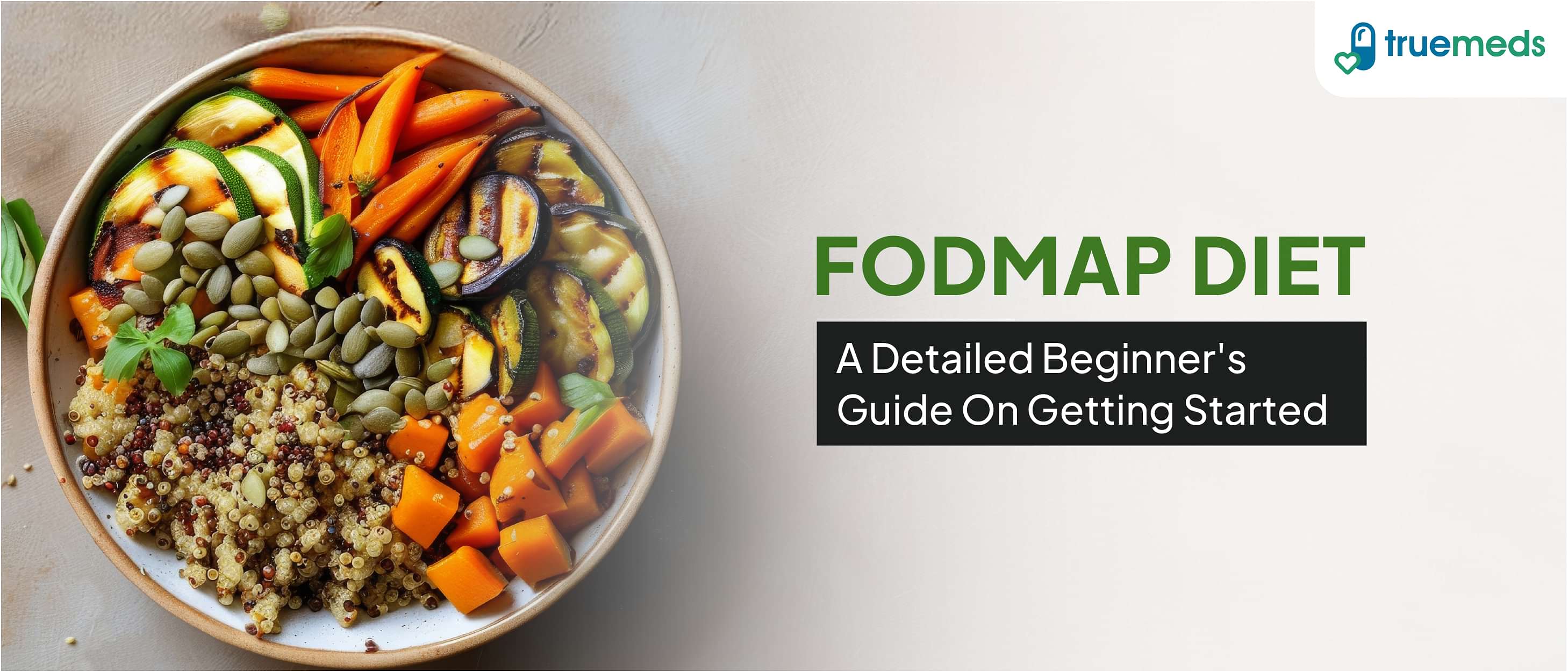
What is the FODMAP Diet? A Complete Guide for Beginners
Last updated on : 07 Nov, 2025
Read time : 7 min
Are you struggling with Irritable Bowel Syndrome (IBS) and looking for a structured approach to manage your symptoms? The Low FODMAP Diet is a science-backed approach that may significantly help in managing symptoms of IBS and other functional gut disorders [1]. This specialized eating plan may help you identify and avoid problematic foods, leading to improved digestive health and reduced discomfort.
In this guide, we’ll introduce you to the basics of the FODMAP diet, how it works, and the critical steps required to follow it safely and effectively.
What are FODMAPs?
FODMAPs is an acronym that stands for: Fermentable Oligosaccharides, Disaccharides, Monosaccharides, And Polyols. These are groups of short-chain carbohydrates that are poorly absorbed by the small intestine in some individuals [2]. Common high FODMAP compounds include fructans (in wheat/garlic), lactose (in milk), fructose (in certain fruits), and sugar polyols (like sorbitol).
What Happens When You Eat High FODMAP Foods?
When the small intestine struggles to absorb these carbohydrates effectively, the undigested FODMAPs travel to the large intestine. Here, they are rapidly fermented by gut bacteria, which produces excess gas [2].
Additionally, FODMAPs are highly osmotic, meaning they draw extra water into the large intestine [3]. This combination of increased gas and water leads to the common digestive issues experienced by people with IBS, such as bloating, abdominal pain, flatulence, and altered bowel habits (diarrhea or constipation) [1].
Evidence-Based Benefits of a Low FODMAP Diet
Adopting a low FODMAP diet, under supervision, can offer several advantages for those dealing with functional gastrointestinal conditions like IBS.
- Significant Symptom Relief: By temporarily reducing the intake of problematic carbohydrates, individuals can experience a notable reduction in IBS symptoms. Clinical trials consistently show that up to 50-86% of people with IBS report significant symptom improvement when strictly following the elimination phase [4, 5].
- Personalised Dietary Plan: The structured reintroduction phase of the diet is designed to help you precisely identify which of the five FODMAP categories trigger your specific symptoms. This process moves you toward a more balanced, long-term diet that restricts only the identified trigger foods [2].
- Improved Quality of Life: Effective symptom management can significantly improve the overall quality of life, reducing anxiety and distress often associated with chronic digestive discomfort [6].
Key High FODMAP Food Groups
High FODMAP foods contain fermentable carbohydrates that can trigger digestive discomfort. It is crucial to note that FODMAP content is often portion-dependent; a food may be low FODMAP in a small serving but high in a large one.
1. Fruits (Excess Fructose)
Certain fruits, such as apples, pears, mangoes, and watermelon, are high in free fructose or contain excess fructose over glucose. Limiting these is essential during the elimination phase.
2. Dairy Products (Lactose)
Products containing high levels of lactose, such as regular cow’s milk, standard yogurt, and soft cheeses, are high FODMAP. Lactose-free versions and hard cheeses (like Cheddar or Parmesan) are often low FODMAP alternatives.
3. Grains and Cereal (Fructans and GOS)
Wheat, barley, and rye are high in fructans (a type of oligosaccharide). It is the fructan content, not gluten, that makes these grains high FODMAP. Alternative grains like oats, rice, and quinoa are generally safe [7].
4. Vegetables (Fructans and Polyols)
Vegetables like onions, garlic, artichokes, and asparagus are high in fermentable carbohydrates. Onions and garlic are particularly common triggers.
5. Legumes (Galactans/GOS)
Legumes, including kidney beans, black beans, lentils, and chickpeas, are high in galactans (GOS). Canned lentils or chickpeas that are thoroughly rinsed can have a reduced FODMAP content and may be tolerated in small, controlled portions.
6. Sweeteners (Polyols and Fructose)
Sweeteners such as honey, high-fructose corn syrup, and sugar polyols (like sorbitol, mannitol, xylitol, and maltitol) should be avoided.
Low FODMAP Food Alternatives
Low FODMAP foods are the cornerstone of the management phase and allow for a balanced, nutritious intake.
|
Food Group |
Low FODMAP Alternatives (Safe to Eat) |
| Fruits | Bananas (unripe), Oranges, Kiwi, Grapes, Blueberries, Strawberries |
| Vegetables | Carrots, Spinach, Zucchini, Bell Peppers, Tomatoes, Cucumbers |
| Grains | Oats, Quinoa, Rice, Gluten-free bread/pasta |
| Dairy | Lactose-free milk (cow or goat), Hard cheeses, Almond milk, Rice milk |
| Protein | Meats, Fish, Eggs (plain, unprocessed), Firm tofu |
| Sweeteners | Stevia, Maple syrup, Table sugar (in very limited amounts) |
The Three-Step Process of the Low FODMAP Diet
The Low FODMAP Diet is not a permanent way of eating but a therapeutic three-phase process that must be followed sequentially for success:
1. Elimination Phase (2-6 Weeks)
You must eliminate all high FODMAP foods from your diet. The goal is to see a significant reduction in IBS symptoms. This phase should be as short as possible (no longer than 6 weeks) to prevent gut microbiome changes and nutrient deficiencies.
2. Reintroduction Phase (6-8 Weeks)
You will systematically reintroduce foods from each of the five FODMAP groups (Fructans, GOS, Lactose, Fructose, Polyols) one category at a time in measured doses. This is the diagnostic phase where your personal triggers are identified.
3. Personalisation Phase (Long-Term)
Based on the results of the reintroduction phase, you will create a long-term diet that only restricts the specific FODMAPs you react to, while incorporating all tolerated FODMAPs back into your daily eating. This is the most critical step for maintaining a varied and nutritionally balanced diet.
Crucial Note: This entire process should be overseen by a gastroenterologist or a dietitian specializing in the FODMAP diet to ensure safety, nutritional balance, and accurate interpretation of the reintroduction results [2].
Conclusion
The Low FODMAP Diet is a highly effective, evidence-based approach for managing the uncomfortable symptoms of Irritable Bowel Syndrome. By identifying and restricting your personal food triggers, it offers a path toward improved gut health and a better quality of life.
It is essential to view the low FODMAP diet as a temporary learning tool, not a permanent eating plan. Working closely with a qualified healthcare professional ensures that the process is followed correctly, minimizing the risk of nutrient deficiencies and leading to the most effective, sustainable long-term dietary solution.
References
[1] Bellini, M., Tonarelli, S., Nagy, A., Pancetti, A., Costa, F., Ricchiuti, A., De Bortoli, N., Mosca, M., Marchi, S., & Rossi, A. (2020). Low FODMAP diet: Evidence, doubts, and hopes. Nutrients, 12(1), 148. https://doi.org/10.3390/nu12010148
[2] Syed, K., & Iswara, K. (2023). Low-FODMAP diet. StatPearls Publishing. https://www.ncbi.nlm.nih.gov/books/NBK562224/
[3] Bertin, L., Zanconato, M., Crepaldi, M., Marasco, G., Cremon, C., Barbara, G., Zingone, F., & Savarino, E. V. (2024). The role of the FODMAP diet in IBS. Nutrients, 16(3), 370. https://doi.org/10.3390/nu16030370
[4] Nanayakkara, W. S., Skidmore, P. M., O’Brien, L., Wilkinson, T. J., & Gearry, R. B. (2016). Efficacy of the low FODMAP diet for treating irritable bowel syndrome: the evidence to date. Clinical and Experimental Gastroenterology, 9, 131–142. https://www.ncbi.nlm.nih.gov/pmc/articles/PMC4918736/
[5] Algera, J. P., Demir, D., Törnblom, H., Nybacka, S., Simrén, M., & Störsrud, S. (2022). Low FODMAP diet reduces gastrointestinal symptoms in irritable bowel syndrome and clinical response could be predicted by symptom severity: A randomized crossover trial. Clinical Nutrition, 41(12), 2792–2800. https://doi.org/10.1016/j.clnu.2022.11.001
[6] O’Brien, L., Kasti, A., Halmos, E. P., Tuck, C., & Varney, J. (2024). Evolution, adaptation, and new applications of the FODMAP diet. JGH Open: An Open Access Journal of Gastroenterology and Hepatology, 8(5), e13066. https://doi.org/10.1002/jgh3.13066
[7] Graf, B. L., Rojas-Silva, P., Rojo, L. E., Delatorre-Herrera, J., Baldeón, M. E., & Raskin, I. (2015). Innovations in health value and functional food development of quinoa (Chenopodium quinoa Willd.): Quinoa health value and functional foods…. Comprehensive Reviews in Food Science and Food Safety, 14(4), 431–445. https://doi.org/10.1111/1541-4337.12135
















Disclaimer
Our healthcare experts have carefully reviewed and compiled the information presented here to ensure accuracy and trustworthiness. It is important to note that this information serves as a general overview of the topic and is for informational purposes only. It is not intended to diagnose, prevent, or cure any health problem. This page does not establish a doctor-patient relationship, nor does it replace the advice or consultation of a registered medical practitioner. We recommend seeking guidance from your registered medical practitioner for any questions or concerns regarding your medical condition.
Popular Articles



Recommended Articles




Recent Articles







Company
About UsHealth ArticleHealth StoriesHealth LibraryDiseases & Health ConditionsAyurvedaUnderstanding Generic MedicinesAll MedicinesAll BrandsNeed HelpFAQSecuritySubscribe
Registered Office Address
Grievance Officer
Download Truemeds


Contact Us
Our customer representative team is available 7 days a week from 9 am - 9 pm.
v4.10.3

2025 - Truemeds | All rights reserved. Our content is for informational purposes only. See additional information.
Our Payment Partners