

- Medicines
- Personal Care
- Skin Cream
- Sunscreen
- Face Wash
- Skin and Body Soap
- Acne Care
- Body Lotions
- Moisturising Lotion
- Moisturising Cream
- Mosquito Repellent
- Moisturising Gel
- Body Wash
- Hair Oils
- Hair Shampoo
- Hair Conditioners
- Hair Supplements
- Hair Colour
- Hair Serum
- Hair Mask
- Hair Solutions
- Baby Diapers and Wipes
- Baby Lotion and Moisturising Cream
- Baby Bath Essentials
- Baby Skin Care
- Baby and Infant Food
- Baby Healthcare
- Women Multivitamins
- Ovulation Test Kit and Women Intimate Care
- Sanitary Pads
- Nutritional Drinks
- Condoms
- Lubricants
- Massage Gels
- Personal Body Massagers
- Men Performance Booster
- Sexual Health Supplements
- Massage Oils
- Ayurveda
- Tooth Paste
- Mouth Ulcer Gel
- Mouthwash
- Toothache and Gum Pain
- Tooth Brush
- Gargle Solution
- Orthopaedic Supports
- Adult Diapers
- Footwear
- Mobility and Support Accessories
- Urinary Support and Care
- Health Conditions
- Bone and Joint Care
- Digestive Care
- Eye Care
- Pain Relief
- Smoking Cessation
- Liver Care
- Stomach Care
- Cold and Cough
- Heart Care
- Kidney Care
- Piles, Fissures & Fistula
- Respiratory Care
- Mental Wellness
- Derma Care
- Pre and Probiotics
- Acidity
- Gas
- Constipation
- Loose Motion/Diarrhoea
- Digestive Fibres
- Digestive Enzymes
- Eye Lubricant Drops
- Lens Solution
- Safety Eye Wear
- Eye Cream
- Eye Vitamins and Supplements
- Eye Drops
- Eye Ointment and Gel
- Nicotine Patch
- Nicotine Gum
- Nicotine Lozenges
- Cough Syrups
- Chest Rubs and Balms
- Nasal Spray
- Lozenges
- Inhalant Capsules
- Cold and Cough Tablets
- Vitamins & Supplements
- Diabetes Care
- Healthcare Devices
- Homeopathic Medicine
- Health Guide
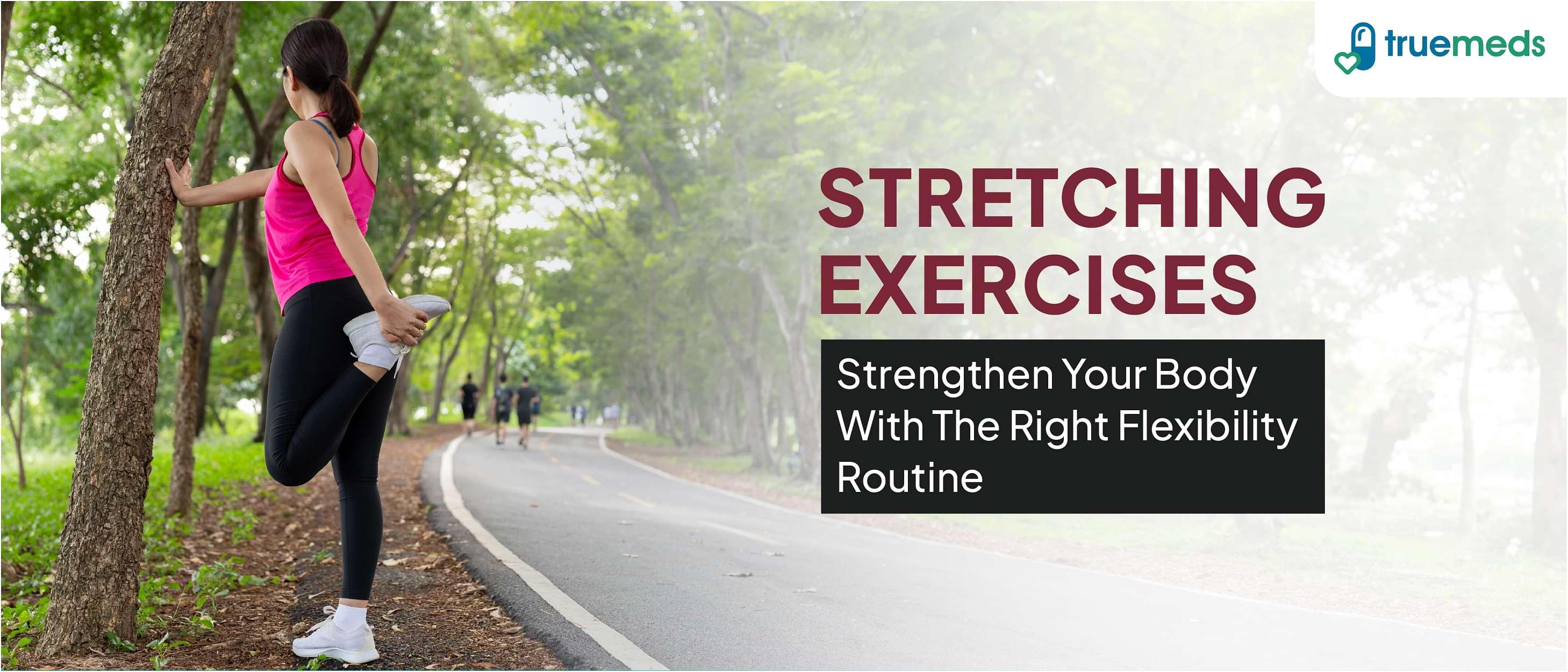
10 Essential Stretching Exercises for a Flexible Body
Last updated on : 01 Dec, 2025
Read time : 9 min
What are Stretching Exercises?
Stretching exercises are intentional physical movements that extend specific muscles or tendons to enhance muscle elasticity, flexibility, and overall mobility. They are a critical component of any fitness regimen [1]. These exercises fall into two main categories: static stretching, where you hold a stretch in a comfortable position for a set duration, and dynamic stretching, which involves active movement to prepare muscles for exercise without sustained holds [2]. Regular stretching can significantly improve flexibility, increase joint range of motion, and support both physical and mental well-being [3]. Now that we understand the basics of stretching exercises, let’s explore the 10 best stretches for a flexible and strong body.
Top 10 Stretching Exercises for Flexibility and Strength
Here are 10 essential stretches to incorporate into your daily routine for improved flexibility and strength.
1. Side Lunge Stretch
Start by standing with your feet together. Lunge to the right, bending your right knee to about 90 degrees while keeping your left leg straight. Both feet should point forward. Place your hands on your thighs and hinge slightly from your hips, keeping your back flat. Hold for 15 to 60 seconds [4], then switch legs and repeat on the other side. This stretch targets your inner thighs and groin muscles.
2. Calf Stretch
Stand facing a wall with one hand on it for balance. Step one foot back about 45-60 cm (1.5 to 2 feet), keeping your heel on the ground. Bend the front knee and lean forward, stretching your calf muscle. Hold for 15 to 60 seconds [4], then switch legs. Ensure your back leg remains straight and your heel stays on the ground to maximise the stretch. The calf stretch is essential for lower leg flexibility and injury prevention, particularly for runners [5].
3. Chest and Shoulder Stretch
Sit or stand with your spine straight and shoulders relaxed. Interlace your fingers behind your back, palms facing inward. Gently lift your arms while keeping them straight, opening your chest and stretching your front shoulder muscles. Keep your neck and jaw relaxed and hold the stretch for 15 to 60 seconds [4]. Release slowly and repeat as needed. This stretch is beneficial for counteracting rounded shoulders caused by prolonged sitting [6].
4. Glute Bridge
Lie on your back with your knees bent and feet flat on the floor, hip-width apart. Slowly lift your hips towards the ceiling, squeezing your glutes and lower back muscles as you lift. Hold briefly at the top, then lower back down. Repeat for 10-15 repetitions. Note: While the glute bridge is primarily a strengthening exercise, the controlled movement offers dynamic stretching and improved mobility for the hips and lower back.
5. Standing Quad Stretch
Stand with one hand against a wall for balance. Bend one knee, keeping your foot behind you, and grab your ankle with your hand. Pull your heel towards your buttocks until you feel a comfortable stretch in the front of your leg. Hold for 15 to 60 seconds [4], then switch legs. This stretch is highly effective for improving flexibility in your quadriceps and hip flexors, which can help reduce common lower back and hip tension.
6. Cobra Pose (Bhujangasana)
Lay face down on the floor with your legs extended behind you and the tops of your feet on the floor. Place your hands under your shoulders, fingers pointing forward, and press your elbows into your body. As you inhale, press down through the tops of your feet and pubic bone, gently lifting your head and chest off the floor. Draw your shoulders back and away from your ears without tensing your neck. Hold for 30 seconds. The Cobra stretch is a foundational yoga posture that may help improve flexibility in your spine and support the strengthening of your back muscles.
7. Standing Hip Flexor Stretch
Stand with your feet hip-width apart. Take a large step forward with one foot and lower your body until your back knee almost touches the ground, forming a 90-degree angle with your front leg. Gently push your hips forward, feeling the stretch in the front of your back hip. Hold for 15 to 60 seconds [4], then switch legs. This stretch targets your hip flexors, muscles often tight from prolonged sitting and essential for good posture.
8. Butterfly Stretch (Baddha Konasana)
Sit tall on the floor with the soles of your feet together and your knees bent out to the sides. Hold onto your ankles or feet and engage your abs. Slowly lower your torso toward your feet as far as you can while pressing your knees toward the floor. Only use your elbows to press down on your knees gently and without pain to further the stretch. Hold for 30 seconds to 2 minutes. The butterfly stretch may help improve flexibility in your inner thighs and groin muscles.
9. Standing Hamstring Stretch
Stand with your feet hip-width apart. Place one heel on a bench or step in front of you with your leg straight and toes up. Without rounding your lower back, gently hinge forward from your hips until you feel a comfortable stretch in your hamstring muscle. Hold for 15 to 60 seconds [4], then switch legs. This stretch is crucial for maintaining flexibility in your hamstrings, reducing the risk of lower back pain and injury [7].
10. Sideways Neck Stretch
Sit or stand with your back straight. Slowly tilt your head to the right, bringing your ear towards your right shoulder. Use your right hand to gently guide your head and increase the stretch if needed. Hold for 15 to 30 seconds [7], then switch sides. Crucially, ensure you do not bounce or force the stretch beyond a comfortable, gentle point. The sideways neck stretch is highly effective for releasing tension in your neck and shoulders, which often accumulates from stress or poor posture.
Mental Health Benefits of Stretching
Did you know that stretching not only improves physical health but also offers significant mental well-being benefits?
Scientific studies suggest that regular stretching may contribute to stress reduction and mental calm. It can help ease physical muscle tension, which is often linked to psychological stress [8]. Furthermore, the focused breathing often associated with stretching, especially in yoga-based postures, can activate the parasympathetic nervous system, promoting a state of relaxation and mental clarity [8].
Comprehensive Benefits of Stretching Exercises
Incorporating regular stretching exercises into your routine offers numerous advantages for your body and mind:
- Improves Flexibility and Mobility: Allows for a greater range of movement in daily activities [1].
- Enhances Joint Range of Motion (ROM): A key factor in injury prevention and maintaining function [1].
- Boosts Athletic Performance: Dynamic stretching performed before activity is linked to improved power and speed [2].
- Enhances Blood Circulation: This aids in delivering nutrients and oxygen to muscles, which can reduce muscle soreness and promote faster recovery [4].
- Promotes Better Posture: Helps correct muscle imbalances that pull the body out of proper alignment.
- Helps Alleviate and Prevent Back Pain: By stretching and strengthening the muscles that support the spine [7].
- Reduces Physical and Mental Stress: By releasing physical tension and promoting relaxation through focused movement [8].
Conclusion
Incorporating these 10 essential stretching exercises into your daily routine is a proactive step toward a more flexible, stronger, and well-aligned body. To maximize the benefits of static stretching, aim to hold each pose for 15-60 seconds and breathe deeply, avoiding any sharp pain or bouncing [4]. Regular practice enhances your range of motion, reduces muscle stiffness, and improves overall physical and postural awareness, making everyday movements easier and reducing the risk of common injuries. For the best outcomes, integrate a mix of static stretching (post-exercise) and dynamic stretching (pre-exercise) into your routine at least twice a week [1].
Disclaimer:
This article is for informational purposes only and should not be considered a substitute for professional medical advice, diagnosis, or treatment. Please consult a physician, certified physical therapist, or qualified yoga instructor before starting or changing any exercise regimen, especially if you have pre-existing health conditions or concerns.
Frequently Asked Questions (FAQs)
What is the best exercise for stretching?
A diverse routine is most effective. Yoga poses like the Downward-Facing Dog, the Cobra Pose, and targeted hamstring and hip flexor stretches are great for overall flexibility.
What is stretching training?
Stretching training involves a systematic approach to exercises designed to improve muscle elasticity, flexibility, and joint mobility to enhance overall movement quality and prevent injuries.
What do 5 minutes of stretching do?
Even a short, focused 5-minute stretching session can improve blood flow, provide temporary relief from muscle stiffness, enhance flexibility, and offer a moment of mental relaxation.
What are the key stretching methods?
The key stretching methods are: Static (holding a passive stretch), Dynamic (active, controlled movements), Ballistic (bouncing movements, generally not recommended), and PNF (Proprioceptive Neuromuscular Facilitation, often involving a contraction-relaxation technique).
What are the disadvantages of stretching?
Potential disadvantages are generally related to improper technique. Overstretching or ballistic (bouncing) stretching may cause muscle strain or lead to injury. Static stretching performed immediately before power-based activity may also temporarily reduce muscle strength or power [2].
References
[1] Page, P. (2012). Current concepts in muscle stretching for exercise and rehabilitation. International Journal of Sports Physical Therapy, 7(1), 109–119. https://pmc.ncbi.nlm.nih.gov/articles/PMC3273886/
[2] Afonso, J., Ramirez-Campillo, R., Moscão, J., Rocha, T., Zacca, R., Martins, A., Milheiro, A. A., Ferreira, J., Sarmento, H., & Clemente, F. M. (2021). Strength training versus stretching for improving range of motion: A systematic review and meta-analysis. Healthcare (Basel, Switzerland), 9(4), 427. https://doi.org/10.3390/healthcare9040427
[3] Mašić, S., Čaušević, D., Čović, N., Spicer, S., & Doder, I. (2024). The benefits of static stretching on health: a systematic review. Journal of Kinesiology and Exercise Sciences, 34(105), 1–7. https://doi.org/10.5604/01.3001.0054.2941
[4] Shrier, I. (2004). Does stretching improve performance? A systematic and critical review of the literature. Clinical Journal of Sport Medicine, 14(5), 267–273. https://doi.org/10.1097/00042752-200409000-00004
[5] Nakamura, M., Ikezoe, T., & Nishishita, T. (2020). Influence of calf stretching on muscle-tendon stiffness and running economy: A systematic review and meta-analysis. Journal of Sports Sciences, 38(18), 2125–2134. https://doi.org/10.1080/02640414.2020.1782298
[6] Kang, J. I., & Lee, S. H. (2018). The effects of stretching exercise on posture and function in people with rounded shoulder posture: A systematic review and meta-analysis. Journal of Physical Therapy Science, 30(7), 903–908. https://doi.org/10.1589/jpts.30.903
[7] Akhtar, R., & Sarwar, A. (2019). The effects of hamstring stretching on lower back pain: A randomized controlled trial. Journal of Exercise Rehabilitation, 15(1), 101–107. https://doi.org/10.12965/jer.1836476.338
[8] Santhi, V., & Balachandar, R. (2019). Effect of yoga on stress and anxiety—A systematic review. International Journal of Yoga, 12(1), 3–14. https://doi.org/10.4103/ijoy.ijoy_57_1














Disclaimer
Our healthcare experts have carefully reviewed and compiled the information presented here to ensure accuracy and trustworthiness. It is important to note that this information serves as a general overview of the topic and is for informational purposes only. It is not intended to diagnose, prevent, or cure any health problem. This page does not establish a doctor-patient relationship, nor does it replace the advice or consultation of a registered medical practitioner. We recommend seeking guidance from your registered medical practitioner for any questions or concerns regarding your medical condition.
Popular Articles


Recommended Articles



Recent Articles








Company
About UsHealth ArticleHealth StoriesHealth LibraryDiseases & Health ConditionsAyurvedaUnderstanding Generic MedicinesAll MedicinesAll BrandsNeed HelpFAQSecuritySubscribe
Registered Office Address
Grievance Officer
Download Truemeds


Contact Us
Our customer representative team is available 7 days a week from 9 am - 9 pm.
v4.11.0

2026 - Truemeds | All rights reserved. Our content is for informational purposes only. See additional information.

Our Payment Partners




