Key Takeaways
- ICMR-NIN recommends about 0.83 g of protein per kg of body weight per day for healthy adults. For the reference body weights used in the guidelines, that is about 46 g for a woman (55 kg) and 54 g for a man (65 kg).
- Needs are higher in pregnancy, breastfeeding, recovery from illness and regular strength training, while protein needs in older adults may require individual assessment.
- Quality matters as much as quantity. Nearly half of the protein in Indian diets comes from cereals, so add dal, curd, paneer, eggs, fish, meat or soya.
- Food comes first. A balanced diet can usually meet daily protein needs; supplements are only needed when dietary intake is insufficient.
- If you have kidney disease, or diabetes or high blood pressure with unknown kidney health, check with your doctor before raising protein intake.
- Tiredness, hair fall and infections have many causes. Seek medical advice rather than assuming low protein is the cause.
Daily protein requirement is one of the most misunderstood parts of Indian nutrition, mainly because most traditional plates are dominated by rice, roti and sabzi, with relatively little emphasis on dals, pulses, milk or meat.
For many Indians, the focus tends to be on calories and carbohydrates, while protein is treated as optional or something only “gym-goers” need. In reality, every cell in the body, including the muscles, organs, skin, hair, immune cells and hormones, depends on adequate protein every single day.
When you do not meet your daily protein requirement, you may feel tired, lose muscle, mood changes and experience frequent infections over time. [1]
Understanding how much protein you need per day helps you plan Indian-style meals that support energy, muscle health and metabolism without completely changing your food culture. With a few simple tweaks, you can meet your daily protein requirement while still enjoying familiar Indian flavours and dishes.
Why Knowing Your Daily Protein Requirement Matters
Protein is the building block for muscles, organs, enzymes, hormones and immune cells. It also supports a healthier metabolism, stabilises blood sugar levels (when replacing refined carbohydrates) and helps control appetite, which is why higher-protein diets often feel more filling and satisfying.
For Indian adults, hitting the right protein requirement per day is especially important because many common diets provide adequate or even excess calories but relatively low protein density, often relying heavily on cereals like rice, wheat and refined snacks.
This calorie-rich but protein-poor pattern can quietly erode muscle mass while increasing fat gain, even if weight on the scale does not change much.
Over time, chronically low or poor-quality protein intake can contribute to:
- Fatigue
- Frequent infections
- Hair loss
- Poor wound healing
- Loss of muscle (Sarcopenia)
- Weaker bones
- Higher risk of lifestyle-related conditions such as insulin resistance, diabetes and cardiovascular disease
Understanding and meeting your daily protein requirement is, therefore, a key pillar of long-term health, not just for bodybuilders or athletes.
How Much Protein Do You Need Per Day?
How much protein is needed per day varies from person to person; there is no single “magic number” that fits everyone. Your daily protein requirement depends on a combination of physical, dietary and health-related factors.
Key factors that influence protein requirement per day:
- Body weight: Protein is usually calculated in grams per kg of body weight, so a heavier person needs more grams per day than a lighter person. For people who are overweight, the appropriate weight to use may depend on individual circumstances.
- Activity level: Sedentary adults need less protein than those who exercise regularly, do strength training or have physically demanding jobs.
- Age: International expert groups suggest that healthy older adults may benefit from about 1.0–1.2 g of protein per kg of body weight per day to help maintain muscle mass and strength. ICMR-NIN’s baseline for healthy adults is 0.83 g/kg/day, but protein needs vary with health status and individual circumstances.
- Diet type: Vegetarians and vegans may need to plan more carefully to combine plant proteins and ensure they are of good quality and adequate quantity.
- Health status: Pregnancy, lactation, recovery from illness, surgery, or chronic diseases can all increase daily protein requirements.
Protein Requirement Per Day: Guidelines for Indians
The latest ICMR-NIN (2020) guidelines recommend a safe daily protein intake of 0.83 g per kilogram of body weight for healthy Indian adults. [2]
These are baseline figures for healthy adults; the requirement naturally increases at certain life stages and under certain conditions. For example:
- Pregnant and lactating women need additional protein beyond these values to support foetal growth, tissue expansion, and breast milk production.
- Athletes, people who do heavy physical work, or those engaging in regular strength training may benefit from a slightly higher protein intake, typically up to 2.0 g/kg/day of body weight per day, depending on their training goals and individual needs. Healthy adults can generally consume higher protein intakes without harm. However, people with pre-existing kidney disease may need to limit protein intake under the guidance of a doctor.
The problem is not only “how much” protein, but also “from where” it comes. Urban and rural dietary data show that nearly half of total protein still comes from cereals, which lowers overall protein quality even if the total grams look adequate on paper.[3]
Calculate Your Daily Protein Requirement by Weight
Protein in Common Indian Foods
Values are approximate and vary with recipe and portion size.
How Much Protein Per Day: Practical Examples and Meal Plans
Understanding how much protein your body needs and how to include it in your daily meals can make it easier to meet your nutritional goals without drastically changing your diet.
A simple way to estimate your daily protein requirement is: [4]
Protein (g/day) ≈ Body weight (kg) × 0.83 for a healthy adult
Those who are more physically active, such as athletes or gym-goers, may need a higher intake (about 1.0–1.4 g per kg body weight), depending on their exercise intensity and goals.
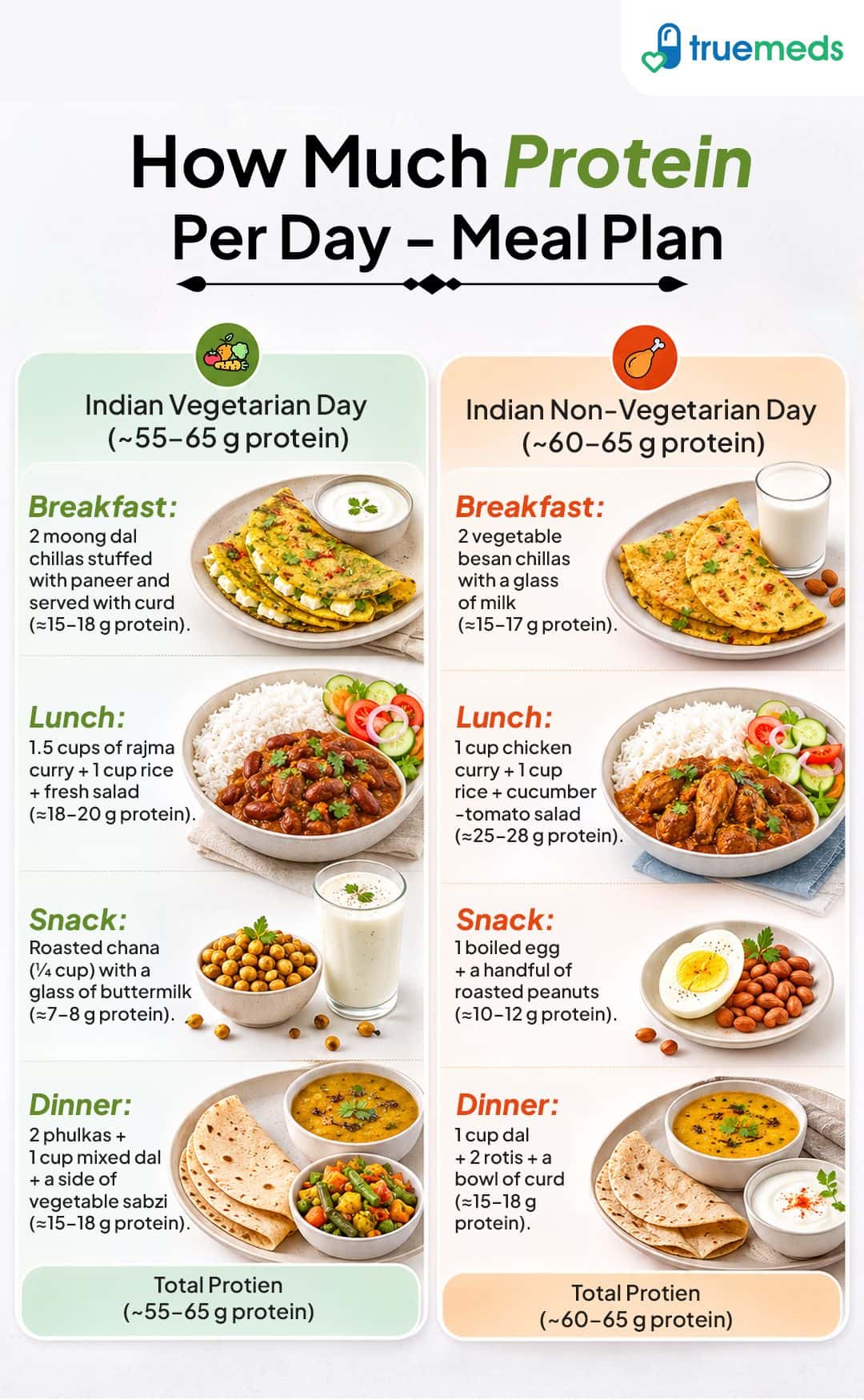
Sample Indian Vegetarian Day (~50–55 g protein)
Sample Indian Non-Vegetarian Day (~60–65 g protein)
Tip: Including curd, paneer, and lentils in different meals throughout the day ensures a steady protein supply and helps maintain muscle mass, especially for vegetarians.
Quality of Protein Matters in an Indian Diet
It’s not just about how much protein you eat each day; the quality is equally important.
A high-quality or ‘complete’ protein contains all nine essential amino acids in adequate amounts.
Animal sources such as eggs, milk, curd, paneer, fish, and meat usually have higher nutritional quality than plant-based proteins. [5]
Most animal proteins are naturally complete.
- They provide amino acids in proportions that the body can easily use for muscle repair and growth.
- These foods also have higher digestibility, meaning the body efficiently absorbs and utilises their protein content.
- Including even modest amounts of animal proteins in a diet can significantly improve overall protein quality.
In contrast, most plant proteins commonly eaten in Indian diets, such as those from cereals, pulses, and legumes, are ‘incomplete.’ This means they lack one or more essential amino acids, and their digestibility is said to be incomplete. [6]
However, traditional Indian meals are nutritionally smart in their combinations.
- When cereals and pulses are eaten together, they complement each other’s amino acid gaps.
- For instance, rice or wheat are low in lysine but contain methionine, while pulses like dals, rajma, and chana offer lysine but are relatively low in methionine. [7]
- Dishes like dal–rice, rajma–chawal, roti–dal, or khichdi naturally provide a more balanced amino acid profile.
- Adding dairy products such as curd, paneer, or milk further enhances the protein quality in vegetarian diets.
By combining plant proteins and adding small portions of high-quality protein foods, it’s easy to achieve complete, balanced nutrition within the framework of a traditional Indian diet.
Common Shortfalls in Indian Diets & How to Fix Them
Many Indian diets suffer from what nutritionists call a “protein paradox.” On paper, the total protein intake may seem close to the recommended amount. Still, the quality of that protein is often suboptimal.[3]
This is because nearly half of the total protein in Indian meals comes from cereal-based foods such as rice, wheat, and millet.
While these staples provide energy, they lack certain essential amino acids that make proteins truly effective for muscle maintenance, immunity, and tissue repair.
Here are some simple, practical ways to bridge the protein gap in everyday meals:
- Add at least one katori of dal, chana, rajma, or sprouts to both lunch and dinner.
- Include dairy such as curd, paneer, or milk daily, or eggs a few times a week, to improve amino acid balance without significant changes to the menu.
- Swap refined carbs, such as biscuits and maida snacks, for nutrient-dense protein options like roasted chana, nuts, seeds, or Greek yoghurt.
- Use cereal–pulse combinations such as khichdi, idli–sambar, dosa–sambar, or dalia cooked with lentils more often. These pairings naturally form complete proteins.
FAQs
What is the daily protein requirement for an average Indian adult?
The daily protein requirement is about 46–54 g/day for healthy adults. However, the requirement varies slightly with age, gender (men require slightly higher protein intake due to greater muscle mass), and conditions such as pregnancy and lactation, due to increased body demand.
How much protein per day does a vegetarian need compared to a non-vegetarian?
The gram requirement per kg remains the same, but vegetarians need to be more deliberate about combining dals, cereals, dairy, nuts, and seeds to achieve high-quality protein.
How much protein is enough if I am trying to build muscle or lose weight?
Active adults or those doing strength training may benefit from a slightly higher intake, provided kidney function is normal, and total calorie intake is balanced.
Can I meet my protein requirement through traditional Indian meals without supplements?
Yes, by increasing portions of dals, pulses, curd, paneer, eggs, fish or meat and using cereal–pulse combinations, most people can meet their daily protein requirement through food alone.
Is it harmful to eat too much protein per day?
Very high protein intakes over long periods may stress the kidneys in people with pre-existing kidney disease, so those individuals should follow medical advice. Still, healthy adults usually tolerate moderate increases well.
How do I calculate how much protein I need per day based on my weight and activity?
Multiply your body weight in kg by 0.83 for a baseline, and consider moving toward 1.0–1.2 g/kg/day if you are very active, while keeping overall calorie intake and health conditions in mind.
References
Why protein matters as you age. (2025, December 12). https://www.ncoa.org/article/8-signs-of-protein-deficiency-in-older-adults/
Dietary Guidelines For Indians. (2024). ICMR-National Institute of Nutrition. https://share.google/IhhVTlBMVK4EChjnP
Gupta, S., Borah, A., & Kochhar, E. (2025). Understanding Trends in Dietary Diversity in India: Moving Towards Sustainable Consumption. https://www.ceew.in/press-releases/indians-are-getting-protein-poor-quality%E2%80%94nearly-50-comes-cereals-ceew
Harvard Health. (2023, June 22). How much protein do you need every day? https://www.health.harvard.edu/blog/how-much-protein-do-you-need-every-day-201506188096