

- Medicines
- Personal Care
- Skin Cream
- Sunscreen
- Face Wash
- Skin and Body Soap
- Acne Care
- Body Lotions
- Moisturising Lotion
- Moisturising Cream
- Mosquito Repellent
- Moisturising Gel
- Body Wash
- Hair Oils
- Hair Shampoo
- Hair Conditioners
- Hair Supplements
- Hair Colour
- Hair Serum
- Hair Mask
- Hair Solutions
- Baby Diapers and Wipes
- Baby Lotion and Moisturising Cream
- Baby Bath Essentials
- Baby Skin Care
- Baby and Infant Food
- Baby Healthcare
- Women Multivitamins
- Ovulation Test Kit and Women Intimate Care
- Sanitary Pads
- Nutritional Drinks
- Condoms
- Lubricants
- Massage Gels
- Personal Body Massagers
- Men Performance Booster
- Sexual Health Supplements
- Massage Oils
- Ayurveda
- Tooth Paste
- Mouth Ulcer Gel
- Mouthwash
- Toothache and Gum Pain
- Tooth Brush
- Gargle Solution
- Orthopaedic Supports
- Adult Diapers
- Footwear
- Mobility and Support Accessories
- Urinary Support and Care
- Health Conditions
- Bone and Joint Care
- Digestive Care
- Eye Care
- Pain Relief
- Smoking Cessation
- Liver Care
- Stomach Care
- Cold and Cough
- Heart Care
- Kidney Care
- Piles, Fissures & Fistula
- Respiratory Care
- Mental Wellness
- Derma Care
- Pre and Probiotics
- Acidity
- Gas
- Constipation
- Loose Motion/Diarrhoea
- Digestive Fibres
- Digestive Enzymes
- Eye Lubricant Drops
- Lens Solution
- Safety Eye Wear
- Eye Cream
- Eye Vitamins and Supplements
- Eye Drops
- Eye Ointment and Gel
- Nicotine Patch
- Nicotine Gum
- Nicotine Lozenges
- Cough Syrups
- Chest Rubs and Balms
- Nasal Spray
- Lozenges
- Inhalant Capsules
- Cold and Cough Tablets
- Vitamins & Supplements
- Diabetes Care
- Healthcare Devices
- Homeopathic Medicine
- Health Guide
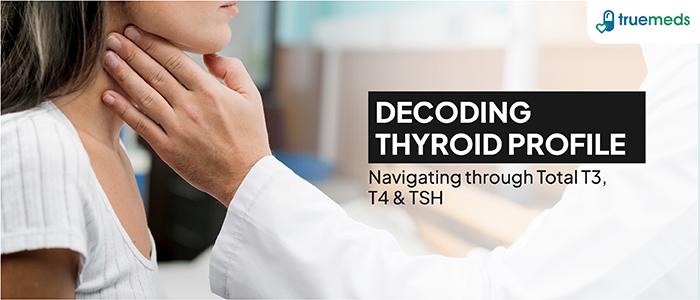
Understanding Thyroid Profile: Total T3, T4 & TSH
Last updated on : 08 Nov, 2025
Read time : 9 min
Your body is a complex machine where every organ plays a pivotal role. Among them, the thyroid gland holds unique importance. This small, butterfly-shaped organ located at the base of your neck is responsible for regulating various functions in your body, like metabolism, growth, and overall energy levels. It does this through the production of hormones, primarily triiodothyronine (T3) and thyroxine (T4) [1].
A thyroid profile is essentially a diagnostic blood test that helps assess the functioning of your thyroid gland. It measures the levels of T3, T4, and thyroid-stimulating hormone (TSH) in your blood [2].
The results of this test offer vital insights into your health and can even flag potential issues before they become serious problems. Understanding these components is essential for anyone who wants to take a proactive approach to their hormonal and metabolic well-being.
What is a Thyroid Profile?
A thyroid profile, also known as a Thyroid Function Test (TFT), is a blood test done to measure the levels of thyroid hormones—T3, T4, and TSH—in your blood. The primary aim of this test is to understand how well your thyroid gland is working [1].
This test plays a crucial role in diagnosing various thyroid disorders, such as hypothyroidism (where the thyroid gland is underactive, often indicated by high TSH) and hyperthyroidism (where the thyroid gland is overactive, often indicated by low TSH) [3]. It is also a key tool for monitoring individuals who are already receiving treatment for thyroid disorders, ensuring that therapy is effective and hormone levels remain balanced.
The thyroid gland produces T3 and T4 hormones, which are critical in regulating your metabolism, heart rate, body temperature, and overall energy levels.
TSH, or thyroid-stimulating hormone, is produced by the anterior pituitary gland. Its function is to stimulate the thyroid to release T3 and T4 into your bloodstream [2]. The interaction between these hormones forms a feedback loop that helps maintain hormonal balance: when the levels of T3 and T4 are low, the levels of TSH rise to stimulate the production of more hormones, and vice versa.
Note: TSH is often considered the most sensitive marker for detecting early thyroid dysfunction due to its responsiveness to small hormonal changes [3].
Components of the Thyroid Profile
To understand your thyroid health better, let’s delve into its key components:
1) Total and Free T3 (Triiodothyronine)
T3 is the most biologically active thyroid hormone, regulating metabolism and energy use. The Total T3 test measures both the hormone bound to proteins and the small, active fraction. In clinical practice, the Free T3 level (unbound and readily available to tissues) is often considered a more precise reflection of true thyroid function, as Total T3 can be skewed by changes in binding proteins (e.g., during pregnancy or while taking certain medications) [4].
2) Total and Free T4 (Thyroxine)
T4 is the main hormone secreted by the thyroid, acting as a reservoir for conversion to T3. Similarly, Total T4 measures all circulating T4, while Free T4 measures the active hormone. Doctors often rely on Free T4 because it is a more reliable marker, as Total T4 is highly sensitive to changes in proteins, often caused by medications or hormone therapies [4].
Interpreting Thyroid Function Tests (TFTs)
- TFTs are a series of blood tests that gauge the health and functionality of your thyroid gland. These tests measure the levels of TSH, T3, and T4 hormones circulating in your blood. Conducting these tests involves drawing a small sample of blood, usually from a vein in your arm. This sample is then sent to a lab for analysis.
- Interpreting the test results primarily involves comparing the measured hormone levels to their normal reference ranges.
- Any significant deviation from these reference ranges can indicate a thyroid disorder like hypothyroidism or hyperthyroidism. These results help doctors and healthcare professionals diagnose and monitor your thyroid conditions, guiding them to make informed treatment decisions.
Normal Ranges for T3, T4, and TSH
It’s important to know what’s usually considered the normal range for these hormones. If your results fall outside the normal range, a clinical evaluation by a healthcare provider is necessary [5].
| Hormone | Typical Adult Reference Range | Notes on Variability |
| Total T3 | 80–220 ng/dL | Total T3 levels are less reliable than Free T3. |
| Total T4 | 5.0–12.0 µg/dL | Total T4 levels are less reliable than Free T4. |
| TSH | 0.5–5.0 mIU/L | TSH is typically the first test ordered. Lower ranges may be used in pregnancy or for treated conditions. |
Source: UCLA Health, American Thyroid Association [5], [3]
These ranges can slightly vary depending on the specific laboratory, the testing method used, and the patient’s age or clinical status. Therefore, your doctor will always interpret your results based on the specific reference range provided by the lab that conducted your test.
T3, T4, and TSH Normal Range in Females
Normal ranges for T3, T4, and TSH in women are generally similar to those of the general population. However, variations can occur due to hormonal changes:
- Age: Normal ranges may shift slightly as a person grows older.
- Pregnancy: The American Thyroid Association (ATA) recommends lower TSH targets in the first trimester (0.1–2.5 mIU/L), with the normal range typically increasing in later trimesters [6]. This is due to the body’s increased demand for thyroid hormones.
How to Prepare for a Thyroid Profile Test
Preparing for a thyroid profile test is straightforward. Let’s break down the process into simple steps.
Medication Considerations
It is essential to keep your doctor informed about any medicines or supplements that you are currently taking. Certain drugs, like high-dose biotin (vitamin B7) supplements, steroids, or lithium, can interfere with the test and affect the levels of thyroid hormones in your body, potentially leading to false readings [4], [7]. Your doctor might ask you to temporarily stop these specific medications or supplements before the test.
Guidelines for Fasting
Typically, there are no strict rules about fasting before a TFT for general screening. However, if other blood tests (like glucose or cholesterol) are being performed simultaneously, a fast may be required [7]. It is always wise to follow your doctor’s specific guidelines to ensure accurate results.
Did You Know? The time of day the blood is drawn can influence TSH levels, with values tending to be lower in the afternoon compared to morning levels. For consistency, many providers prefer to collect samples in the morning [7].
What to Expect During the Test
A thyroid function test is quite straightforward. It involves drawing a small amount of blood, usually from a vein in your arm. The entire procedure takes just a few minutes. You might feel a slight pinch when the needle goes in, but rest assured, it’s not painful. Once your blood sample is collected, it is sent to the lab for analysis.
Conclusion
Understanding the components of your thyroid profile—T3, T4, and TSH—is a valuable step in taking charge of your overall metabolic health. Preparing for the test is straightforward, with minimal requirements for fasting and medication adjustments, but it is crucial to follow your healthcare provider’s instructions. Accurate test results are key for the effective diagnosis and management of thyroid disorders. By following your healthcare provider’s instructions and being aware of the testing process, you can contribute to effective thyroid health monitoring and treatment.
Frequently Asked Questions (FAQs)
What does T3 and T4 tell you about the thyroid?
T3 (triiodothyronine) and T4 (thyroxine) are key hormones produced by the thyroid gland that regulate metabolism, energy levels, and overall bodily functions. Abnormal levels of T3 and T4 can indicate thyroid disorders such as hypothyroidism or hyperthyroidism, affecting various physiological processes [1].
Which is more important, T3, T4 or TSH?
All three are interconnected. TSH is typically the initial and most sensitive screening tool for thyroid disease because it responds quickly to changes in T3 and T4 levels [3]. However, all values must be interpreted together by a healthcare provider for a complete diagnosis.
What happens if TSH is high?
A high TSH typically indicates an underactive thyroid gland (hypothyroidism)—more TSH is being produced by the pituitary gland to try and stimulate the thyroid to make more hormones [2].
What happens if T4 is high?
High levels of T4 suggest that the thyroid is overactive (hyperthyroidism), which can lead to symptoms like rapid heartbeat, anxiety, and unexplained weight loss [1].
What causes TSH to increase?
TSH levels can increase primarily due to hypothyroidism (the most common cause), inflammation of the thyroid (thyroiditis), or due to certain medications [2].
How often should I get a thyroid profile test?
There is no universal recommendation for routine thyroid testing in healthy, asymptomatic adults. Testing is generally recommended when symptoms of thyroid dysfunction are present, during pregnancy, or if you have specific risk factors (e.g., a family history of thyroid disease, other autoimmune conditions) [3]. Your doctor will determine the appropriate frequency based on your individual health profile.
How do thyroid levels affect overall health?
Unbalanced thyroid levels can cause various health issues, including weight changes, fatigue, hair loss, mood swings, and irregular menstrual cycles in females [1].
Disclaimer
This article is for informational purposes only and is not a substitute for professional medical advice, diagnosis, or treatment. Please consult a healthcare provider before beginning any new wellness practice or making decisions related to your health, especially if you have an existing medical condition or are on medication.
References
[1] Healthdirect Australia. (2021). Thyroid function tests. https://www.healthdirect.gov.au/thyroid-function-tests
[2] MedlinePlus. (2020). TSH (Thyroid-stimulating hormone) test. National Library of Medicine. https://medlineplus.gov/lab-tests/tsh-thyroid-stimulating-hormone-test/
[3] American Thyroid Association. (2015). Thyroid function tests. https://www.thyroid.org/thyroid-function-tests/
[4] Lien, K. L. (2018). The effect of biotin on thyroid function tests. Clinical Chemistry, 64(12), 1757–1759. https://doi.org/10.1373/clinchem.2018.291771
[5] UCLA Health. (n.d.). Normal thyroid hormone levels. (Retrieved October 10, 2025). https://www.uclahealth.org/medical-services/surgery/endocrine-surgery/conditions-treated/thyroid/normal-thyroid-hormone-levels
[6] Alexander, E. K., Blithe, D., Brown, R. S., Hollenberg, A. N., Li, J., Perros, P., Reiners, C., Richman, S., Thienpont, L., & Van Herle, A. J. (2017). Guidelines for the diagnosis and management of thyroid disease during pregnancy and the postpartum. Thyroid, 27(3), 315–389. https://doi.org/10.1089/thy.2016.0592
[7] Nair, R., Mahadevan, S., Muralidharan, R. S., & Madhavan, S. (2014). Does fasting or postprandial state affect thyroid function testing? Indian Journal of Endocrinology and Metabolism, 18(5), 705–707. https://doi.org/10.4103/2230-8210.139237













Disclaimer
Our healthcare experts have carefully reviewed and compiled the information presented here to ensure accuracy and trustworthiness. It is important to note that this information serves as a general overview of the topic and is for informational purposes only. It is not intended to diagnose, prevent, or cure any health problem. This page does not establish a doctor-patient relationship, nor does it replace the advice or consultation of a registered medical practitioner. We recommend seeking guidance from your registered medical practitioner for any questions or concerns regarding your medical condition.
Popular Articles


Recommended Articles




Recent Articles









Company
About UsHealth ArticleHealth StoriesHealth LibraryDiseases & Health ConditionsAyurvedaUnderstanding Generic MedicinesAll MedicinesAll BrandsNeed HelpFAQSecuritySubscribe
Registered Office Address
Grievance Officer
Download Truemeds


Contact Us
Our customer representative team is available 7 days a week from 9 am - 9 pm.
v4.11.1

2026 - Truemeds | All rights reserved. Our content is for informational purposes only. See additional information.

Our Payment Partners




