

- Medicines
- Personal Care
- Skin Cream
- Sunscreen
- Face Wash
- Skin and Body Soap
- Acne Care
- Body Lotions
- Moisturising Lotion
- Moisturising Cream
- Mosquito Repellent
- Moisturising Gel
- Body Wash
- Hair Oils
- Hair Shampoo
- Hair Conditioners
- Hair Supplements
- Hair Colour
- Hair Serum
- Hair Mask
- Hair Solutions
- Baby Diapers and Wipes
- Baby Lotion and Moisturising Cream
- Baby Bath Essentials
- Baby Skin Care
- Baby and Infant Food
- Baby Healthcare
- Women Multivitamins
- Ovulation Test Kit and Women Intimate Care
- Sanitary Pads
- Nutritional Drinks
- Condoms
- Lubricants
- Massage Gels
- Personal Body Massagers
- Men Performance Booster
- Sexual Health Supplements
- Massage Oils
- Ayurveda
- Tooth Paste
- Mouth Ulcer Gel
- Mouthwash
- Toothache and Gum Pain
- Tooth Brush
- Gargle Solution
- Orthopaedic Supports
- Adult Diapers
- Footwear
- Mobility and Support Accessories
- Urinary Support and Care
- Health Conditions
- Bone and Joint Care
- Digestive Care
- Eye Care
- Pain Relief
- Smoking Cessation
- Liver Care
- Stomach Care
- Cold and Cough
- Heart Care
- Kidney Care
- Piles, Fissures & Fistula
- Respiratory Care
- Mental Wellness
- Derma Care
- Pre and Probiotics
- Acidity
- Gas
- Constipation
- Loose Motion/Diarrhoea
- Digestive Fibres
- Digestive Enzymes
- Eye Lubricant Drops
- Lens Solution
- Safety Eye Wear
- Eye Cream
- Eye Vitamins and Supplements
- Eye Drops
- Eye Ointment and Gel
- Nicotine Patch
- Nicotine Gum
- Nicotine Lozenges
- Cough Syrups
- Chest Rubs and Balms
- Nasal Spray
- Lozenges
- Inhalant Capsules
- Cold and Cough Tablets
- Vitamins & Supplements
- Diabetes Care
- Healthcare Devices
- Homeopathic Medicine
- Health Guide
Health Benefits of Garudasana (Eagle Pose) and How to Do It?
Last updated on : 01 Dec, 2025
Read time : 8 min
Garudasana, or the Eagle Pose in yoga, is a powerful standing balance pose that can help improve strength, flexibility, and mental focus. But what exactly is Garudasana? And how can you approach this pose safely? Let’s explore this important asana.
What is Garudasana?
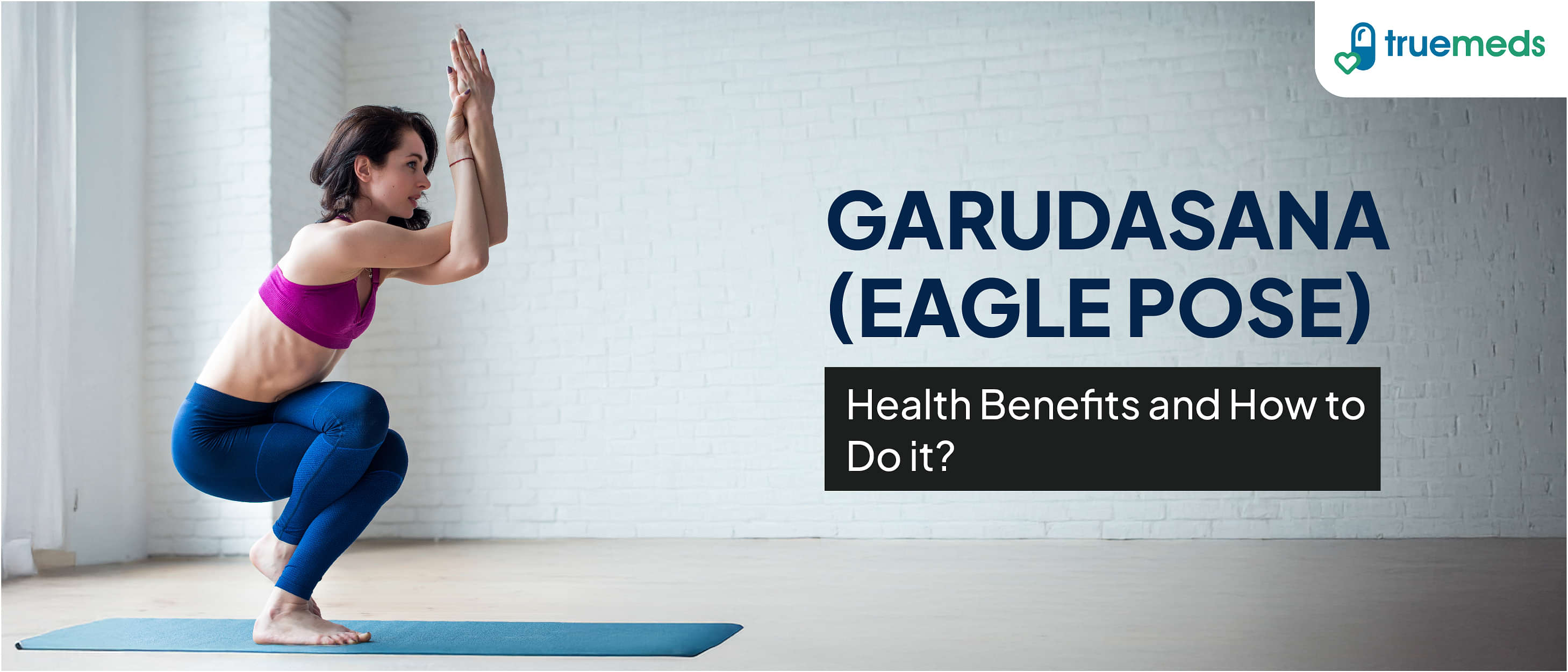
Garudasana, commonly known as the Eagle Pose, is a standing balance pose from the ancient practice of yoga. The term ‘Garudasana’ comes from the Sanskrit words ‘Garuda’, which means eagle (a mythical king of birds), and ‘asana’, meaning pose.
This pose involves twisting your arms and legs around each other in a manner that creates a stable yet challenging structure. It is a complex balance of strength, flexibility, and mental focus. The pose not only encourages deep concentration but also offers numerous health benefits, making it a common part of many yoga routines.
How to do Garudasana?
Here is a step-by-step guide to safely perform this posture:
- Start with Tadasana or Mountain Pose.
- Bend your knees slightly and cross your left thigh over your right thigh. If possible, try to hook the top of your left foot behind your right calf. Ensure your left toes are pointing downwards.
- Extend your arms forward until they are parallel to the floor. Cross your right arm over your left one.
- Bend your elbows so that your arms become perpendicular to the floor, with the backs of your hands facing each other.
- Slowly rotate your palms to face each other, pressing them together while extending your fingers upwards.
- Stabilize your gaze at a fixed point and hold the pose for a few breaths.
- Gradually release your arms and legs, returning to Tadasana.
- Now, repeat the pose on the other side.
Remember: Practice safely and only go as far as your body allows. It may take time to achieve the full pose.
Potential Benefits of Garudasana
Garudasana has several potential benefits that may contribute to both physical and mental well-being. It is important to note that most research on yoga’s benefits is general, and specific, large-scale studies on Garudasana are limited [1]. Here are some of its key potential advantages:
1) Potential to Strengthen Your Legs
As you balance on one leg and wrap the other around it, the pose may engage and strengthen the muscles of the standing leg, including the quadriceps, calves, and ankles [2]. The twisting action on the wrapped leg may help stretch the muscles of the anterior thigh. Furthermore, maintaining balance demands muscular activation, which can potentially enhance circulation in the lower extremities.
2) Potential to Improve Flexibility of Your Hips
The pose requires internal rotation and flexion of the hips, which can help increase the range of motion in the hip joint over time [2]. This internal rotation and flexion may help release tension in the hip flexors and surrounding muscles, promoting greater mobility and coordination.
3) Potential to Relieve Shoulder and Upper Back Tension
By requiring the arms to intertwine, Garudasana may promote a deep stretch of the shoulders and upper back muscles. This can be beneficial for individuals who experience stiffness or tightness due to poor posture or prolonged sitting, as it can help relieve discomfort and improve shoulder mobility [3].
4) Potential to Enhance Focus and Reduce Stress
The balancing nature of the pose requires intense focus and concentration (Drishti), which can help quiet the mental chatter [4]. The requirement for sustained focus can act as a form of mindfulness, potentially contributing to a reduction in stress and anxiety levels [4].
5) Potential to Improve Posture and Balance
This pose encourages core engagement and spinal alignment while demanding balance. By repeatedly practising balance, you can develop proprioception (awareness of the body’s position in space) and the core strength needed to support an upright posture [2]. This may help counteract the negative effects of slouching [2].
Important Considerations and Contraindications
While Garudasana offers benefits, it is crucial to approach it with caution, especially if you have existing health conditions. This pose should generally be avoided or modified by individuals with:
- Serious or chronic knee injury, or recent knee surgery.
- Ankle injury.
- Shoulder injury (especially rotator cuff issues).
- Severe or persistent headaches/migraines.
- Pregnancy (modifications are essential and only with instructor guidance).
Always consult a certified yoga instructor for personalised modifications, particularly if you are a beginner or have any physical limitations.
3 Key Alignment Techniques in Garudasana
To safely maximise the potential benefits of Garudasana, focus on these alignment cues:
a) Leg Alignment
- Begin by bending both knees slightly, as if sitting in a chair (Utkatasana). Then cross your one thigh over the other. If the full wrap is difficult, simply cross the legs and keep the toes of the top foot resting on the floor or a block for support.
- Apply gentle pressure from your outer top knee into your standing leg. This helps stabilise the pose.
- Distribute your weight evenly across the sole of your standing foot.
- Keep your hips level and avoid letting the hip of the standing leg jut out to the side.
b) Arm Alignment
- Extend both arms forward until they are parallel to the floor.
- Cross your arms at the elbow joint.
- Lift your elbows slightly and gently draw your hands away from your face to deepen the stretch across the upper back.
- Engage your shoulder and upper back muscles to maintain the bind.
c) Gaze and Balance (Drishti)
- Look straight ahead at a fixed point (Drishti). This enhances your stability and concentration during the pose.
- Engage your abdominal muscles (Uddiyana Bandha). This is vital for maintaining balance and spinal alignment in the pose.
- Focus on maintaining steady, controlled breathing (Ujjayi Breath) throughout the pose [4].
Conclusion
Garudasana, or Eagle Pose, is a challenging yet rewarding yoga posture that promotes physical stability, flexibility, and mental clarity. By actively strengthening the legs, opening the shoulders, and demanding sustained focus, this pose can be a valuable addition to a holistic well-being practice. Regular, safe, and mindful practice of Garudasana can contribute to better posture, improved balance, and a more centred lifestyle. Consulting with a certified yoga instructor is highly recommended to ensure safe and effective practice.
Frequently Asked Questions (FAQs)
How to do Garudasana and what are its benefits?
To perform Garudasana, cross one thigh over the other while bending the standing knee. Cross your arms at the elbows and wrists. Potential benefits include improved balance, as well as a stretch for the shoulders and hips.
How to do the eagle pose correctly?
Stand in Tadasana, bend your knees, and cross one thigh over the other, hooking the foot if possible. Extend your arms forward and cross them, binding the wrists. Focus on drawing the crossed limbs towards the midline and keeping the hips level.
What are the potential risks or disadvantages of the eagle pose?
Potential risks of Garudasana include putting excessive strain on the knees or ankles, especially if performed with existing injuries or an imbalance leading to falls. Individuals with existing shoulder or hip problems may find the full pose challenging.
What are the methods of Garudasana?
The method of Garudasana involves standing in Tadasana, initiating the leg and arm binds with a slight bend in the standing leg, maintaining a fixed gaze, and holding the pose with focused breath.
What chakra is the Eagle pose good for?
Eagle Pose or Garudasana is often associated with the Anahata (Heart Chakra), as the arm bind helps open and broaden the upper back and chest area, promoting feelings of openness and compassion. It is also strongly linked to the Muladhara (Root Chakra) due to its grounding and balancing nature.
Disclaimer
This article is for informational purposes only and is not a substitute for professional medical advice, diagnosis, or treatment. Please consult a healthcare provider or a certified and experienced yoga instructor before beginning any new wellness practice, especially if you have an existing medical condition, are on medication, or are pregnant.
References
[1] Ross, A., & Thomas, S. (2010). The Health Benefits of Yoga and Exercise: A Review of Comparison Studies. The Journal of Complementary and Alternative Medicine, 16(1), 3–12. https://doi.org/10.1089/acm.2009.0044
[2] Telles, S., Gaurav, V., Sharma, S. K., & Gupta, R. K. (2017). Changes in static standing balance after a single session of yoga. Journal of Bodywork and Movement Therapies, 21(4), 841–844. https://doi.org/10.1016/j.jbmt.2017.02.008
[3] Fishman, L. M., & Saltonstall, K. (2009). The effect of yoga on the intervertebral discs. Orthopedic Research and Reviews, 1(1), 1–9. https://doi.org/10.2147/ORR.S3437
[4] Balasubramaniam, M., Telles, S., Pattanayak, R. D., & Ganesan, M. C. (2020). Yoga practice, attention, and executive functions: A systematic review. Journal of Complementary and Integrative Medicine, 17(2). https://doi.org/10.1515/jcim-2019-0187













Disclaimer
Our healthcare experts have carefully reviewed and compiled the information presented here to ensure accuracy and trustworthiness. It is important to note that this information serves as a general overview of the topic and is for informational purposes only. It is not intended to diagnose, prevent, or cure any health problem. This page does not establish a doctor-patient relationship, nor does it replace the advice or consultation of a registered medical practitioner. We recommend seeking guidance from your registered medical practitioner for any questions or concerns regarding your medical condition.
Popular Articles

Recommended Articles


Recent Articles








Company
About UsHealth ArticleHealth StoriesHealth LibraryDiseases & Health ConditionsAyurvedaUnderstanding Generic MedicinesAll MedicinesAll BrandsNeed HelpFAQSecuritySubscribe
Registered Office Address
Grievance Officer
Download Truemeds


Contact Us
Our customer representative team is available 7 days a week from 9 am - 9 pm.
v4.10.2

2025 - Truemeds | All rights reserved. Our content is for informational purposes only. See additional information.

Our Payment Partners




