

- Medicines
- Personal Care
- Skin Cream
- Sunscreen
- Face Wash
- Skin and Body Soap
- Acne Care
- Body Lotions
- Moisturising Lotion
- Moisturising Cream
- Mosquito Repellent
- Moisturising Gel
- Body Wash
- Hair Oils
- Hair Shampoo
- Hair Conditioners
- Hair Supplements
- Hair Colour
- Hair Serum
- Hair Mask
- Hair Solutions
- Baby Diapers and Wipes
- Baby Lotion and Moisturising Cream
- Baby Bath Essentials
- Baby Skin Care
- Baby and Infant Food
- Baby Healthcare
- Women Multivitamins
- Ovulation Test Kit and Women Intimate Care
- Sanitary Pads
- Nutritional Drinks
- Condoms
- Lubricants
- Massage Gels
- Personal Body Massagers
- Men Performance Booster
- Sexual Health Supplements
- Massage Oils
- Ayurveda
- Tooth Paste
- Mouth Ulcer Gel
- Mouthwash
- Toothache and Gum Pain
- Tooth Brush
- Gargle Solution
- Orthopaedic Supports
- Adult Diapers
- Footwear
- Mobility and Support Accessories
- Urinary Support and Care
- Health Conditions
- Bone and Joint Care
- Digestive Care
- Eye Care
- Pain Relief
- Smoking Cessation
- Liver Care
- Stomach Care
- Cold and Cough
- Heart Care
- Kidney Care
- Piles, Fissures & Fistula
- Respiratory Care
- Mental Wellness
- Derma Care
- Pre and Probiotics
- Acidity
- Gas
- Constipation
- Loose Motion/Diarrhoea
- Digestive Fibres
- Digestive Enzymes
- Eye Lubricant Drops
- Lens Solution
- Safety Eye Wear
- Eye Cream
- Eye Vitamins and Supplements
- Eye Drops
- Eye Ointment and Gel
- Nicotine Patch
- Nicotine Gum
- Nicotine Lozenges
- Cough Syrups
- Chest Rubs and Balms
- Nasal Spray
- Lozenges
- Inhalant Capsules
- Cold and Cough Tablets
- Vitamins & Supplements
- Diabetes Care
- Healthcare Devices
- Homeopathic Medicine
- Health Guide
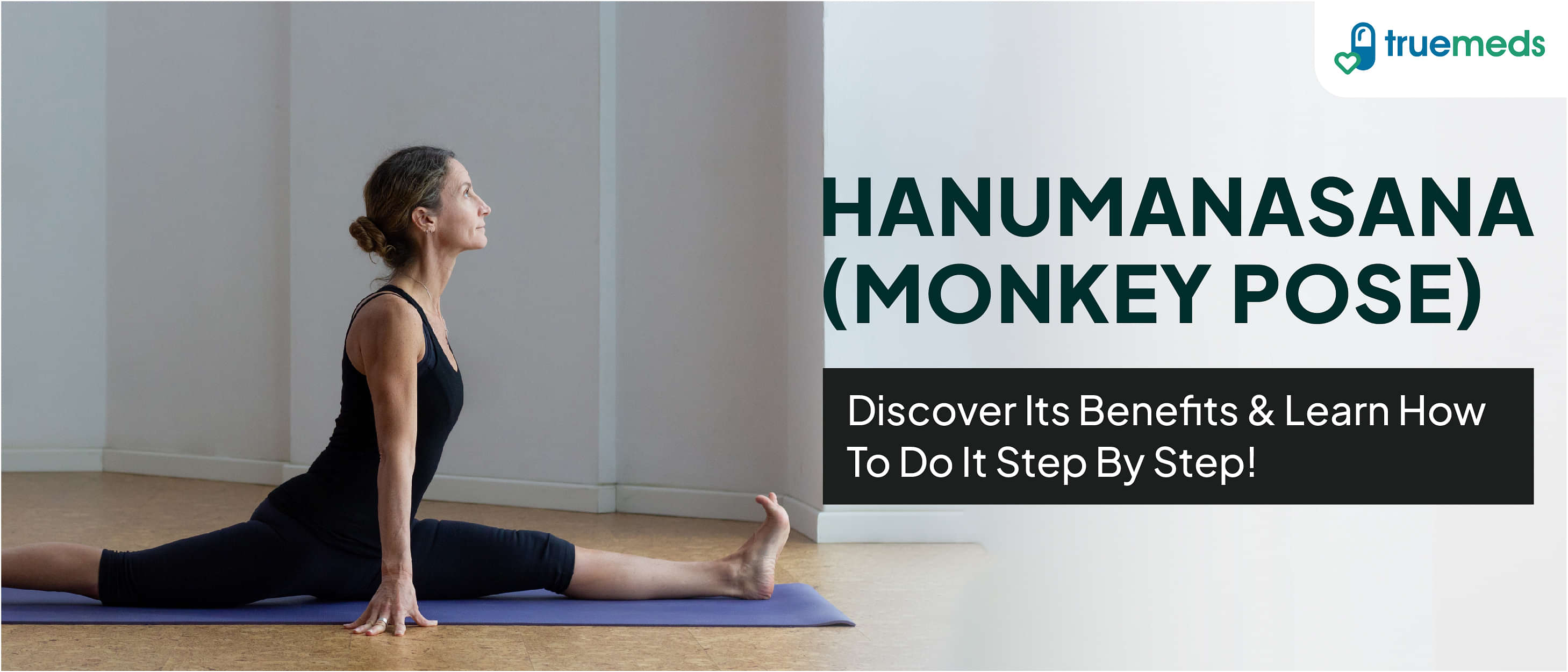
Benefits of Hanumanasana (Monkey Pose) and How to Do It
Last updated on : 30 Nov, 2025
Read time : 8 min
Hanumanasana, also known as the Monkey Pose, is a powerful yoga asana that offers numerous benefits for both the body and mind. Named after the Hindu monkey god Hanuman, this pose embodies strength, flexibility, and trust. By incorporating this deep hip opener into your yoga practice, you can experience a range of physical and mental benefits that contribute to overall well-being.
Let’s dive deeper into the essence of this transformative pose.
How To Do It?
To practice Hanumanasana, follow these steps with careful attention to alignment and comfort.
Step 1: Preparing with Half Splits (Ardha Hanumanasana)
- Start in a high lunge position with your front foot forward and your back knee on the ground.
- Keep your back toes tucked under and your front quadriceps contracted.
- Slowly shift your front leg forward and your back leg backwards, using blocks or supports if necessary to maintain comfort and proper alignment.
- Once you feel comfortable in the Half Splits, move on to the Low Crescent pose.
Step 2: Transition via Low Crescent
- Transition into a low crescent lunge (Anjaneyasana) by placing your hands or fingertips on the ground or blocks next to your pelvis, ensuring your arms are perpendicular to the floor.
- Flex your front foot and pull your toes towards you.
- Square your hips by externally rotating the front leg and pushing the hip of the same side backwards.
- From the Low Crescent pose, you can begin to extend both legs to move closer to the full split pose.
Step 3: Extending Both Legs
- From the low crescent lunge, begin to extend both legs. Slightly internally rotate the front leg by moving the big toe in and pushing the hip further back.
- Slowly slide your front heel forward until your front leg is straight, and then allow your back leg to straighten as well.
- Keep your hips squared and focus on maintaining a neutral leg alignment.
- With both legs extended, you are now ready to move into the full split.
Step 4: Achieving the Full Pose
- To achieve the full Monkey Pose, continue to slide your front heel forward and your back heel backwards until you are in a split position.
- Ensure your pelvis moves forward and down, and the front of your front thigh and the back of your back thigh touch the floor, if possible.
- Maintain proper form and avoid forcing the stretch beyond your comfortable limit.
- Use blocks or supports if necessary to support your hips and ensure stability.
Benefits of Hanumanasana
This advanced yoga posture offers numerous benefits for both the body and mind. Let’s explore how it can positively impact your well-being.
1. Supports Spinal Alignment
Practising this pose regularly may help support better spinal alignment by promoting awareness and balance in the pelvis and lower back (e.g., it can help address tightness that contributes to excessive or insufficient lumbar curve). By promoting a more balanced and aligned posture, this pose may enhance overall body alignment and reduce the risk of posture-related issues linked to lower body stiffness [1].
2. Enhances Lower Body Flexibility
Hanumanasana is a beneficial pose for improving flexibility in the lower body. It deeply stretches the muscles surrounding the hips, including the hamstrings, quadriceps, and hip flexors, which can help enhance mobility in the hips and pelvis. This increased flexibility is particularly beneficial for activities that require lower-body agility, such as running and cycling.
3. Tones and Strengthens Leg Muscles
By engaging the hamstrings, quadriceps, and hip flexors, Hanumanasana effectively tones and strengthens the leg muscles. As you use your leg muscles to support the pose and maintain proper alignment, you build strength and definition in these areas. This toning effect can contribute to overall leg strength and stability.
4. May Aid in Stress Management
Practising deep stretches like this one can have a calming effect on the mind, potentially reducing anxiety and stress. By stimulating the Root (Muladhara) and Sacral (Svadhisthana) Chakras, this pose is believed to foster personal growth, focus, creativity, and inner acceptance according to traditional yoga philosophy. As a result, it may help support mental health and overall well-being, promoting a sense of balance and harmony [2].
5. Supports Spine and Abdominal Health
Hanumanasana can help gently decompress the spine, back, and neck by lengthening the spine and stabilising the lower back. It also gently massages the abdominal area through compression, which may aid in digestion and promoting overall spinal health. This soothing effect can alleviate tension and discomfort in these regions, leading to a greater sense of relaxation and well-being.
6. Opens the Psoas Muscle and Groin
The psoas muscle, which is often associated with the body’s ‘fight or flight’ response and emotional stability, is effectively stretched in Hanumanasana. By opening the psoas muscle and the groin area, this pose allows for emotional release and promotes a sense of stability. This release can contribute to a more profound sense of inner peace and balance.
7. Comprehensive Full-Body Engagement
Hanumanasana provides a full-body stretch, targeting the muscles of the legs, including the hamstrings, quadriceps, and hip flexors. It also engages the abdominal muscles to maintain a lifted torso and requires the entire body to work together to maintain balance and alignment. This comprehensive stretch helps to lengthen and strengthen the body, promoting overall flexibility and strength. While Hanumanasana offers numerous benefits, it is essential to be aware of the potential risks associated with this advanced pose.
Precautions While Practising Hanumanasana (Monkey Pose)
Hanumanasana is an advanced yoga posture that requires significant flexibility and control. Beginners are encouraged to practise this pose under the supervision of a certified yoga instructor to ensure proper technique and minimise the risk of strain.
Individuals with existing hamstring tightness or discomfort should approach this pose cautiously and avoid pushing beyond their limits, as it may increase the risk of muscle strain. Using props such as yoga blocks or bolsters can help support the pelvis and maintain alignment without overexertion.
Take care to avoid any feeling of compression in the lower back. A full warm-up focusing on the hips, hamstrings, and thighs is recommended before attempting the posture. Avoid forcing the body into the pose. Always practice Ahimsa (non-violence) towards your body; gradual progression and mindful movement are more beneficial and safer than trying to achieve the full stretch quickly.
If you have any underlying health concerns, particularly related to the back or joints, it is advisable to consult a healthcare professional before incorporating any new asana into your practice.
Conclusion
In conclusion, Hanumanasana, or the Monkey Pose, is a highly beneficial yet challenging asana that develops significant strength, flexibility, and emotional balance. As a deep stretch for the lower body, it enhances flexibility in the hips, hamstrings, and hip flexors. When approached mindfully and with preparation, this pose can be a valuable addition to any yoga routine, fostering personal growth and promoting a sense of inner peace. Always listen to your body and prioritise safety over depth in the stretch.
Disclaimer: This article is for informational purposes only and is not a substitute for professional medical advice, diagnosis, or treatment. Please consult a qualified healthcare professional or a certified yoga instructor before starting or changing any practice, especially if you have existing health conditions or injuries.
Frequently Asked Questions (FAQs)
What are the primary benefits of the Monkey Pose?
Hanumanasana, or Monkey Pose, is an effective stretch for the hamstrings, hip flexors, and quadriceps. It helps improve flexibility, supports hip mobility, and may stimulate abdominal organs.
Is the Monkey Pose suitable for beginners?
The full pose is considered advanced. However, beginners can practise preparatory poses like Ardha Hanumanasana (Half Split) and use modifications and props, such as blocks and straps, to gradually work up to the full pose safely.
What are the preparatory poses for Hanumanasana?
Preparatory poses include Low Lunge (Anjaneyasana), Pigeon Pose (Eka Pada Rajakapotasana), Standing Forward Bend, Warrior I, Supta Padangusthasana, and Ardha Hanumanasana (Half Split), which help warm up and stretch the hips, hamstrings, and hip flexors.
What are the different variations of this split pose?
Variations include Ardha Hanumanasana with blocks, Kneeling Lunge, Standing Splits Against the Wall, and Upavistha Hanumanasana (Seated Wide-Legged Forward Fold), which cater to different flexibility levels and offer modified approaches to the pose.
What is Ardha Hanumanasana?
Ardha Hanumanasana, or Half Split, is a less intense version of Hanumanasana that involves extending one leg forward while keeping the other leg bent. It helps prepare the body for the full split by stretching the hamstrings and hip flexors.
Who should be cautious or avoid Hanumanasana?
Individuals with severe hip or knee injuries, or those experiencing significant discomfort or pain in these areas, should avoid or modify Hanumanasana under the guidance of a qualified yoga instructor. Always consult with a healthcare provider if you have underlying health conditions.
References
[1] Hanumanasana. (2024, March 27). Insideyoga.org. https://insideyoga.org/asana-library/hanumanasana/
[2] Hiray, Y., & Shinde, O. (2025). Comparative Analysis of Mudras in Hatha Pradipika and Gheranda Samhita: A Systematic Review. International Journal of Science and Research (IJSR), 14(4), 803–809. https://doi.org/10.21275/sr25408001822













Disclaimer
Our healthcare experts have carefully reviewed and compiled the information presented here to ensure accuracy and trustworthiness. It is important to note that this information serves as a general overview of the topic and is for informational purposes only. It is not intended to diagnose, prevent, or cure any health problem. This page does not establish a doctor-patient relationship, nor does it replace the advice or consultation of a registered medical practitioner. We recommend seeking guidance from your registered medical practitioner for any questions or concerns regarding your medical condition.
Popular Articles


Recommended Articles




Recent Articles










Company
About UsHealth ArticleHealth StoriesHealth LibraryDiseases & Health ConditionsAyurvedaUnderstanding Generic MedicinesAll MedicinesAll BrandsNeed HelpFAQSecuritySubscribe
Registered Office Address
Grievance Officer
Download Truemeds


Contact Us
Our customer representative team is available 7 days a week from 9 am - 9 pm.
v4.11.0

2026 - Truemeds | All rights reserved. Our content is for informational purposes only. See additional information.

Our Payment Partners