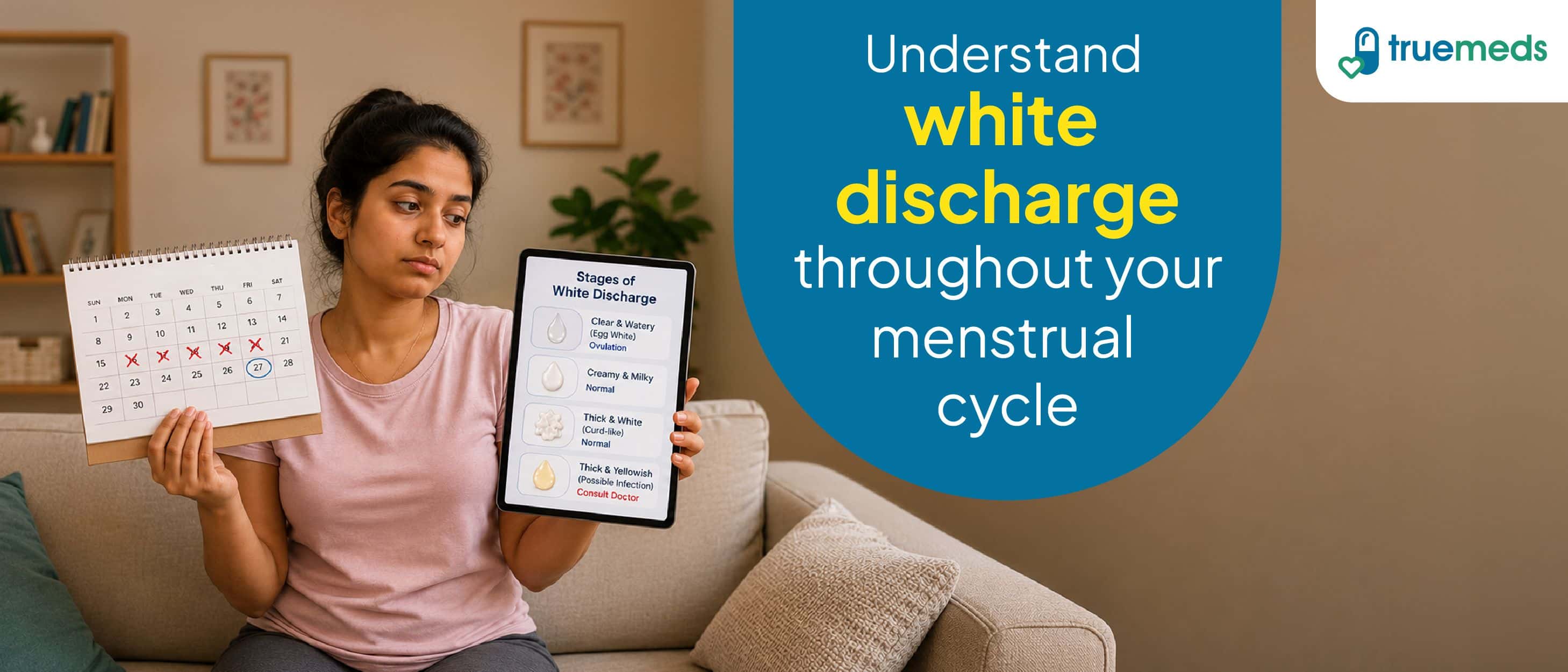
Vaginal discharge is a natural part of a woman's health, and white discharge before and after your period is often a completely normal sign that the body is working as it should. The amount and appearance of discharge change throughout the menstrual cycle because hormone levels rise and fall at different stages[1]. This article explains what healthy discharge looks like at different points in your cycle, which everyday factors can influence it, and when a change may be worth discussing with a healthcare provider.
Understanding How Vaginal Discharge Changes Throughout the Menstrual Cycle
Discharge during the menstrual cycle follows a fairly predictable pattern driven by shifting hormone levels. Cervical fluid typically moves through several phases over the course of a month[2]:
- Little or no discharge during the period itself
- Dry or minimal discharge in the days just after bleeding ends
- Sticky discharge as the cycle progresses
- Creamy or white discharge in the mid-cycle phase
- Clear and stretchy discharge around ovulation
- Brown or dark discharge just before or after your period, from older blood taking longer to leave the body, is usually normal on its own
This week-to-week variation reflects changes in ovarian hormones, so discharge looking or feeling different at different points in the cycle does not automatically mean something is wrong[1]. Understanding this pattern helps you recognise what is normal for your own body.
White Discharge Before Your Period: What Your Body May Be Telling You
In the days leading up to menstruation, the body is in a progesterone-dominant phase. During this time, white discharge before a period is commonly thicker, stickier, or creamier rather than clear and stretchy[2]. This is a normal hormonal shift and does not indicate infection on its own.
White discharge before a period is generally considered normal when it is[3]:
- Is mild to moderate in amount
- Stays white or off-white in colour
- Does not have a strong or unpleasant smell
- Is not accompanied by itching, burning, or pelvic pain
- Does not represent a sudden or unexplained change from your usual pattern
Every person's baseline is different. Some may notice more discharge in the days before their period, while others notice very little. What matters most is whether the discharge fits your own usual pattern rather than comparing it to a single standard.
White Discharge After Your Period: What Changes Are Expected
After menstruation ends, the cervix gradually begins producing more cervical mucus again. Many people notice very little discharge in the first few days after bleeding stops, followed by sticky or creamy white discharge as the cycle moves toward ovulation again[2].
As bleeding clears, the vaginal environment gradually returns to its usual protective state. Normal discharge helps keep the vagina clean, moist, and protected[3]. This gradual return to a normal pattern is a healthy sign of recovery, not a cause for concern.
The texture and amount of white discharge after a period may shift over several days. A small amount of creamy or white discharge early in the post-period phase is common and usually reflects the body resuming its natural cycle.
Is White Discharge Normal? Knowing the Signs of a Healthy Vaginal Discharge
A common question many women have is, 'Is white discharge normal?' The short answer is yes, in most cases. Healthy discharge is typically clear or white, may be thick and sticky or slippery and wet depending on the cycle phase, and should not carry a strong or unpleasant smell[3].
Normal discharge may also vary with the following[1]:
- Ovulation (often heavier and more stretchy)
- Pregnancy
- Sexual activity
- Hormonal birth control use
Colour, smell, texture, and amount are the four main things to observe. A mild, neutral odour or no smell at all is reassuring. Discharge that remains within your usual colour range and does not cause any discomfort is generally not a cause for concern.
Everyday Factors That Can Influence Vaginal Discharge
Several everyday factors can cause temporary changes in vaginal discharge. Review evidence links psychosocial stress, sexual activity, hormonal contraception, and some hygiene practices to changes in the vaginal microbiota, while pregnancy and certain irritant products may also alter discharge or cause irritation[4]. Vaginitis (an inflammation of the vagina) and related conditions can also be triggered by some irritants and environmental factors[5].
Clinical data reinforces that vaginal discharge can be physiological (normal) or pathological (related to a condition), which is why symptoms always need proper context rather than self-diagnosis[6].
Some factors that may influence your usual discharge pattern include[1]:
- Pregnancy, which can increase normal vaginal discharge
- Sexual activity or sexual excitement, which can increase vaginal secretions
- Irritation from products such as feminine sprays, douches, creams, and other vaginal products
- Use of contraceptive foams, jellies, or creams, which may contribute to vaginal irritation
Consult your doctor before starting any new treatment or making changes based on discharge alone.
When Vaginal Discharge Stops Following Your Usual Pattern
Some changes in discharge are worth taking seriously. Sudden shifts in colour, smell, amount, or texture may signal an underlying condition that needs assessment rather than home treatment. Common patterns that warrant medical review include[5]:
- A fishy or foul odour
- Green, yellow, or frothy discharge
- Thick, white "cottage cheese" texture
- Grey-coloured discharge
Alongside these changes in discharge, the following symptoms are stronger reasons to see a healthcare provider promptly[1]:
- Itching or burning around the vagina or vulva
- Genital redness or soreness
- Pelvic or lower belly pain
- Fever
- A small amount of light pink spotting around ovulation can be normal for some women, but any other bleeding between periods is worth mentioning to a doctor
- Any concern about possible STI exposure[7]
Professional diagnosis is essential. Do not self-medicate without medical supervision.
These symptoms together help clinicians decide whether discharge is related to a hormonal change or an infection, and proper testing is needed to determine the cause.
Simple Ways to Track Vaginal Discharge and Spot Changes Early
Keeping a simple record of your discharge over a few cycles can be genuinely helpful, both for your own awareness and when speaking to a healthcare provider. Clinicians use a detailed history alongside testing to evaluate whether discharge is physiological or linked to infection[8].
When tracking your discharge, consider noting the following:
- The cycle day or date
- Colour and texture
- Amount (light, moderate, or heavy)
- Any smell
- Itching, burning, or pain
- Any bleeding outside your period
- Recent sexual activity
- New products, medicines, or supplements started
- Any possibility of pregnancy
A menstrual tracking app or a simple diary works well for this. When you visit a healthcare provider, sharing this recorded history helps them get a clearer picture of what is normal for you and what has changed.
Key Takeaways
- Discharge naturally changes across the menstrual cycle because hormone levels rise and fall at each phase.
- White discharge before or after a period is often normal if it matches your usual pattern and has no unpleasant smell or discomfort.
- Stress, pregnancy, birth control, sexual activity, and hygiene products can all influence discharge.
- Sudden changes in colour, smell, texture, or amount, especially with itching, burning, pain, or fever, need medical attention.
- Tracking your discharge over a few cycles helps you recognise your own normal pattern and spot changes early.
- Every woman's pattern is unique, and comparing cycle to cycle is more useful than comparing to an average.
FAQs
Can white discharge delay my period or be a sign that it's about to start?
White discharge in the days before your period is a normal part of the luteal phase. The discharge itself does not cause a late period. Cycle variation and pregnancy are separate reasons a period may be delayed, and a healthcare provider can help assess this.
Is it normal to have white discharge every day, even between periods?
Yes, daily discharge can be normal. As long as it stays white or clear, does not have a foul smell, and fits your usual pattern without causing discomfort, day-to-day discharge between periods is generally not a concern.
Can dehydration or diet affect vaginal discharge?
Lifestyle may influence overall vaginal health, but direct evidence that routine diet or hydration specifically changes normal white discharge from day to day is limited. Hormones, stress, pregnancy, contraception, and hygiene habits tend to have a stronger influence.
Does white discharge change after starting birth control pills?
Yes, hormonal birth control can change discharge amount or pattern. Some people notice heavier normal discharge after starting the pill. If the change is accompanied by unusual smell, itching, or discomfort, consult your doctor.
Can stress temporarily increase white vaginal discharge?
Stress may affect vaginal health indirectly through hormonal and microbiota pathways, so temporary changes in your usual discharge pattern are possible. However, if changes persist or are accompanied by uncomfortable symptoms, speak to a healthcare provider.
How can I tell if my vaginal discharge pattern is different from my usual cycle?
Compare the colour, smell, texture, amount, and timing of discharge against what you normally notice month to month. If something feels noticeably different, especially with added symptoms like itching or pain, that is worth tracking and discussing with a doctor.
Can white vaginal discharge vary from one menstrual cycle to another?
Yes, some variation from cycle to cycle is expected. Hormones and everyday factors such as stress, activity, and diet can differ month to month, so minor changes in discharge amount or texture are generally normal.
When should I keep track of my vaginal discharge before speaking to a healthcare provider?
Track for a short period if a change is mild and not causing discomfort. Seek earlier care if you notice a foul smell, itching, burning, pelvic pain, fever, bleeding between periods, or any concern about STI exposure.
Medical Disclaimer
This article is for informational purposes only and does not constitute medical advice. The information provided should not be used for diagnosing or treating health conditions. Always consult a qualified healthcare provider for diagnosis, treatment, and personalised medical advice. Do not disregard professional medical advice or delay seeking it because of information found in this article. If you have a medical emergency, contact your doctor or emergency services immediately.
References
NLM MedlinePlus. (2025). Vaginal itching and discharge - adult and adolescent. MedlinePlus. https://medlineplus.gov/ency/article/003158.htm
NLM MedlinePlus. (2024). Pregnancy - identifying fertile days. MedlinePlus. https://medlineplus.gov/ency/article/007015.htm
NHS. (2024). Vaginal discharge. https://www.nhs.uk/symptoms/vaginal-discharge/
Morsli, M., Gimenez, E., Magnan, C., Salipante, F., Huberlant, S., Letouzey, V., & Lavigne, J. P. (2024). The association between lifestyle factors and the composition of the vaginal microbiota: a review. European journal of clinical microbiology & infectious diseases : official publication of the European Society of Clinical Microbiology, 43(10), 1869–1881. https://doi.org/10.1007/s10096-024-04915-7