

- Medicines
- Lab Tests
- Personal Care
- Skin Cream
- Sunscreen
- Face Wash
- Skin and Body Soap
- Acne Care
- Body Lotions
- Moisturising Lotion
- Moisturising Cream
- Mosquito Repellent
- Moisturising Gel
- Body Wash
- Hair Oils
- Hair Shampoo
- Hair Conditioners
- Hair Supplements
- Hair Colour
- Hair Serum
- Hair Mask
- Hair Solutions
- Baby Diapers and Wipes
- Baby Lotion and Moisturising Cream
- Baby Bath Essentials
- Baby Skin Care
- Baby and Infant Food
- Baby Healthcare
- Women Multivitamins
- Ovulation Test Kit and Women Intimate Care
- Sanitary Pads
- Nutritional Drinks
- Condoms
- Lubricants
- Massage Gels
- Personal Body Massagers
- Men Performance Booster
- Sexual Health Supplements
- Massage Oils
- Ayurveda
- Tooth Paste
- Mouth Ulcer Gel
- Mouthwash
- Toothache and Gum Pain
- Tooth Brush
- Gargle Solution
- Orthopaedic Supports
- Adult Diapers
- Footwear
- Mobility and Support Accessories
- Urinary Support and Care
- Health Conditions
- Bone and Joint Care
- Digestive Care
- Eye Care
- Pain Relief
- Smoking Cessation
- Liver Care
- Stomach Care
- Cold and Cough
- Heart Care
- Kidney Care
- Piles, Fissures & Fistula
- Respiratory Care
- Mental Wellness
- Derma Care
- Pre and Probiotics
- Acidity
- Gas
- Constipation
- Loose Motion/Diarrhoea
- Digestive Fibres
- Digestive Enzymes
- Eye Lubricant Drops
- Lens Solution
- Safety Eye Wear
- Eye Cream
- Eye Vitamins and Supplements
- Eye Drops
- Eye Ointment and Gel
- Nicotine Patch
- Nicotine Gum
- Nicotine Lozenges
- Cough Syrups
- Chest Rubs and Balms
- Nasal Spray
- Lozenges
- Inhalant Capsules
- Cold and Cough Tablets
- Vitamins & Supplements
- Diabetes Care
- Healthcare Devices
- Homeopathic Medicine
- Health Guide
Why Medicine Prices Differ Between Brands in India
Last updated on :27 Nov, 2026
Read time :9 min
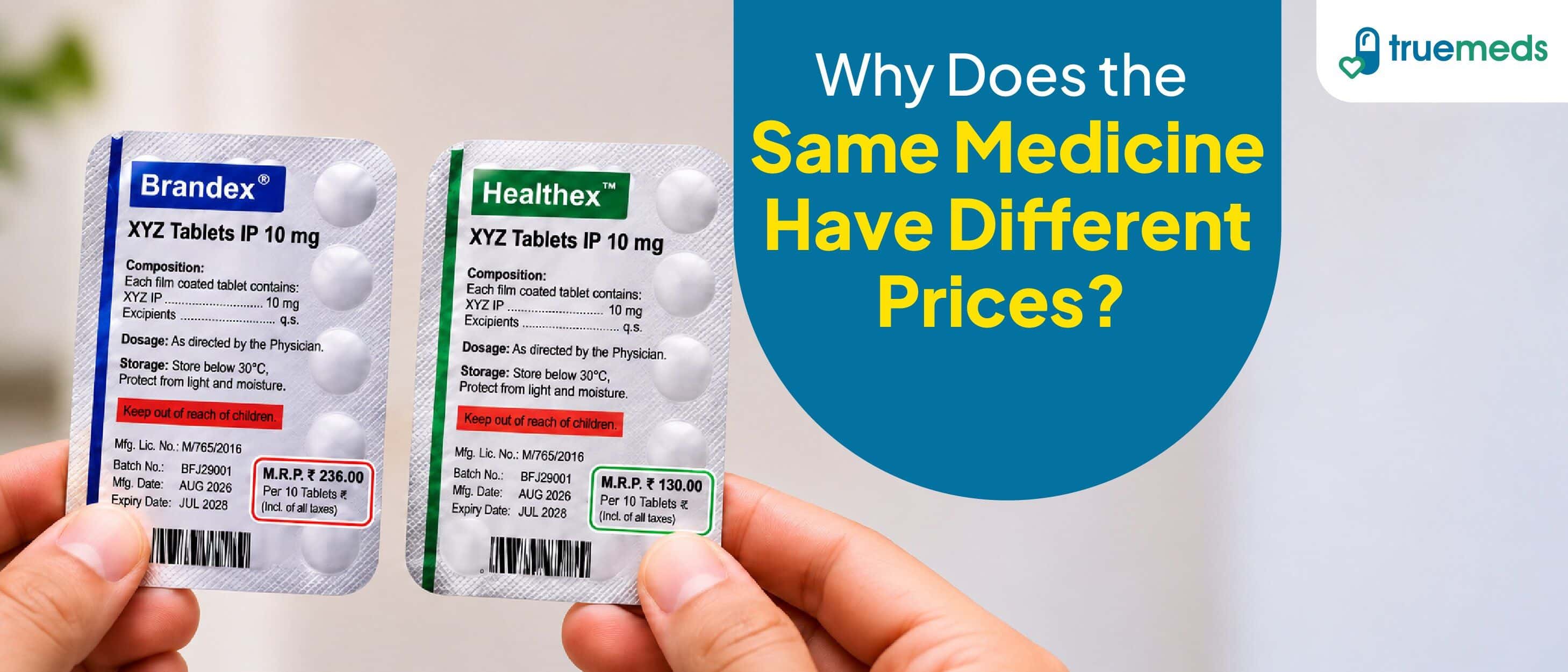
Have you ever noticed that two brands containing the same salt, the active ingredient that treats your condition, can have very different prices? One may cost much more than another, even when the strength and form look the same. Medicine prices can vary because of branding, marketing, distribution, retailer margins and companies’ pricing strategies [1]. A higher price does not automatically mean better quality, and a lower price does not automatically mean a medicine can replace your prescribed brand.
Quick answer: Different brands of the same medicine can have different prices because companies compete through branding, pricing and distribution [1]. In India, branded and generic medicines must meet the quality standards set by law, and the government controls or monitors medicine prices [2], [3]. Before switching to a cheaper brand, ask your pharmacist or doctor to check it is right for you, especially for certain epilepsy medicines or thyroxine [4], [5].
This guide explains why medicine prices differ, how India’s price-control system works, and how to compare medicine prices safely.
Branded, Branded-Generic And Generic Medicines
Branded medicines are sold under a brand name and promoted to doctors by the company.
Branded generics also carry a brand name but are not promoted. Almost all medicines in India are sold as one of these two types [6].
Generic medicines have no formal definition in Indian law. In general, they contain the same amount of the same active ingredient, in the same form, taken the same way, as the branded medicine [2]. Jan Aushadhi Kendras sell medicines under their generic names.
Why The Same Medicine Costs More Under Different Brand Names
In 2021, the Competition Commission of India found that drug companies compete mainly through their brands rather than on price [1]:
- Brand image: market leaders charge more than smaller companies, and the belief that some makers’ medicines are of better quality keeps their prices higher.
- Margins for chemists: companies offer chemists high margins to stock their brands. As the margin can be built into the MRP, a higher margin does not mean a lower price for you.
- Several brands from one company: one company may sell the same salt under different brands at different prices.
A 2011 Indian study looked at five medicines that one company sold under two names: a promoted brand and a cheaper, unpromoted version. Patients paid 0% to 41% more for the promoted brands. When tested against Indian Pharmacopoeia standards, the cheaper versions were of the same quality [6]. The study was small and is now dated.
Is A Cheaper Brand Lower In Quality?
Not because of its price. In India, branded and generic medicines must meet the same quality standards under the Drugs and Cosmetics Act, 1940 and its Rules [2]. Price alone cannot tell you the quality, effectiveness or suitability of a particular product. A higher price does not mean better quality, and a lower price does not mean a product suits you.
Quality problems can occur with any brand. If you are unsure about a pack, you can check whether its batch appears on the government’s monthly list of medicines that failed quality tests. Our guide to checking medicine expiry dates explains how.
How To Tell If A Cheaper Brand Is Right For You
Check these four details against your prescription:
- the salt, or each salt in a combination
- the strength
- the form, such as tablet, capsule or syrup
- the release letters after the name, such as SR or XL
Matching the salt, strength, form and release type helps you find medicines that may be comparable. But matching label details alone does not confirm that two products can be swapped for you. Ask your pharmacist or doctor to check the alternative before you switch.
UK safety guidance names four epilepsy medicines, carbamazepine, phenobarbital, phenytoin and primidone, where products from different makers may differ in ways that matter, even when tests show they work the same way in the body. For these, it advises keeping patients on one maker’s product [4]. A small number of people taking thyroxine (levothyroxine) also report symptoms after changing to a different product [5]. For these medicines, or any your doctor has asked you to keep the same, the decision to switch is your doctor’s. Our guide to reading the composition on a medicine strip explains the four checks step by step.
How Medicine Prices Are Controlled In India
Medicine prices are governed by the Drugs (Prices Control) Order, 2013, which treats medicines in two groups [3]:
- Price-controlled medicines: the government fixes a ceiling price for medicines in Schedule I of the order, which is based on the National List of Essential Medicines 2022. Every brand must sell at or below the ceiling.
- All other medicines: the government monitors their prices, and a maker cannot raise the MRP by more than 10% in 12 months.
Ceiling prices are revised every year on 1 April, in line with the wholesale price index [3].
Checking The Price Before You Buy
No one may sell you a medicine above the price in the current price list or on the label, whichever is lower [3].
It is also best to ask your doctor to write the generic name on your prescription, so you can compare brands of the same salt. India’s code of ethics for doctors says they should prescribe by generic name, legibly and preferably in capital letters [7].
The price regulator’s Pharma Sahi Daam app lets you check medicine prices and lodge a complaint about overcharging [8]. More than 20,000 Jan Aushadhi Kendras sell generic medicines at prices around 50% to 80% lower than branded ones, and every batch is tested in an accredited laboratory before it is sent out [9].
If you get a side effect after switching brands, tell your doctor. You can also report it to the Pharmacovigilance Programme of India (PvPI) on its toll-free helpline, 1800-180-3024 [10].
Before You Switch Brands: A Quick Checklist
- Salt: every salt on the new pack matches your prescription.
- Strength: the mg per tablet, or per 5 ml for a syrup, is the same.
- Form: it is the same form, such as a tablet, capsule or syrup.
- Release letters: letters such as SR or XL match.
- Doctor’s go-ahead: you have it for epilepsy medicines, thyroxine or any medicine your doctor wants kept the same.
- Old strip: kept, to compare and to show your doctor if you feel different.
Conclusion
Brands of the same medicine often differ in price because of branding and trade margins, and every brand must meet the same legal quality standards. Before your next refill, compare the salt, strength, form and release letters, and ask your pharmacist about cheaper matching brands or a Jan Aushadhi version. For epilepsy medicines, thyroxine or any medicine your doctor wants kept the same, check with your doctor first. Use the Pharma Sahi Daam app to check prices.
Frequently Asked Questions
Are Generic Medicines As Good As Branded Ones?
In India, generic, branded-generic and branded medicines must all meet the same quality standards set by law. Check that the salt, strength, form and release letters match your prescription, and ask your pharmacist or doctor to confirm the switch, especially for epilepsy medicines or thyroxine.
Why Are Jan Aushadhi Medicines Cheaper?
They are sold under their generic names through a government scheme, without the brand promotion that adds to the cost of many branded medicines. Every batch is tested in an accredited laboratory before it reaches the stores.
Can A Chemist Charge More Than The Printed MRP?
No. If you are asked to pay more, ask for a bill and lodge a complaint through the Pharma Sahi Daam app.
What If I Feel Different After Switching Brands?
Tell your doctor, and keep the old and new strips to show them. Do not switch back or stop the medicine on your own.
DISCLAIMER: This content is for general information and education only. It is not medical advice, diagnosis or a substitute for consulting a professional. Advice can vary by brand and formulation. Always follow the instructions that came with your medicine and ask your doctor, pharmacist or qualified healthcare professional about your situation.
References
[1] Competition Commission of India. (2021, November 18). Market study on the pharmaceutical sector in India: Key findings and observations. https://www.cci.gov.in/images/marketstudie/en/market-study-on-the-pharmaceutical-sector-in-india1652267460.pdf
[2] Press Information Bureau. (2021, March 16). Sale of generic drugs in the country. Ministry of Health and Family Welfare, Government of India. https://pib.gov.in/PressReleasePage.aspx?PRID=1705065
[3] Department of Pharmaceuticals, Government of India. (2023). The Drugs (Prices Control) Order, 2013 (as amended up to 25 May 2023). https://www.pharma-dept.gov.in/sites/default/files/DPCO%202013.pdf
[4] Medicines and Healthcare products Regulatory Agency. (2017, November 24). Antiepileptic drugs: Updated advice on switching between different manufacturers’ products. GOV.UK. https://www.gov.uk/drug-safety-update/antiepileptic-drugs-updated-advice-on-switching-between-different-manufacturers-products
[5] Medicines and Healthcare products Regulatory Agency. (2021, May 19). Levothyroxine: New prescribing advice for patients who experience symptoms on switching between different levothyroxine products. GOV.UK. https://www.gov.uk/drug-safety-update/levothyroxine-new-prescribing-advice-for-patients-who-experience-symptoms-on-switching-between-different-levothyroxine-products
[6] Singal, G. L., Nanda, A., & Kotwani, A. (2011). A comparative evaluation of price and quality of some branded versus branded-generic medicines of the same manufacturer in India. Indian Journal of Pharmacology, 43(2), 131–136. https://pmc.ncbi.nlm.nih.gov/articles/PMC3081449/
[7] Medical Council of India. (2002). Indian Medical Council (Professional Conduct, Etiquette and Ethics) Regulations, 2002 (amended up to October 8, 2016). National Medical Commission. https://nmc.org.in/storage/cms/Ethics-Regulations-2002.pdf
[8] Press Information Bureau. (2026, June 25). NPPA integrates Pharma Jan Samadhan Portal with Pharma Sahi Daam Portal for enhanced citizen services. Ministry of Chemicals and Fertilizers. https://www.pib.gov.in/PressReleasePage.aspx?PRID=2277731
[9] Pharmaceuticals & Medical Devices Bureau of India. (2026, August 14). Jan Aushadhi Varta (Edition 49). https://www.pmbi.co.in/News/Edition-49%20JA%20Varta_14082026.pdf
[10] Indian Pharmacopoeia Commission. (2018). PvPI: Frequently asked questions. https://www.ipc.gov.in/PvPI/faq.html
















Disclaimer
Our healthcare experts have carefully reviewed and compiled the information presented here to ensure accuracy and trustworthiness. It is important to note that this information serves as a general overview of the topic and is for informational purposes only. It is not intended to diagnose, prevent, or cure any health problem. This page does not establish a doctor-patient relationship, nor does it replace the advice or consultation of a registered medical practitioner. We recommend seeking guidance from your registered medical practitioner for any questions or concerns regarding your medical condition.
Recent Articles







Company
About UsHealth ArticleHealth StoriesHealth LibraryDiseases & Health ConditionsAyurvedaUnderstanding Generic MedicinesAll MedicinesAll BrandsNeed HelpFAQSecuritySavings CalculatorAdvertise with UsSubscribe
Registered Office Address
Grievance Officer
Download Truemeds


Contact Us
Our customer representative team is available 7 days a week from 9 am - 9 pm.
v4.28.30

2026 - Truemeds | All rights reserved. Our content is for informational purposes only. See additional information.

Our Payment Partners




