- Medicines
- Lab Tests
- Personal Care
- Skin Cream
- Sunscreen
- Face Wash
- Skin and Body Soap
- Acne Care
- Body Lotions
- Moisturising Lotion
- Moisturising Cream
- Mosquito Repellent
- Moisturising Gel
- Body Wash
- Hair Oils
- Hair Shampoo
- Hair Conditioners
- Hair Supplements
- Hair Colour
- Hair Serum
- Hair Mask
- Hair Solutions
- Baby Diapers and Wipes
- Baby Lotion and Moisturising Cream
- Baby Bath Essentials
- Baby Skin Care
- Baby and Infant Food
- Baby Healthcare
- Women Multivitamins
- Ovulation Test Kit and Women Intimate Care
- Sanitary Pads
- Nutritional Drinks
- Condoms
- Lubricants
- Massage Gels
- Personal Body Massagers
- Men Performance Booster
- Sexual Health Supplements
- Massage Oils
- Ayurveda
- Tooth Paste
- Mouth Ulcer Gel
- Mouthwash
- Toothache and Gum Pain
- Tooth Brush
- Gargle Solution
- Orthopaedic Supports
- Adult Diapers
- Footwear
- Mobility and Support Accessories
- Urinary Support and Care
- Health Conditions
- Bone and Joint Care
- Digestive Care
- Eye Care
- Pain Relief
- Smoking Cessation
- Liver Care
- Stomach Care
- Cold and Cough
- Heart Care
- Kidney Care
- Piles, Fissures & Fistula
- Respiratory Care
- Mental Wellness
- Derma Care
- Pre and Probiotics
- Acidity
- Gas
- Constipation
- Loose Motion/Diarrhoea
- Digestive Fibres
- Digestive Enzymes
- Eye Lubricant Drops
- Lens Solution
- Safety Eye Wear
- Eye Cream
- Eye Vitamins and Supplements
- Eye Drops
- Eye Ointment and Gel
- Nicotine Patch
- Nicotine Gum
- Nicotine Lozenges
- Cough Syrups
- Chest Rubs and Balms
- Nasal Spray
- Lozenges
- Inhalant Capsules
- Cold and Cough Tablets
- Vitamins & Supplements
- Diabetes Care
- Healthcare Devices
- Homeopathic Medicine
- Health Guide
How To Check Medicine Expiry Dates And Avoid Using Expired Medicines
Last updated on :12 Nov, 2026
Read time :12 min
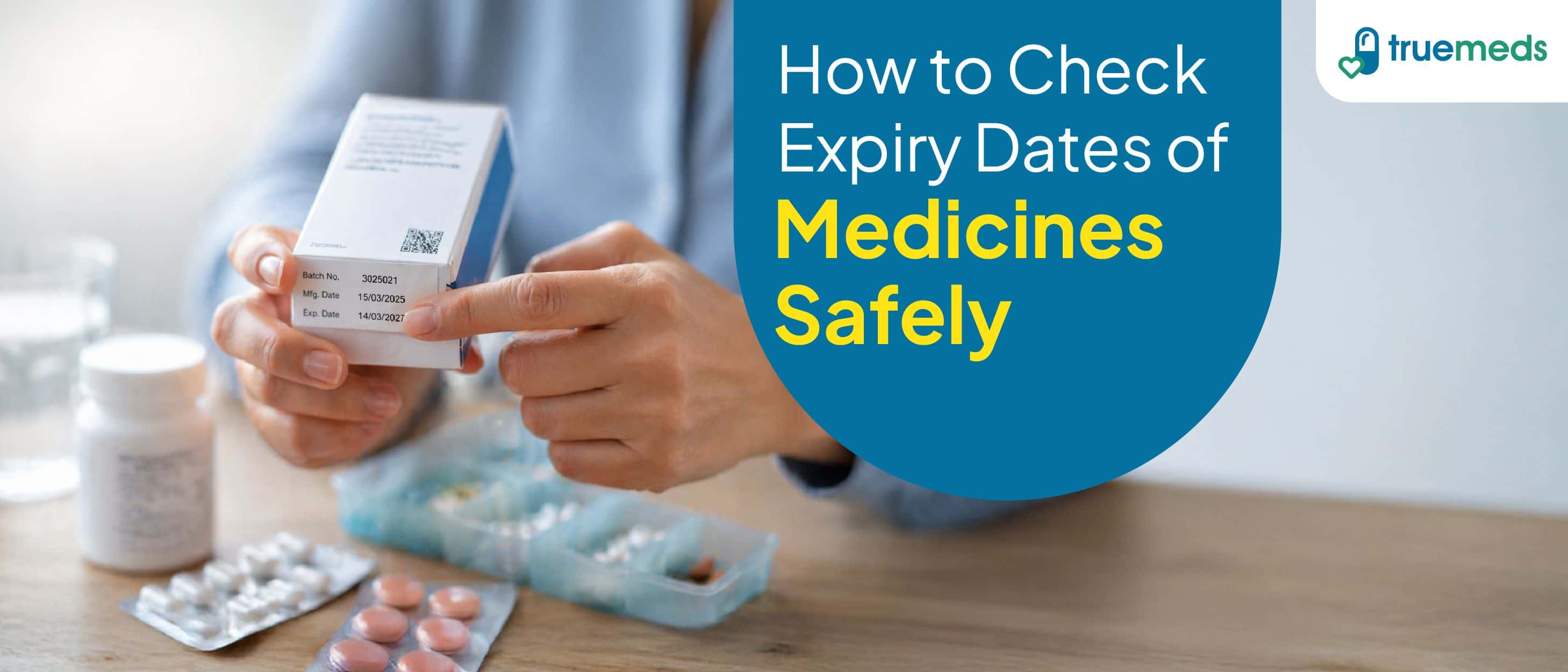
Found an old medicine strip at home and wondering whether it’s still safe to use? The expiry date is usually printed on the medicine strip, bottle or outer packaging, alongside details such as the manufacturing date and batch number [1].
Knowing how to read these details can help you avoid using expired medicines. It’s also important to remember that some medicines have shorter usage periods once opened.
Quick answer: Look for “EXP” or “Expiry Date” on the medicine packaging. In India, an expiry date written as 03/2027 generally means the medicine is within its labelled shelf life until March 31, 2027, provided it has been stored correctly and no shorter in-use period applies [1], [2]. Do not use medicines after their expiry date [4]. If the date is missing, unreadable, or the medicine appears damaged, ask your pharmacist for a suitable replacement [2].
This guide explains how to read expiry dates, check medicine conditions, understand after-opening limits, and dispose of expired medicines safely.
How To Read The Expiry Date On A Medicine Strip Or Bottle
Find the words “Expiry date”, or its short form “Exp.”, on the strip, bottle or carton, and read the month and year after them. The label also carries the manufacturing date, the batch number and, for medicines made in India, the manufacturing licence number [1].
| What the label says | What it tells you |
| Mfg. date: 04/2025 | The medicine was made in April 2025 |
| Expiry date: 03/2027 | Use it until 31 March 2027, if it has been stored as the label says |
| Batch No.: AB1234 | The production lot it came from |
| Mfg. Lic. No.: 12345 | The licence it was made under |
Indian rules say a month-and-year expiry date means the medicine is recommended until the last day of that month [1]. This holds only if the medicine has been stored as its label instructs [2]. The batch number is a code for the production lot, so do not read it as a date. Quality alerts list medicines by this number, so keep it handy if you need to check a pack [3].
When you buy a medicine, check the expiry date on the label before you leave the counter, and ask for a bill [2]. If the date is missing, cut off or rubbed away, do not guess it or work it out from the manufacturing date. Ask for a pack that shows it. If the chemist cuts a strip for you, check that your piece still shows the expiry date.
What A Medicine’s Expiry Date Means
The expiry date is the last month the maker recommends the medicine for, when it is stored the way the label says. Schedule P of the Drugs Rules sets shelf lives for some medicines. For the rest, the expiry date can be no more than 60 months after manufacture. The licensing authority can allow longer if the maker shows evidence [1].
Poor storage, such as in a damp bathroom cabinet, can make a medicine work less well before its printed date. Keep medicines in a cool, dry place, such as a drawer or cupboard, away from the sink and hot appliances [4].
Expiry Dates After Opening Insulin, Eye Drops And Syrups
Some medicines have a shorter limit once you open them, so check the date you opened them as well as the printed date.
Insulin
Heat or direct sunlight damages insulin, so it loses strength and may not work as well.
- Unopened pens and cartridges: are usually stored in the fridge until their expiry date.
- Needles: never store a pen with the needle attached.
- Freezing: insulin should never be frozen.
- When you buy it: check the expiry date, and check that the insulin looks as described in its own leaflet, with no clumps or change in colour [5].
Once you start using a pen, cartridge or vial, how long it can be kept at room temperature depends on the product [6]. Check your insulin’s leaflet for its in-use period, temperature limits and refrigeration instructions, and ask your doctor or pharmacist how to store it in hot weather. If your insulin has frozen, been left in heat or sunlight, or does not look as described in its leaflet, do not use it. Ask your doctor or pharmacist what to do about your next dose.
Eye Drops, Syrups And Other Liquids
Check the label or leaflet of eye drops, syrups and other liquids for how long you can use them once opened. Write the date you open the bottle on its label. Throw it away when that period ends, even if the printed expiry date is later. If your pharmacist mixed a dry syrup with water for you, ask how long it keeps.
Damaged Or Discoloured Medicines Before The Expiry Date
A medicine within its expiry date can still be unfit to use if it has been stored badly [4]. Do not take a medicine that is damaged or has changed colour. Show it to your chemist, return it if it is damaged or spoiled, and report it to your state’s drug control authority if you are not satisfied [2].
Get a fresh pack before your next dose.
Using Medicine After Its Expiry Date
Do not take a medicine after its expiry date. Once the date has passed, there is no guarantee that it is safe or that it works.
Expired medicines can be less effective or risky, because their chemical make-up changes or their strength drops. Some expired medicines are at risk of bacterial growth. An expired antibiotic may be too weak to treat an infection, which can lead to a more serious illness and to antibiotic resistance [4].
If you have taken an expired medicine by mistake, do not take any more doses from that pack. Tell your pharmacist which medicine you took and ask how to replace it. If you feel unwell, or you rely on the medicine for a long-term condition, tell your doctor.
How To Check Medicine Details With A QR Code Or Batch Number
Expiry, damage and a failed quality test are three different problems, and each needs its own check.
| Problem | How to check | What to do |
| The medicine has expired | Read the expiry date on the label | Do not use it; buy a fresh pack |
| The medicine is damaged or discoloured | Look at the medicine and its pack | Do not use it; show it to your pharmacist |
| The batch failed a quality test | Search CDSCO’s NSQ and spurious drug lists | Ask your pharmacist or doctor for a replacement |
A pack can pass one check and fail another. For example, a strip within its date can still belong to a batch that failed a quality test.
QR Codes On Medicines
Since 1 August 2023, 300 branded medicines listed in Schedule H2 of the Drugs Rules must carry a QR code or bar code. The list names each brand and strength. The code stores the product code, generic and brand name, manufacturer, batch number, manufacturing and expiry dates, and licence number. It is there to help authenticate the medicine [1].
From 1 July 2027, the rule extends to all vaccines, anticancer medicines, and medicines under the Narcotic Drugs and Psychotropic Substances (NDPS) Act. Antimicrobials, the group that includes antibiotics, follow from 1 July 2028 [7].
Many medicines do not carry a QR code yet. If your pack has one, scan it with a QR code reader on your phone. Compare the batch number and expiry date it shows with those on the pack. If they do not match, show the pack to your pharmacist.
Checking A Batch In CDSCO Quality Alerts
India’s drug regulator, the Central Drugs Standard Control Organisation (CDSCO), publishes lists of medicine batches that failed quality tests. It calls these “not of standard quality” (NSQ). It also lists spurious (fake) batches, and each entry gives the medicine’s name, batch number, dates and maker [3]. A batch that is not listed may not have been tested.
To check your batch:
- Note the medicine’s name, batch number and maker from the pack.
- Open the NSQ Alerts page on the CDSCO website.
- Search the NSQ Drugs tab, then the Spurious Drugs tab, for the name or batch number.
If the name, batch number and maker all match an entry, contact your pharmacist or doctor before your next dose and ask for a replacement. Do not stop a prescribed medicine unless your doctor advises it [2].
How To Dispose Of Expired Medicines Safely In India
Take expired medicines to a drug take-back site where one exists, and flush only the few medicines that CDSCO lists for flushing. Careless disposal pollutes the environment, and antibiotics thrown away carelessly can seep into soil and water. State drug control departments and chemists’ associations may jointly set up take-back sites, where people can drop off unused medicines [8].
CDSCO lists 17 medicines, including tramadol, morphine and diazepam, that the public should flush down the sink or toilet. These medicines can cause serious harm, even with one dose, if someone they were not prescribed for takes them [8]. The full list is in the CDSCO guidance. If there is no take-back site near you, ask your pharmacist how to dispose of other medicines.
Conclusion
Make the expiry date part of every purchase and every dose. Read it at the counter, read it again before you take a tablet, and write the opening date on insulin, eye drops and syrups. A pack that has expired, is damaged or appears on a quality alert goes for disposal, and a fresh pack takes its place.
FAQs
Is It Safe To Take Medicine That Expired A Few Months Ago?
No. Once the expiry date has passed, there is no guarantee that a medicine is safe or works. That is true whether it expired one month or two years ago. Expired medicines can lose strength, so replace the pack and ask your pharmacist if you are unsure.
Does An Expiry Date Of 03/2027 Mean The First Or Last Day Of March?
The last day. Indian rules say a month-and-year expiry date means the medicine is recommended until the last day of that month. A strip marked 03/2027 can be used until 31 March 2027, provided it has been stored as its label says.
Can I Know The Expiry Date From The Batch Number?
No. The batch number identifies the production lot, and the expiry date is printed separately after the words “Expiry date”. If your pack has a QR code, it stores both. If the date is missing or unreadable, ask for a pack that shows it, and do not guess the date.
Can I Check The Batch Number Of A Medicine Online?
Yes. CDSCO lists batches that failed quality tests or were found to be fake on its NSQ Alerts page. Search the medicine’s name or batch number in both tabs, and match the maker too. If your batch appears, contact your pharmacist or doctor before your next dose for a replacement.
How Do I Get Rid Of Expired Medicines At Home?
Take them to a drug take-back site if there is one near you. If not, ask your pharmacist how to dispose of them. Flush only the 17 medicines CDSCO lists for flushing, such as tramadol and morphine, which can cause serious harm if someone else takes them.
DISCLAIMER: This content is for general information and education only. It is not medical advice, diagnosis or a substitute for consulting a professional. Advice can vary by brand and formulation. Always follow the instructions that came with your medicine and ask your doctor, pharmacist or qualified healthcare professional about your situation.
References
[1] Central Drugs Standard Control Organisation. (2024). The Drugs Rules, 1945 (as amended up to 1 July 2024). Ministry of Health and Family Welfare, Government of India. https://cdsco.gov.in/opencms/opencms/system/modules/CDSCO.WEB/elements/download_file_division.jsp?num_id=MTIwMjc=
[2] Directorate of Food and Drugs Administration, Government of Goa. (2026). FAQ’s. https://dfda.goa.gov.in/?p=4354
[3] Central Drugs Standard Control Organisation. NSQ alerts. Ministry of Health and Family Welfare, Government of India. https://cdsco.gov.in/opencms/opencms/en/Notifications/nsq-drugs/
[4] U.S. Food and Drug Administration. (2024, October 31). Don’t be tempted to use expired medicines. https://www.fda.gov/drugs/safe-disposal-medicines/dont-be-tempted-use-expired-medicines
[5] Indian Council of Medical Research. (2022). ICMR guidelines for management of type 1 diabetes. https://www.icmr.gov.in/icmrobject/custom_data/pdf/resource-guidelines/ICMR_Guidelines_for_Management_of_Type_1_Diabetes.pdf
[6] NHS. (2023, July 7). Storing and travelling with long-acting insulin. https://www.nhs.uk/medicines/insulin/long-acting-insulin/storing-and-travelling-with-long-acting-insulin/
[7] Ministry of Health and Family Welfare. (2026, June 22). G.S.R. 506(E): Drugs (Seventh Amendment) Rules, 2026. The Gazette of India: Extraordinary. https://egazette.gov.in/WriteReadData/2026/273811.pdf
[8] Central Drugs Standard Control Organisation. (2025, May 26). Guidance document on disposal of expired/unused drugs (WI/01/DCC-P-25). Ministry of Health and Family Welfare, Government of India. https://cdsco.gov.in/opencms/resources/UploadCDSCOWeb/2018/UploadPublic_NoticesFiles/Guidance%20document%20on%20disposal.pdf















Disclaimer
Our healthcare experts have carefully reviewed and compiled the information presented here to ensure accuracy and trustworthiness. It is important to note that this information serves as a general overview of the topic and is for informational purposes only. It is not intended to diagnose, prevent, or cure any health problem. This page does not establish a doctor-patient relationship, nor does it replace the advice or consultation of a registered medical practitioner. We recommend seeking guidance from your registered medical practitioner for any questions or concerns regarding your medical condition.
Recent Articles
Company
About UsHealth ArticleHealth StoriesHealth LibraryDiseases & Health ConditionsAyurvedaUnderstanding Generic MedicinesAll MedicinesAll BrandsNeed HelpFAQSecuritySavings CalculatorAdvertise with UsSubscribe
Registered Office Address
Grievance Officer
Download Truemeds


Contact Us
Our customer representative team is available 7 days a week from 9 am - 9 pm.
v4.28.26

2026 - Truemeds | All rights reserved. Our content is for informational purposes only. See additional information.
Our Payment Partners